
SAGAD Beats Fraud Detection Baselines by 12.8% on Massive Graphs
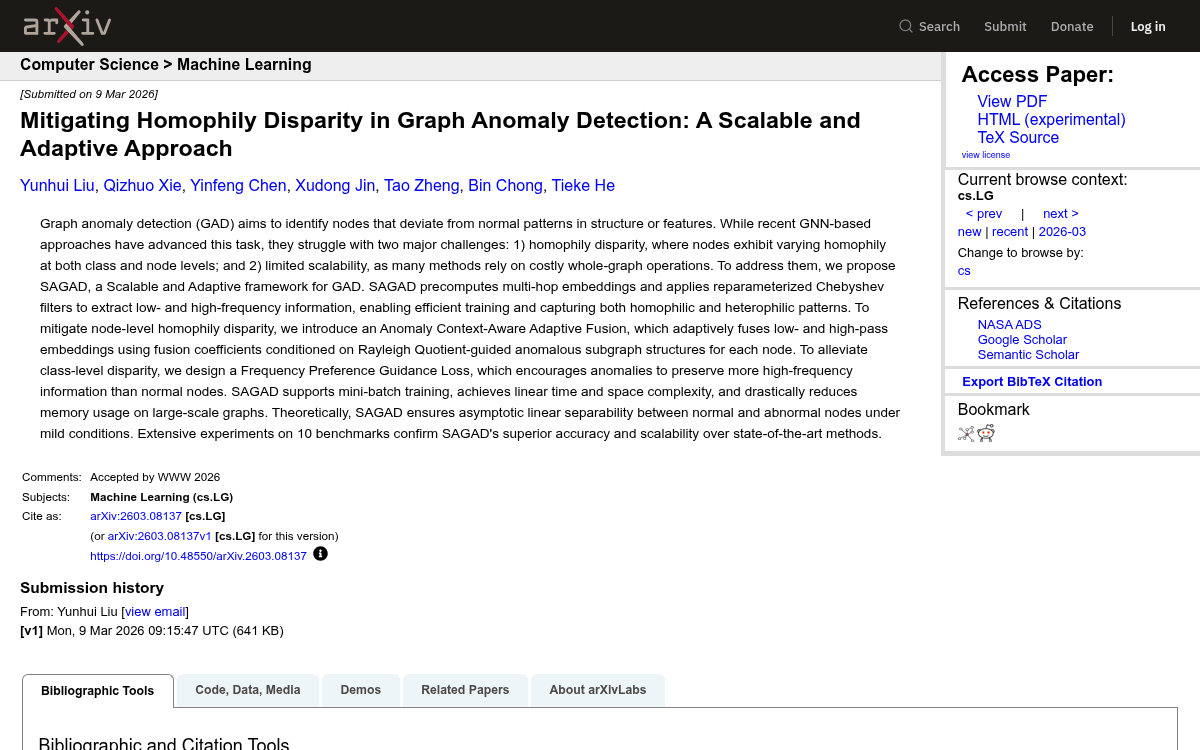
SAGAD tackles two long-standing GNN blind spots — uneven neighborhood homophily and poor scalability — to set new state-of-the-art on 10 fraud detection benchmarks
 Pro
Takeaways
- SAGAD is a new graph anomaly detection framework accepted at WWW 2026 that addresses homophily disparity and scalability simultaneously.
- It precomputes dual-pass Chebyshev spectral filters (low + high frequency) once, enabling mini-batch training with linear time and space complexity.
- A per-node adaptive fusion module uses Rayleigh Quotient-guided subgraphs to assign personalized low/high-frequency mixing weights to each node.
- On T-Social (5.78M nodes, 73M edges), SAGAD uses ~10x less GPU memory than competitors (1,455 MB vs. 14,000-28,000 MB) and trains ~100x faster.
- SAGAD achieves an average AUPRC of 47.9 across 10 benchmarks, outperforming the next-best method (XGBGraph at 42.9) by 5 points.
- Code is open-sourced on GitHub; best suited for supervised fraud/anomaly detection on large static graphs with limited labels.
Graph anomaly detection (GAD) is the backbone of fraud detection systems at banks, e-commerce platforms, and social networks. The task sounds deceptively simple: given a graph of users or transactions, flag the nodes that don't belong. But the models doing this work have been quietly failing in two predictable ways, and a new framework called SAGAD, accepted at WWW 2026, takes direct aim at both.
The two cracks in the foundation
Most GNN-based fraud detectors are built around a concept called homophily -- the tendency of connected nodes to share the same label. Fraudsters, however, deliberately camouflage themselves by connecting to many legitimate users, creating heterophilic (cross-class) edges. Existing methods know this and try to compensate, but they treat the whole graph with a single global strategy. The SAGAD paper shows that's not enough.
The authors identify two distinct levels of what they call homophily disparity:
- Class-level disparity: Anomalous nodes, on average, have far fewer same-class neighbors than normal nodes. On the Reddit dataset, for example, the average homophily for anomalous nodes is 0.000 versus 0.994 for normal nodes.
- Node-level disparity: Even within the anomalous class, individual nodes vary wildly in how heterophilic their local neighborhoods are. A one-size-fits-all filter will over-smooth some nodes and under-smooth others.
The second problem is scalability. Modern Web-scale graphs often contain millions of nodes and edges, easily surpassing the memory limits of GPUs and rendering many existing GAD models impractical. Heterophily-oriented designs like edge perturbation or learnable spectral filters depend on whole-graph operations, so memory and compute grow rapidly with graph size. The paper demonstrates that forcing a competitive baseline to train on T-Social (5.78M nodes, 73M edges) by shrinking its hidden dimensions to 8 cripples its performance.
What SAGAD actually does
SAGAD emphasizes simplicity and scalability by decoupling graph structure from iterative computations and relying solely on a set of precomputed node embeddings. It performs multi-hop graph propagation as a preprocessing step and caches the resulting embeddings, which are then reweighted using two sets of reparameterized Chebyshev polynomial coefficients to generate low- and high-pass embeddings. Think of these as two views of every node: one that averages signals from similar neighbors (low-pass, good for normal nodes) and one that amplifies differences from neighbors (high-pass, good for anomalies).
The framework has three main components working together:
- Dual-pass Chebyshev Polynomial Filter: Two spectral filters -- one low-pass, one high-pass -- are computed via Chebyshev polynomial approximation. Crucially, the Chebyshev basis terms can be precomputed once and cached, so training never needs to touch the full graph again. This is what unlocks mini-batch training.
- Anomaly Context-Aware Adaptive Fusion (ACAF): Rather than naively concatenating or averaging the two embeddings, SAGAD learns a per-node, per-dimension fusion coefficient matrix. For each node, it extracts a small subgraph guided by the Rayleigh Quotient -- a measure of spectral energy that is provably monotonically increasing with a node's anomaly degree. Nodes with high Rayleigh Quotient scores are structurally anomalous. An MLP conditioned on both the node's raw features and this anomaly-rich subgraph produces personalized mixing weights.
- Frequency Preference Guidance Loss: A regularization term that explicitly pushes anomalous nodes toward higher-frequency representations and normal nodes toward lower-frequency ones. This encodes the class-level spectral bias directly into the loss function, rather than hoping the model discovers it on its own.
Here is a simplified sketch of the fusion step:
# Z_L: low-pass embedding, Z_H: high-pass embedding (both precomputed)
# C: per-node fusion coefficients from ACAF module
Z = C * Z_L + (1 - C) * Z_H  # element-wise blend
# C is generated by:
# 1. Sample anomaly-rich subgraph via Rayleigh Quotient (MRQSampler)
# 2. Pool subgraph features
# 3. MLP(pooled_subgraph_context || raw_node_features) -> C
The scalability numbers are striking
On the large-scale T-Social dataset (5.78M nodes and 73.1M edges), SAGAD requires only 1455.50 MB of GPU memory, approximately 10x less than competitive baselines, demonstrating excellent scalability. Training time tells a similar story: SAGAD finishes in 13.76 seconds on T-Social, while ConsisGAD takes 1,674 seconds and SpaceGNN takes 1,273 seconds on the same graph. The reason is architectural: the decoupled architecture enables mini-batch training without processing the entire graph, thereby ensuring linear scalability with respect to batch size.
Benchmarks and results
Following GADBench, experiments are conducted on 10 real-world datasets spanning various scales and domains: Reddit, Weibo, Amazon, YelpChi, T-Finance, Elliptic, Tolokers, Questions, DGraph-Fin, and T-Social. These range from small social graphs (Reddit, ~11K nodes) to massive financial networks (T-Social, ~5.8M nodes). Each model is trained with only 100 labeled nodes -- 20 anomalies and 80 normal nodes -- simulating real-world label scarcity.
SAGAD yields an average improvement of 5.0% in AUPRC, 3.3% in AUROC, and 5.7% in Rec@K over the strongest baselines. The gains are especially large on the hardest graphs: on Weibo and T-Social, SAGAD achieves substantial AUPRC gains of 8.8% and 12.8%, respectively. The average AUPRC across all 10 datasets is 47.9, compared to 42.9 for XGBGraph and 41.8 for SpaceGNN.
One honest caveat: on the Elliptic dataset, there is a performance gap between SAGAD and XGBGraph. This may be attributed to the highly heterogeneous tabular node features in Elliptic, which are better handled by tree-based models such as XGBoost compared to deep learning methods. SAGAD still leads all other deep learning baselines on Elliptic, but it's a useful reminder that graph structure isn't always the dominant signal.
The real breakthrough: per-node spectral mixing
The deeper contribution here isn't just better numbers. It's the theoretical grounding. The authors prove, using a variant of the Contextual Stochastic Block Model (CSBM) -- a generative model for attributed graphs that captures class imbalance and degree heterogeneity -- that applying node-adaptive low- and high-pass filters guarantees linear separability between normal and anomalous nodes with high probability. In other words, the adaptive fusion isn't just a heuristic trick; there's a formal reason it works.
The ablation study confirms each piece matters. Removing the Rayleigh Quotient-guided subgraph (replacing it with a plain k-hop neighborhood or raw features alone) consistently hurts performance. Removing the frequency preference guidance loss hurts further. And using only one of the two frequency bands is substantially worse than using both.
Where to use it
SAGAD is purpose-built for supervised node-level anomaly detection on large graphs where labels are scarce. The most natural applications are:
- Financial fraud detection: Transaction graphs with millions of nodes where fraudsters camouflage via legitimate connections
- Social network abuse: Bot and spam detection on platforms with heterogeneous user behavior
- E-commerce review fraud: Reviewer interaction graphs where fake reviewers cluster with real ones
- Loan default prediction: Guarantor networks like DGraph-Fin where anomalous borrowers have low homophily
The main constraint is that SAGAD is supervised -- it needs at least some labeled anomalies to train the frequency preference guidance loss and the adaptive fusion. It also assumes the graph is static; dynamic graphs with rapidly changing edges would require recomputing the Chebyshev basis. The code is publicly available on GitHub, and the benchmark follows the GADBench evaluation protocol, making it straightforward to reproduce and extend.