
Saarland Researcher Explains Why Translated Text Always Feels Slightly Off
A new study links translationese, the subtle statistical fingerprint of translated text, to measurable cognitive load using LLM surprisal and translation entropy.
 Pro
Takeaways
- Paper argues translationese reflects cognitive load, not just linguistic interference or style.
- Translatedness measured segment-level via SVM classifier on 37 syntactic and morphological features.
- Difficulty measured with GPT-2 surprisal, NMT surprisal, translation entropy, and structural complexity.
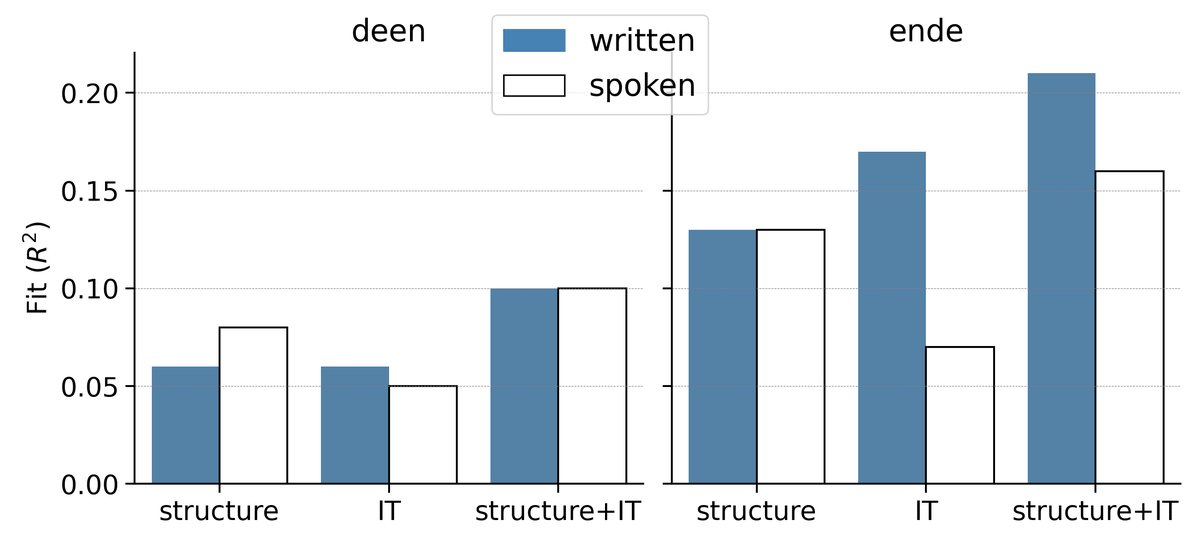
- Combined difficulty features explain up to 21% of translatedness variance in English-to-German written translation.
- Cross-lingual transfer difficulty dominates source-text complexity, especially for written mode.
- Interpreters show inverse pattern: harder source yields more fluent, less translationese-marked output.
Translated text has a fingerprint. Even when a translation is fluent and accurate, corpus studies consistently find that translated texts drift away from the natural patterns of the target language. This drift, called translationese, has been documented for decades, but nobody has convincingly explained why it happens. A new paper from Maria Kunilovskaya at the University of Saarland proposes a surprisingly clean answer: translationese is what happens when translators optimize for cognitive effort, and you can predict it from how hard the source text is to process.
The puzzle behind the fingerprint
Translationese has been attributed to production tendencies like interference and simplification, socio-cultural variables, and language-pair effects, yet a unified explanatory account is still lacking. Prior work catalogued recurring patterns (over-explanation, simplified syntax, overly literal renderings, reduced lexical variety) but treated them as separate quirks. This study proposes that translationese reflects cognitive load inherent in the translation task itself, and tests whether observable translationese can be predicted from quantifiable measures of translation task difficulty.
The framing borrows from information-theoretic accounts of language production, where speakers balance communicative goals against processing effort. Apply that to a translator and the deviations start to look rational: when the task gets harder, producing slightly awkward, source-hugging output is cheaper than searching for a perfectly natural target-language phrasing.
How you measure something translators cannot even see
The pipeline has two halves. First, quantify translationese. The author trains a linear SVM to distinguish translated segments from originally-authored ones in the target language, using a set of 58 linguistically-motivated features covering grammatical forms, morphological word classes, clause types, syntactic dependencies, word order patterns, discourse elements, and textual measures. The classifier's probability of "translated" becomes a continuous translatedness score per segment.
Second, quantify how hard the translation task was. Difficulty is split into two components, each measured with both information-theoretic (IT) and traditional structural features:
- Source comprehension difficulty: average GPT-2 surprisal of the source segment, dependency tree depth, branching factor, mean dependency distance, number of clauses, lexical density, word length.
- Cross-lingual transfer difficulty: average NMT surprisal of the target given source (from OPUS-MT), mean word alignment score from multilingual BERT, entropy of translation solutions per segment, and a teacher-forced pseudo-BLEU.
The star measure here is entropy of translation solutions, which quantifies the number and distribution of alternative target-language realisations available for a given source item. High entropy means the source word has many roughly-equally-plausible translations, forcing more decision-making.
The dataset and setup
Experiments run on EPIC-EuroParl-UdS, a bidirectional English-German parallel corpus that includes both written translations of European Parliament documents and manual transcripts of simultaneous interpretation. That written-versus-spoken split matters, because interpreters work under much tighter time pressure than translators. Classifiers and regressors were trained per direction and per mode with 10-fold cross-validation, using GroupKFold to prevent segments from the same document leaking across splits.
How much does difficulty actually explain?
The regression results are modest but real. Overall, the models account for between 6% and 21% of the variance in translatedness. The explanatory power is highest for English to German, particularly in the written mode, where the combined model reaches R² of 0.21. In contrast, the models explain considerably less variance for German to English, where the best-performing models in both modes reach only R² of 0.10.

Two patterns stand out. First, transfer features tend to be more predictive of translationese than source complexity in written mode, but this edge disappears in interpreting, where the difficulty components are on par. In other words, it is the difficulty of mapping between languages, not merely the difficulty of understanding the source, that leaves the biggest mark on written translations.
Second, IT and structural features are not interchangeable. For English to German, IT features clearly outperform structural alternatives (R² of 0.17 versus 0.13), while in spoken mode structural features yield substantially stronger results in both translation directions. LLM surprisal buys you something in careful written translation but adds noise when the task is real-time interpreting.
The counterintuitive twist for interpreters
The most interesting finding is a sign flip. For structural complexity features like tree depth and branching, the correlation with translatedness is positive in written tasks but negative in spoken tasks across both language pairs. This suggests that while written translationese tends to mirror source complexity, spoken mode may elicit the opposite response: the more difficult the task, the more fluent and less translationese-marked the output.
That is consistent with a well-known survival strategy in simultaneous interpreting: when things get hard, interpreters aggressively simplify and paraphrase rather than track structure. The same cognitive-load framework predicts opposite surface behaviour depending on how much time you have.
Why it matters beyond translation studies
For anyone building or evaluating MT systems, the takeaway is that translationese is not just an artifact to scrub out. It is a measurable signal that correlates with quantities like NMT surprisal and translation entropy, which you can compute for free from existing models. Potential uses include:
- Segment-level quality estimation that flags high-difficulty source spans before an MT system mangles them.
- Training data filtering, since heavily translationese-marked references may hurt models learning to produce natural target language.
- Evaluation of human interpreters, where a divergence between structural difficulty and translatedness could indicate compensatory simplification.
The code and processed data are released on GitHub, including the feature extraction pipeline, the SVM classifiers, and the regression scripts. Given that the whole approach hinges on off-the-shelf GPT-2 and OPUS-MT models plus standard UD annotations, it is straightforward to port the methodology to other language pairs to test whether the English-German asymmetry generalizes.