
SA-GS Co-Design Flips Robot Safety From Controller Afterthought to Core Priority
A new arXiv paper argues that goal-oriented semantic communication for robots has been optimizing the wrong thing, and proposes a safety-first redesign.
 Pro
Takeaways
- New arXiv paper proposes SA-GS: safety-aware goal-oriented semantic sensing, communication, and control co-design for wirelessly-connected robots.
- Argues existing GSC work optimizes throughput and MSE while ignoring ISO-defined safety requirements like speed and distance limits.
- Catalogs five safety primitives and effectiveness metrics across robot arm grasping, UAV tasks, and multi-robot exploration.
- Outlines nine research directions spanning semantic segmentation, semantic rate-distortion, semantic queue priority, and LLM-plus-MPC coordination.
- Case study SemCE reorders C&C packets by age and value of information instead of executing the latest arrival.
- Reports over 2x safety rate improvement and over 4.5x tracking success rate improvement on a UAV target-tracking task.
Most work on shrinking the data that flows between robots and edge servers has been chasing one number: task success. A new paper on arXiv from Wu and colleagues argues that priority list is backwards for anything that operates around people or expensive hardware, and lays out a framework where safety constraints, not throughput, drive what gets sensed, transmitted, and executed.
The work, titled Safety-aware Goal-oriented Semantic Sensing, Communication, and Control for Robotics, introduces what the authors call SA-GS co-design. To the best of the authors' knowledge, this is the first work to extend communication design beyond task effectiveness by explicitly incorporating practical safety requirements into the communication objective.
The bandwidth problem nobody solved cleanly
Wirelessly-connected robots offload perception and planning to an edge server so they can act on richer models than an onboard chip could run. The catch is bidirectional traffic. The uplink must support the real-time transmission of bandwidth-intensive multi-modal sensory data, where limited wireless capacity can degrade the information freshness and completeness, leading to delayed or suboptimal decision-making. The downlink carries control and command (C&C) packets that need to arrive fast and reliably, or the robot acts on stale instructions.
Goal-oriented semantic communication (GSC) is the standard response: instead of shipping raw point clouds or video, extract and transmit only the features the downstream task needs. Prior work has done this for scene graphs from UAV images, avatar reconstruction, and DRL-based selection of which C&C packets are worth executing. But existing works in GSC focused only on optimizing effectiveness metrics, such as throughput and mean squared error, without realizing that safety should be prioritized.

Why safety cannot live only in the controller
A second argument in the paper is structural. Robotics research typically bolts safety onto the control layer, using things like collision-probability constraints or emergency-stop force thresholds. The authors point out that sensing, communication, and control are tightly coupled: control quality depends on sensor fidelity and link reliability, and control decisions in turn change what needs to be sensed and transmitted next. Treat safety at one layer only and the other two silently violate it.
Standards already spell out what safe operation means in numbers. For robot arms, ISO/TS 15066 and ISO 10218 specify that the speed of an end effector should be limited to 250 mm/s when a human enters the workspace. For mobile robots, ISO 3691-4 caps speeds at 1.2 m/s near lateral obstacles and 0.3 m/s if the robot has no personnel detection. The paper catalogs five safety primitives that any SA-GS system should respect:
- Safety distance between the robot and objects, static or dynamic.
- Safety tracking error between intended and actual trajectory.
- Safety grasping force bounded by a contact model of stiffness, friction, and weight.
- Safety speed as defined by ISO limits.
- Quasi-dynamic stability for legged robots, quantified via Zero Moment Point or Force Restoration Index.
Nine research directions across the stack
Rather than a single algorithm, the paper enumerates challenges and matching directions at each layer. On the sensing side: semantic-based point cloud segmentation that prioritizes boundaries of important objects, multi-view image fusion to fix distortion in UAV bird's-eye views, and semantic-based queue priority so that safety-critical frames (a robot approaching an obstacle) jump ahead of static ones.
On the communication side, the authors propose replacing bit-level rate-distortion with a semantic version. To address this, one direction is to design semantic-based rate-distortion functions, which can replace bit rate with semantic representation rate (semantic content transmitted per time slot) and distortion with semantic representation distortion (deviation in reconstructed semantics). Resource allocation and scheduling get similar treatment: existing schemes like frequency-domain packet scheduling can starve a critical frame on a bad channel, so allocation should track semantic importance instead of pure bit throughput.
On the control side, one direction combines LLMs with model predictive control for multi-robot coordination. Each robot uses an LLM to exchange capabilities and intentions, collaboratively generating a high-level cooperation plan. MPC then translates this plan into low-level motion commands and validates safety via future-state simulations before execution.
The case study: SemCE on a tracking UAV
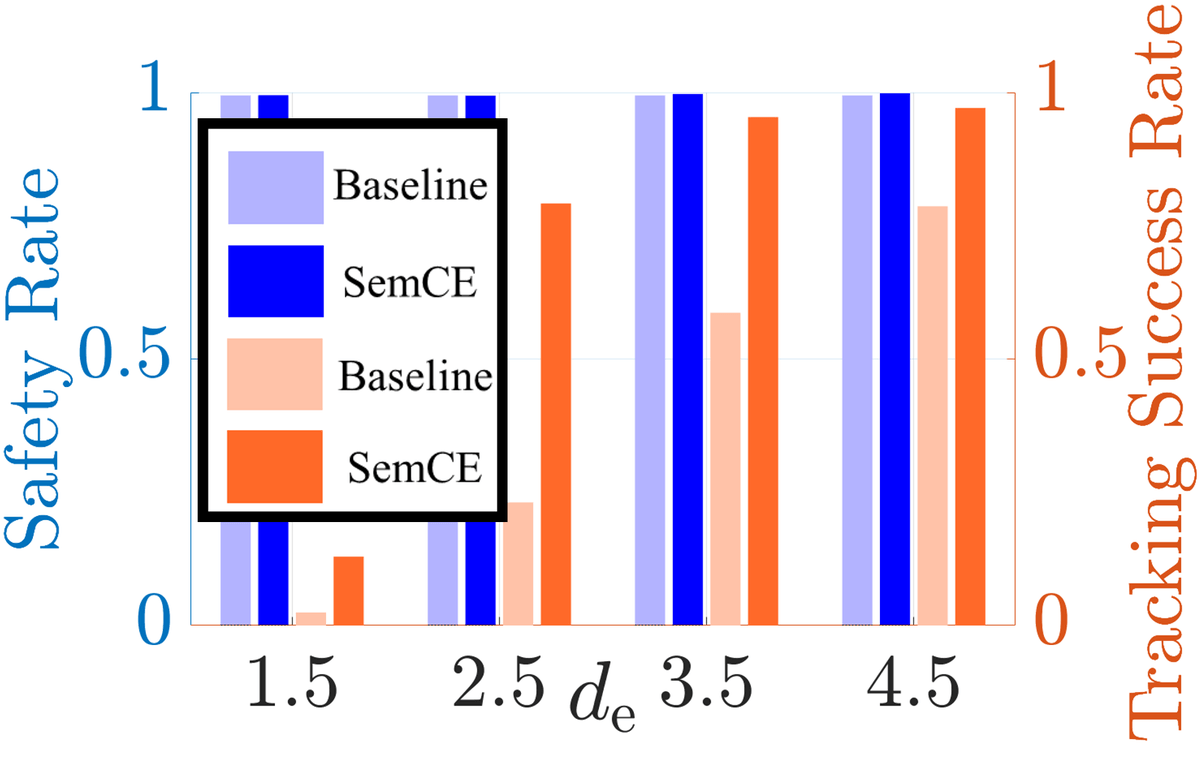
To show one of the directions actually pays off, the authors implement semantic-based C&C packet execution (SemCE) on a single UAV chasing a moving target. An edge server generates PID-controlled commands each time slot and ships them over a Rayleigh-fading channel. The baseline executes whichever C&C packet arrived most recently. SemCE instead ranks packets in the execution queue by freshness (age of information) and semantic value (value of information).
The tracking status at each time slot depends on the Euclidean distance between UAV and target, with a safety distance d_s and tracking threshold d_e. Anything closer than d_s is unsafe; between d_s and d_e is a successful track; beyond that is a miss.

Across four safety-distance settings from 1 m to 4 m with d_e fixed at 5 m, SemCE consistently outperforms the latest-arrived baseline in both safety rate and tracking success rate across all evaluated settings. The reported headline numbers: safety rate improves by more than 2x and tracking success rate by more than 4.5x versus the latest-arrived policy.
What is and is not on offer
This is a position and framework paper, not a code release. The authors do not publish an open-source repo, benchmark suite, or trained model. What you get is a taxonomy that maps ISO safety requirements to concrete failure modes in each layer of an edge-connected robot, plus nine research directions with enough specificity to build against, plus one worked example showing that even the simplest of those directions (reordering packets in the execution queue by AoI and VoI) meaningfully moves both safety and effectiveness numbers.
The limits are also worth naming. The case study is a single UAV against a single mobile target with clean position feedback and a linear PID controller. The bigger claims about LLM-plus-MPC coordination, semantic rate-distortion, and hierarchical replanning are proposed directions rather than validated results. For anyone building edge-offloaded robotics though, the framing itself is the useful part: treating safety as a communication objective, not just a controller constraint, changes which packets you drop, which sensors you compress harder, and which queues you reorder when the wireless link gets tight.