
S2D Fixes 3D Scene Reconstruction From Just a Few Photos
Researchers propose Sparse to Dense lifting, a pipeline that combines point clouds and Gaussian Splatting to reconstruct scenes from very few images.
 Pro
Takeaways
- New arXiv preprint introduces S2D, a sparse-to-dense 3D reconstruction pipeline.
- Combines point cloud geometry with 3D Gaussian Splatting rendering for minimal-input scenes.
- Uses a one-step diffusion model to fix artifacts in point-cloud renders quickly.
- Adds random sample drop and weighted gradient tricks to prevent Gaussian overfitting.
- Reports first-tier sparse-view quality against 3DGS, ScaffoldGS, DIFIX, StreetGS, and SEVA.
- No public code release mentioned; results are self-reported and not peer reviewed.
A team of researchers has posted a new preprint on arXiv describing S2D, short for Sparse to Dense lifting, a pipeline aimed at one of the most stubborn problems in neural 3D reconstruction: what happens when you only have a handful of photos of a scene instead of hundreds.
The method targets 3D Gaussian Splatting (3DGS), the technique that has largely replaced NeRF for real-time novel view synthesis. 3DGS offers a reduction in computational overhead compared to Neural Radiance Fields, but it is susceptible to high-frequency artifacts and demonstrates suboptimal performance under sparse viewpoint conditions. S2D tries to fix that by bridging point clouds and Gaussians with a small diffusion model that cleans up the rendered mess.
Why sparse-view 3DGS keeps breaking
Gaussian Splatting represents a scene as millions of tiny oriented blobs of color that get rasterized into an image. It works beautifully when you feed it dozens of well-distributed camera views, and terribly when you don't. With only three or four input photos, the optimizer has no idea what to put in the regions no camera ever saw, so it hallucinates floaters, streaks, and blurry patches.
The industry has been circling this problem for a while. Recent work has tried two main paradigms: depth-prior supervision, which uses monocular depth estimators to constrain Gaussian positions, and diffusion-based refinement, which uses generative models to predict missing details. Point clouds, meanwhile, are geometrically robust but produce non-photorealistic renders full of holes. S2D's authors argue that neither representation alone is enough, and that the two should be combined.
The pipeline in two halves

According to the paper, S2D has two coupled components:
- An artifact fixer. A one-step diffusion model takes the noisy image rendered from a sparse point cloud and produces a clean, high-fidelity RGB frame. The architecture combines convolutional features, DINO features for semantic guidance, a VAE, and attention modules. One-step here means it does not iterate through many denoising passes like typical diffusion models, which keeps it fast enough to use inside a reconstruction loop.
- A robust fitting strategy. On the 3DGS side, the authors introduce random sample drop, where training views are randomly withheld during optimization, plus a weighted gradient scheme that biases learning toward reliable regions. The combination is meant to prevent the Gaussians from overfitting to the few real photos while still respecting the diffusion-generated pseudo views.
The idea of using a diffusion model to repair renders is not new. Prior works have addressed sparse-view limitations by employing diffusion models to repair corrupted renders and using them as pseudo ground truths for later optimization, though such approaches incur heavy computation from the diffusion fine-tuning and repair steps. S2D's one-step formulation is the main efficiency lever here.
What the results look like

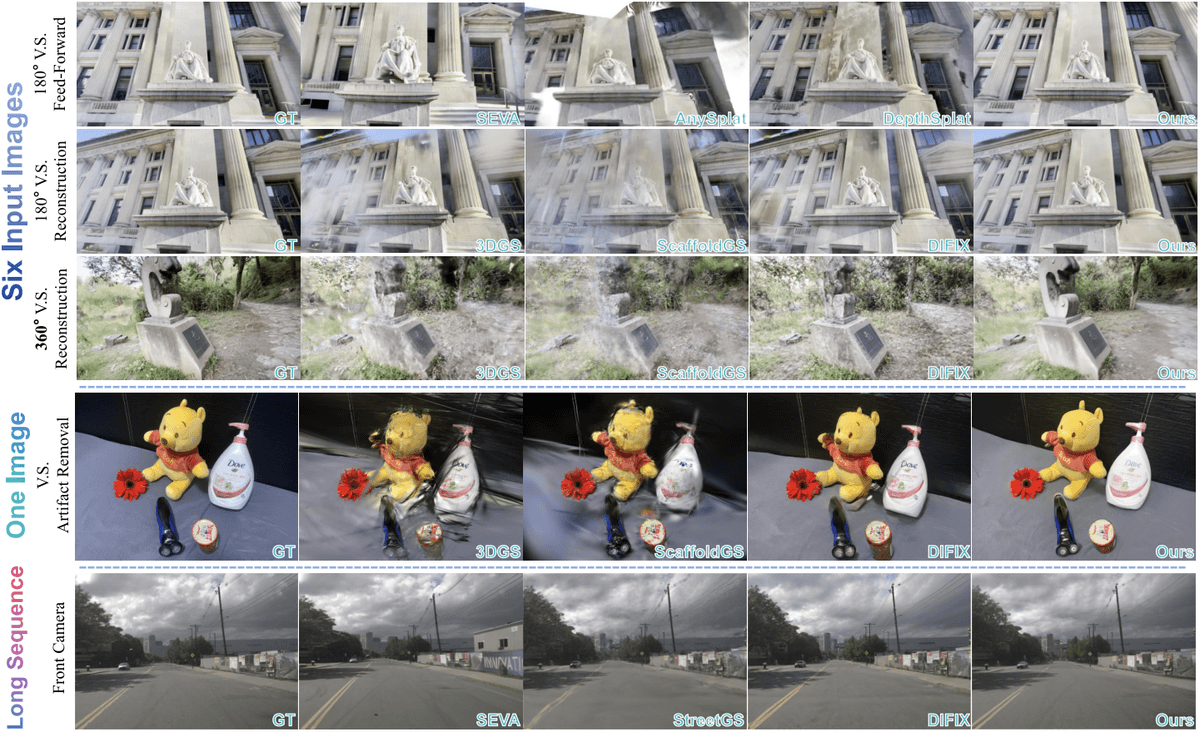
The authors report qualitative and quantitative comparisons against several strong baselines, including vanilla 3DGS, ScaffoldGS, DIFIX, StreetGS, and SEVA, across indoor object scenes, outdoor 360-degree scenes, and driving street views. Their headline claim from the abstract is that S2D achieves the best consistency in generating novel view guidance and first-tier sparse-view reconstruction quality across different input sparsity levels, and that it reconstructs stable scenes with fewer captures than competing methods.
The preprint does not report a public code release, and the paper has not been through peer review at the time of posting.
When it might actually help
If you are working on any of the following, S2D is worth watching:
- Mobile 3D capture apps where users will not shoot 50 photos of a couch.
- Autonomous driving simulators that need to bootstrap street views from a limited log of camera frames.
- Robotics pipelines that combine LiDAR point clouds with a few RGB images and want a photorealistic renderable model out the other end.
The obvious caveats: one-step diffusion models trade generation quality for speed, and diffusion-based inpainting can still invent geometry that is not physically consistent across views. Any downstream task that treats the reconstruction as ground truth, such as measurement or safety-critical simulation, should treat the invented regions with suspicion. As with most sparse-view papers, generalization outside the training data distributions remains the open question.