
RWTH Aachen Study Shows Old-School Speech AI Beats Trendy Speech LLMs
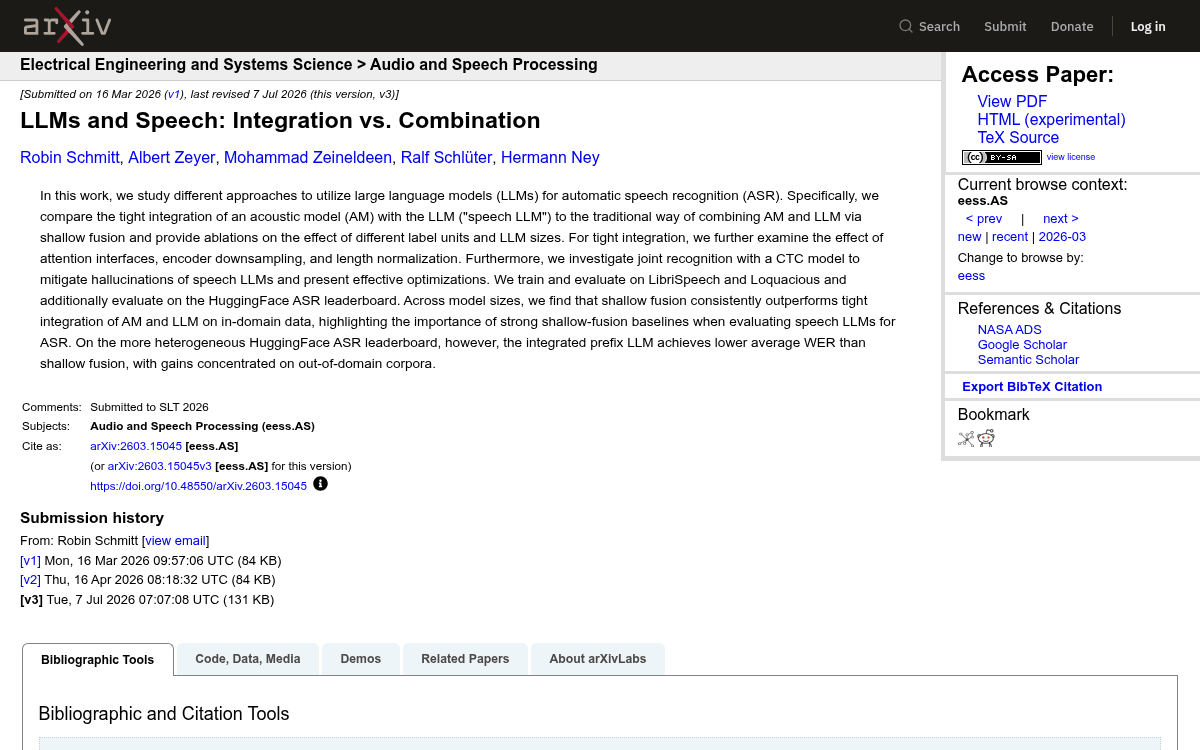
RWTH Aachen researchers stress-test speech LLMs against classical acoustic model plus language model shallow fusion, and find the old approach still holds up.
 Pro
Takeaways
- Shallow fusion of CTC and a standalone LLM matches or beats tightly integrated speech LLMs on in-domain data.
- Prefix LLMs win on the HuggingFace ASR leaderboard, but only on out-of-domain corpora.
- Joint CTC decoding suppresses speech LLM hallucinations, cutting deletions and runaway insertions.
- Top-k pruning plus CTC compression cut decoding memory from 68.9GB to 9.3GB with no WER loss.
- Fine-tuning with a compact 10K SPM ASR vocabulary beats the original 150K Qwen vocabulary.
- Full decoder fine-tuning beats LoRA; prefix LLM slightly beats merged attention interface.
Everyone building speech recognition these days seems to be gluing an audio encoder onto a pre-trained LLM and calling it a speech LLM. A new study from RWTH Aachen and AppTek asks a blunt question: does that actually beat the pipeline where you run a CTC acoustic model and fuse its scores with a standalone language model? Their answer is more nuanced, and less flattering to speech LLMs, than the current hype suggests.
Two ways to marry audio and text
There are broadly two schools of thought for injecting language knowledge into an ASR system. The classical route is shallow fusion: a Conformer-based acoustic model produces CTC probabilities, and during beam search you log-linearly combine those scores with a separately trained language model. The modern route is tight integration, where the encoder output is prepended to the LLM input and self-attention runs over the combined sequence, producing what the community calls a prefix LLM or speech LLM.
Most papers introducing speech LLMs never compare them to a well-tuned shallow fusion baseline trained on the same data. This work does exactly that, running head-to-head experiments on LibriSpeech and the 25,000-hour Loquacious corpus with Qwen2 decoders at 0.5B, 1.5B, and 7B parameters.
Shallow fusion refuses to die
Across almost every configuration tested, shallow fusion of CTC and a standalone LLM matched or beat the tightly integrated prefix LLM on in-domain data, both with and without joint CTC decoding. On Loquacious and LibriSpeech under comparable model sizes, the speech LLM performs on par with an AED baseline trained solely on ASR data, which raises real doubts about the payoff from pre-trained LLMs relative to specialized ASR models.
The picture flips on the heterogeneous HuggingFace ASR leaderboard. There the prefix LLM wins on average. Shallow fusion still leads on in-domain corpora like LibriSpeech and VoxPopuli, but the prefix LLM pulls ahead on out-of-domain sets like AMI, Earnings22, Gigaspeech, and SPGI Speech. The LLM's broad pre-training helps most exactly where the acoustic training data doesn't cover the domain.
Fixing the hallucination problem
Speech LLMs have a well-known failure mode: they hallucinate, often producing runaway insertions from repeating n-grams. The authors show that joint decoding with the auxiliary CTC head fixes this, but only if you optimize the joint search aggressively. Their two tricks:
- Top-k pruning on the CTC posteriors, computed once per utterance after taking the max over time, keeping only labels that ever got a high CTC probability.
- CTC compression, which collapses consecutive encoder frames whose CTC argmax agrees and exceeds a probability threshold, dynamically shortening the sequence fed to the LLM.
The impact is dramatic. Top-k pruning with k=10,000 and CTC compression with a threshold of 0.9 reduces peak GPU memory from 68.9 GB to 9.3 GB and the real-time factor from 69.0 to 6.7 milliseconds per second of audio, while preserving WER. Call it a 7x memory cut and 10x speedup for free.
Small design choices that actually matter
Several practical findings from the ablations are worth stealing:
- Vocabulary matters more than you'd think. Fine-tuning the speech LLM with a compact 10K SPM ASR vocabulary beats using the original 150K Qwen BPE vocabulary. Only 26% of Qwen vocabulary labels appear in Loquacious and 19% in LibriSpeech, so most of the LLM's vocabulary is wasted.
- Length normalization is a coin flip. With larger beam sizes and length normalization, the decoder sometimes hallucinates catastrophically, producing more than 500 insertions in a single utterance. Without it, the model becomes deletion-happy.
- Full fine-tuning beats LoRA on the decoder, though a two-stage schedule (train new weights first, then jointly fine-tune) closes most of the gap.
- Prefix LLM slightly edges out merged attention when starting from a pre-trained decoder, while the two are equivalent when trained from scratch.
- The same PLLM can serve as both AM and LM. Forwarding the label context through the decoder once with the encoder output and once without, then combining both scores with CTC, gives the best WER of any configuration tested.
What it means if you build ASR
If your target domain matches your training data, a strong Conformer plus CTC plus a fine-tuned standalone LLM via shallow fusion is still the WER-optimal choice, and it's cheaper to train. Tight integration into a speech LLM starts to pay off when you need robustness to domains outside your acoustic training set, which explains why the leaderboard numbers favor it. The joint CTC plus SLLM decoding gains shrink as the LLM grows, so the hallucination-suppression trick matters most for smaller decoders.
The authors say they will release all relevant code upon publication, which should make replicating the shallow fusion baseline straightforward for anyone benchmarking a new speech LLM. If your next paper skips a properly tuned shallow fusion baseline, the numbers may not mean what you think they mean.