
Rutgers' Re-MeanFlow Cuts One-Step Image Generation FID by 72% Faster
A new research paper combines Rectified Flow trajectory straightening with MeanFlow's average-velocity trick to hit 8.6 FID and 26x faster training.
 Pro
Takeaways
- New paper Rectified MeanFlow trains MeanFlow on straightened trajectories from a pretrained flow model.
- Improves baseline MeanFlow FID from 30.9 to 8.6 on ImageNet 512x512 under the same training budget.
- Beats 2-rectified flow++ by 33.4 percent in FID while running 26x faster in GPU hours.
- Adds a distance-based truncation heuristic that discards the top 10 percent longest noise-data pairs.
- Shifts most compute to inference-only reflow sampling, reducing dependence on high-end training GPUs.
- Code released on GitHub, applied to ImageNet at 64, 256, and 512 resolutions.
One-step image generation just got a meaningful boost. A team of researchers from Rutgers University, working with a collaborator at Red Hat AI Innovation, has released Rectified MeanFlow (Re-MeanFlow), a training framework that fixes a core convergence problem in MeanFlow, the recent one-step generative modeling method from a CMU and MIT team.
The paper argues that MeanFlow's slow, noisy training isn't a limitation of the objective itself but a consequence of the curved trajectories it tries to learn on. Straighten the paths first, then learn the mean velocity, and everything gets easier. Code is available on GitHub.
Why one-step generation is hard
Flow matching and diffusion models produce great samples but need many neural network evaluations to solve an ODE from noise to image. Two lines of work have tried to collapse that into a single step:
- Rectified Flow iteratively straightens the trajectories connecting noise and data, so one Euler step can approximately traverse the whole path. The catch: theoretically you need infinite reflow iterations to get perfectly straight paths, and each iteration is expensive.
- MeanFlow, introduced earlier by Geng et al., sidesteps ODE integration entirely by directly modeling the average velocity over a time interval. It achieves an FID of 3.43 with a single function evaluation on ImageNet 256x256 trained from scratch, which had been a strong result for one-step models.
The problem the new paper identifies is that MeanFlow's average-velocity target becomes irregular and hard to fit when the underlying flow is highly curved. Training gets stuck on a noisy loss landscape, burning GPU hours for modest quality gains.
The rectify-then-average recipe
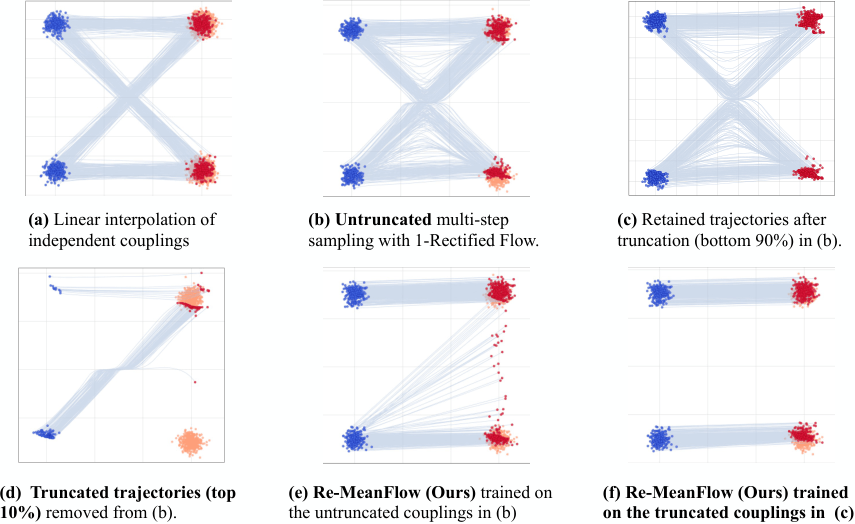
Re-MeanFlow is conceptually simple. Rather than training MeanFlow on raw noise-data couplings, the authors first run a single reflow step from a pretrained flow model to produce straighter couplings, and then train the MeanFlow objective on those. This is a form of self-distillation: the pretrained model generates its own straighter training data.

Two components make this work in practice:
- Rectified couplings. Generate 5M noise-data pairs by sampling through the 1-rectified flow. These pairs have far fewer path crossings, so conditional velocities better approximate the marginal velocity field, dramatically reducing variance in the MeanFlow loss.
- Distance truncation. A surprisingly effective heuristic: rank all couplings by their L2 distance between noise and data, then throw out the top 10 percent. Long-distance pairs correlate strongly with high-curvature paths and dominate the error tail, so pruning them smooths training further.
The numbers
The authors report results on ImageNet at 64x64, 256x256, and 512x512, using EDM2-S and SiT-XL as pretrained backbones. Highlights:
- On ImageNet 512x512, Re-MeanFlow improves FID from a baseline MeanFlow score of 30.9 down to 8.6 under the same training budget, and reaches the final MeanFlow FID roughly 2x faster in wall-clock time.
- Against 2-rectified flow++, a strong Rectified Flow variant, Re-MeanFlow cuts FID by 33.4 percent on ImageNet 64x64 while running about 26x faster in GPU hours.
- Final one-step FIDs are 2.87 on ImageNet 64x64, 3.41 on 256x256, and 3.03 on 512x512, edging out or matching state-of-the-art one-step baselines like AYF, sCD-S, and TCM.

The ablation table is worth reading. Starting from the best reported MeanFlow config (FID 7.81), each design choice contributes: reducing normalization strength, swapping the time embedding, using a U-shaped time distribution, avoiding a high-variance region where t is above 0.95 and r below 0.4, and finally the distance truncation each bring FID down step by step to 3.03.
A subtler cost-shifting story
There is a practical angle beyond the FID numbers. Traditional distillation pipelines are backprop-heavy and effectively require A100-class training GPUs. Re-MeanFlow moves most of the compute into the reflow sampling stage, which is pure inference and runs fine on cheaper accelerators. The actual MeanFlow training phase accounts for only around 17 percent of the total GPU hours used by comparable methods like AYF.
For teams doing hyperparameter sweeps or exploring one-step models on tighter budgets, this is a meaningful shift. You can generate 5M rectified couplings once on inference hardware, then iterate quickly on the training recipe.
Where it falls short
The method is not without limits. Because training relies entirely on synthetic couplings from a pretrained model, quality is bounded by the teacher. The authors flag this explicitly and point to prior work on mixing in real data as a natural next step. There is also a practical dependency on having a good enough pretrained flow model to reflow from, so this is a distillation tool, not a from-scratch training method.
The core takeaway is that one-step generation quality isn't just about clever objectives, it is about the geometry of what you are trying to fit. Straighter trajectories give a smoother loss landscape, and a smoother loss landscape gives faster, better convergence. Whether that principle generalizes to text-to-image scales is the open question the authors are already pointing at.