
Rutgers' R-WoM Gives AI Agents a 23.4% Boost on Hard Computer Tasks
R-WoM fixes LLM world models for computer-use agents by grounding simulations in retrieved tutorials, boosting task success by up to 23% on OSWorld and WebArena.
 Pro
Takeaways
- Core finding: LLMs are good at predicting the next screen state but fail badly at multi-step planning, rarely exceeding 65% accuracy without grounding.
- The fix: R-WoM retrieves relevant tutorials at inference time and uses them to anchor LLM world-model simulations, no fine-tuning needed.
- Results: Up to 23.4% relative improvement on OSWorld and 16.3% on WebArena over strong baselines, consistent across Qwen-2.5-VL-72B, Claude-3.5, 3.7, 4, and 4.5.
- Key innovation: LongCoT single-pass rollouts replace expensive iterative policy/world-model back-and-forth, and listwise relative reward ranking replaces brittle absolute scores.
- Tutorial-scarce setting: When no official docs exist, tutorials synthesized from self-played trajectories still yield consistent gains.
- Limitations: Content-modification tasks (drag, select, highlight) and tasks requiring implicit reasoning remain the primary failure modes.
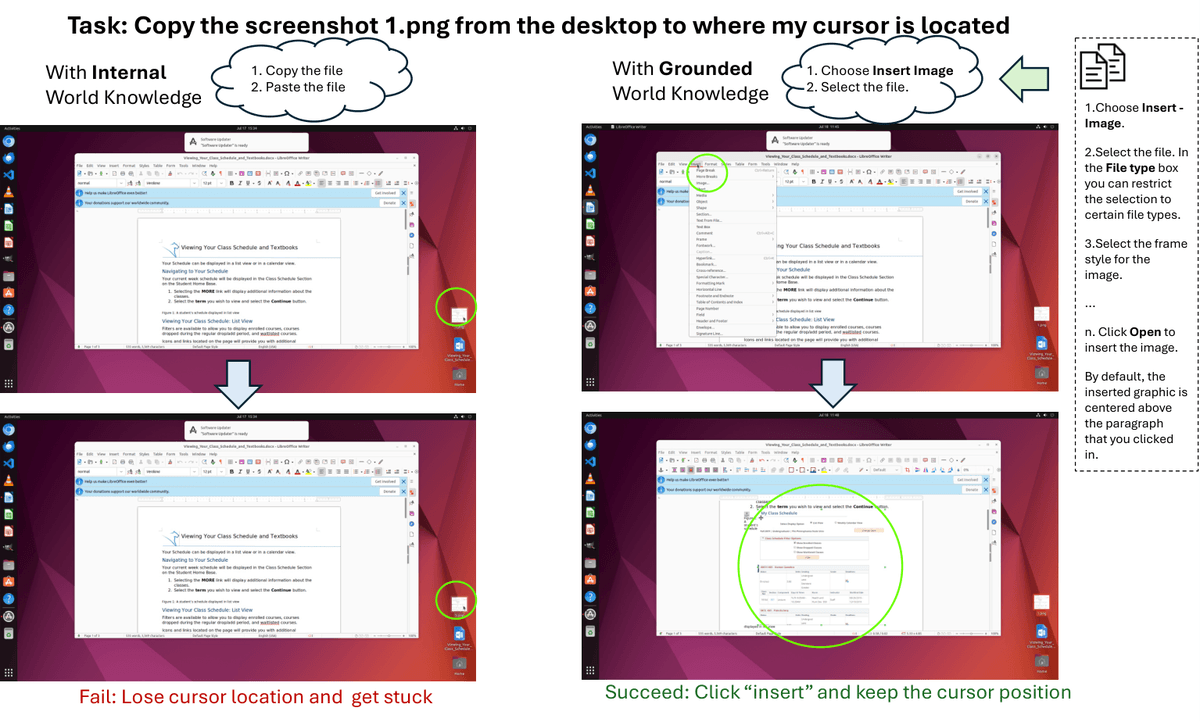
LLM-based agents that control computers and browsers are getting better at following instructions, but they still make costly mistakes on multi-step tasks. One promising fix is to give agents a world model -- a simulator they can consult before acting, letting them mentally rehearse a sequence of clicks before committing to any of them. The problem is that LLMs make surprisingly bad world models when tasks get long. A new paper from Rutgers University and AWS Agentic AI, R-WoM: Retrieval-augmented World Model For Computer-use Agents, diagnoses exactly why, and proposes a fix that delivers up to 23.4% relative improvement on hard computer-use benchmarks.
Why world models break down
A world model, in this context, is an LLM asked to imagine what the screen will look like after a given action is taken -- and then to keep imagining several steps further. This lets the agent evaluate candidate actions without actually executing them, which matters a lot when mistakes are hard to undo (deleting a file, submitting a form, sending an email).
Due to their inherent tendency toward hallucination and reliance on static parametric knowledge, LLMs perform world modeling in a fundamentally ungrounded manner. To understand exactly where the breakdown happens, the authors designed three probing tasks:
- Next-state identification: Given a current screen and an action, pick the correct next screen from two candidates. This tests one-step prediction.
- Full-procedure planning alignment: Generate a full multi-step plan for a task, then check whether it matches what the environment's official tutorial says should happen. This tests long-horizon planning.
- Milestone transition recognition: Given a sequence of screen states, decide whether they represent meaningful progress toward the goal. This tests reward estimation.
The analysis shows that while LLMs effectively capture immediate next states and identify meaningful state transitions, their performance rapidly degrades in full-procedure planning. This highlights LLMs' limitations in reliably modeling environment dynamics over long horizons. Concretely, models like Claude-3.7-Sonnet hit 86% accuracy on next-state identification and milestone recognition, but full-procedure planning alignment rarely exceeded 65% -- even for the strongest model tested.
The grounding gap in numbers
The probing results are telling. When models were given access to relevant tutorials during the planning task, alignment jumped dramatically -- from 65% to 95% for Claude-3.7-Sonnet. That single data point is the motivation for the entire R-WoM framework: the knowledge exists, it just needs to be retrieved and injected at the right moment.

The core insight behind R-WoM is that while LLMs possess broad world knowledge from pretraining, they lack the specific, up-to-date procedural knowledge required for accurate simulation in dynamic digital environments. The knowledge base the team assembled includes over 30,000 chunked tutorial documents from sources like WikiHow, GIMP documentation, LibreOffice Help, GitLab docs, and Adobe Commerce guides.
How R-WoM works, step by step
At each decision point, R-WoM runs the following loop:
- Retrieve and rerank tutorials. The task goal is rewritten into a generalized search query (e.g., "Fork ChatGPT" becomes "How to fork a repository in GitLab"), then top-k chunks are fetched by cosine similarity and re-ranked by an LLM that scores semantic relevance -- not just lexical overlap.
- Generate candidate actions. The policy model proposes 1 to N candidate actions. Crucially, it only proposes multiple candidates when it is uncertain; if the next step is obvious, it proposes one. Semantically duplicate candidates are pruned before rollouts begin.
- Simulate futures with LongCoT rollouts. For each candidate action, the world model -- grounded by the retrieved tutorials -- runs a multi-step simulation inside a single long chain-of-thought reasoning pass. This avoids the expensive back-and-forth between policy and world model used in prior work like WebDreamer.
- Rank by listwise reward. Instead of assigning an absolute score (success / in-progress / failure) to each rollout, R-WoM ranks all rollouts against each other. Absolute sparse rewards can be insensitive when candidate rollouts are all plausible yet differ in subtle ways. Relative ranking sidesteps this bias.
- Execute the top-ranked action and repeat.
Benchmark results
The team evaluated on two standard computer-use benchmarks. WebArena covers web-based tasks across e-commerce, social forums, and developer tools. OSWorld covers desktop tasks in applications like Chrome, GIMP, LibreOffice, and VSCode -- all running in real virtual machines with execution-based scoring.
| Model | Method | OSWorld | WebArena |
|---|---|---|---|
| Qwen-2.5-VL-72B | Vanilla | 26.36% | 21.84% |
| Qwen-2.5-VL-72B | WebDreamer | 28.37% | 24.50% |
| Qwen-2.5-VL-72B | R-WoM | 37.48% (+21.5%) | 28.49% (+16.3%) |
| Claude-3.7-Sonnet | Vanilla | 28.47% | 28.92% |
| Claude-3.7-Sonnet | WebDreamer | 31.24% | 31.86% |
| Claude-3.7-Sonnet | R-WoM | 38.54% (+23.4%) | 34.58% (+5.6%) |
R-WoM consistently outperforms all alternatives, with improvements remaining stable across different backbones, highlighting that R-WoM provides more consistent benefits compared with retrieval alone or ungrounded world modeling. The gains also hold on newer models: with Claude-4.5-Sonnet, R-WoM reaches 67.84% on OSWorld versus 59.12% for the vanilla baseline -- a 15% relative gain on a much stronger starting point.
The imagination horizon problem
One of the more interesting findings is how the two approaches behave as you increase the simulation depth (how many steps ahead the world model imagines). WebDreamer, the ungrounded baseline, shows initial gains at horizon 1-2 but then degrades -- compounding errors pile up and the simulation drifts away from reality. R-WoM maintains or improves performance up to horizon 3 before tapering off. This is the clearest evidence that tutorial grounding is doing real work: it anchors the simulation to factual procedural knowledge at each step.
When tutorials are scarce
Not every task has an official tutorial online. To handle this, the authors synthesized tutorials from 2,000 open-source agent trajectories released by the AgentNet project. A two-stage pipeline first extracts skill-level tutorials from each trajectory, then deduplicates and merges similar skills across the corpus. R-WoM has consistent improvement over other baselines across three Claude-Sonnet models (3.7, 4, and 4.5), demonstrating that R-WoM can adapt to tutorial-scarce tasks by grounding the world model using synthesized tutorials derived from self-play.
Where it still struggles
The failure analysis reveals a clear pattern. Content-modification tasks -- such as editing text in LibreOffice or modifying code in VSCode -- are where R-WoM fails more frequently. These failures often arise from ambiguous task goals, where the model must infer intermediate steps, or from the inherent difficulty of manipulating fine-grained content through UI actions such as dragging, selecting, or highlighting text. Information-seeking tasks (navigation, search) are significantly easier. Retrieval also fails on tasks that require implicit reasoning -- a query like "calculate employee ages from birthdays" retrieves date-formatting tutorials rather than formula-writing instructions.
On the cost side, the adaptive variant of R-WoM reduces world-model triggers to roughly 15-20% of the naive rate, cutting total token usage by more than 50% compared to full R-WoM, while retaining most of the performance gains. Retrieval itself accounts for less than 2% of total latency per task.
What this unlocks
The practical implication is that any computer-use agent framework can be upgraded with a retrieval-grounded world model at inference time -- no fine-tuning required. The knowledge base is just a collection of documentation pages and wikis. The most natural use cases are:
- Automating multi-step workflows in enterprise software (CRM, ERP, office suites) where official documentation exists
- Web agents operating on well-documented platforms like GitLab, Shopify, or Google Workspace
- Any setting where irreversible actions (form submission, file deletion, email sending) make trial-and-error too costly
Code and implementation details are described in the paper's appendix, including full prompt templates for query rewriting, reranking, rollout simulation, and reward estimation. The authors note the work is reproducible using the provided algorithm and setup descriptions, though no public repository link is given in the paper itself.