
RouteNet-Gauss Beats Classic Network Simulators With 488x Faster Inference
A hybrid approach that trains a graph neural network on real testbed hardware cuts network simulation error by 95 percent and inference time by 488x.
 Pro
Takeaways
- RouteNet-Gauss uses a real hardware testbed instead of a simulator to generate high-fidelity training data for a graph neural network.
- Achieves up to 95% lower prediction error and 488x faster inference than state-of-the-art DES methods.
- Modular MPNN architecture assembled dynamically from per-element building blocks (flows, links, queues, devices).
- Generalizes from 5-8 node training topologies to unseen networks up to 110 nodes at 5-7% MAPE.
- TAPE mechanism gives configurable temporal granularity for handling bursty, non-stationary traffic.
- Code, datasets, and TensorFlow implementation available on GitHub.
Network simulation is one of those unglamorous but essential tools that sits behind capacity planning, traffic engineering, and QoS assurance. For decades, the workhorse has been Discrete Event Simulation with tools like ns-3 and OMNeT++, but those simulators are painfully slow at data-center scale and rely on idealized assumptions about hardware they cannot fully see inside. A team at the Barcelona Neural Networking Center is proposing a different bargain: swap the simulator for a real network testbed as the source of training data, then let a graph neural network do the inference.
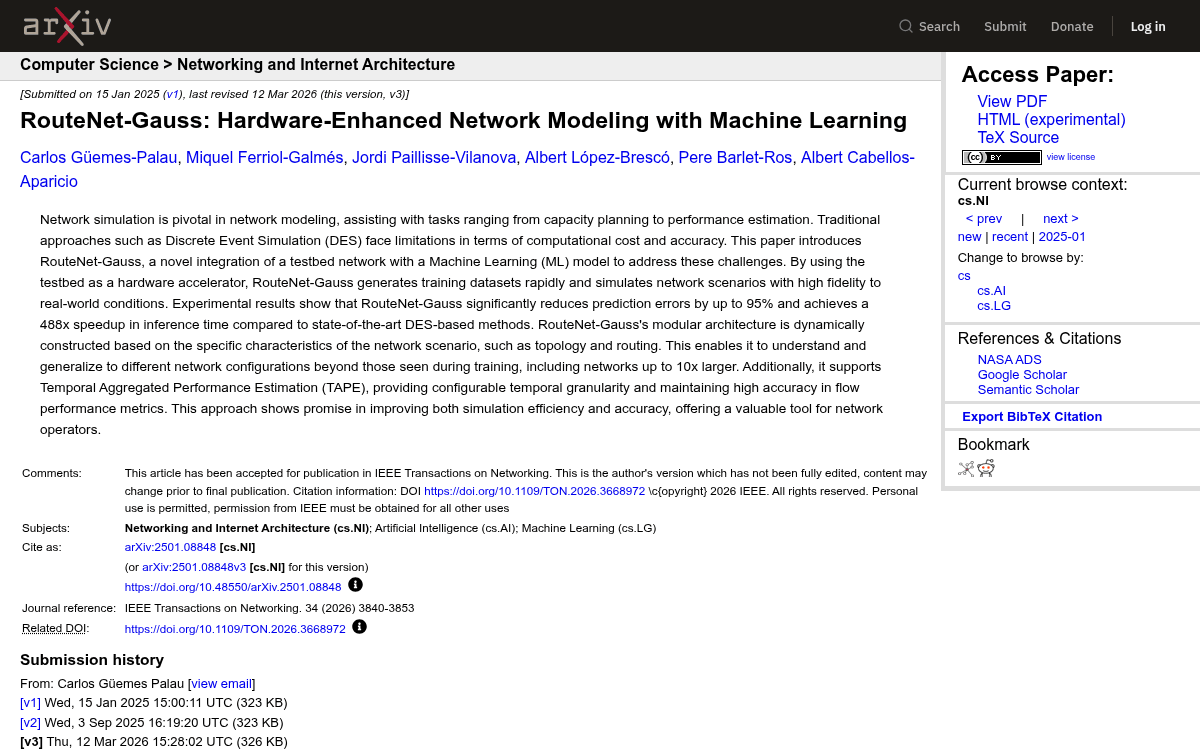
The result is RouteNet-Gauss, and the numbers are striking. Experimental results show that RouteNet-Gauss significantly reduces prediction errors by up to 95% and achieves a 488x speedup in inference time compared to state-of-the-art DES-based methods. Just as importantly, it generalizes to network topologies up to 10x larger than anything it saw during training.
Why simulating a network is harder than it sounds
DES engines model networks by processing individual events (packet generation, queueing, forwarding, exit) one at a time. That granularity is what makes them accurate, but it is also what makes them expensive. A single 1 Gbps link at typical loads pushes hundreds of thousands of packets per second, and the sequential nature of event processing resists easy parallelization. Even DONS, a heavily optimized parallel DES engine, still needs roughly 2,500 seconds to simulate one second of a 10 Gbps data-center link at 80 percent load.
The other issue is subtler. Commercial routers and switches have proprietary internals such as queue sizes, scheduling policies, and buffer behavior that vendors do not publish. When the team compared OMNeT++ against measurements from real hardware running the same scenarios, MAPE was 46 to 54 percent on packet delay. That is not a rounding error, it is the simulator systematically failing to reproduce reality. Any ML model trained on that simulated data inherits the same ceiling.
Hardware as a data generator
RouteNet-Gauss sidesteps both problems by treating a physical testbed as a hardware accelerator for producing ground-truth training data. The testbed itself is modest: 8 Huawei NetEngine 8000 M1A routers wired through two Huawei switches acting as a reconfigurable backbone, with VLANs used to synthesize different topologies. TREX generates synthetic traffic, an optical splitter mirrors packets to a capture server, and a DPDK-based capture pipeline records hardware timestamps without adding measurable delay.
Because the traffic runs at line rate on real silicon, the team can generate thousands of realistic scenarios quickly, at fidelity a simulator cannot match. The trade-off is that the model works at flow-level rather than packet-level granularity, which is fine for the use cases they target: capacity planning, topology design, traffic engineering, and performance estimation.
The architecture, in plain terms
The model is a Message Passing Neural Network, a type of graph neural network where every node repeatedly updates its state by exchanging small vector messages with its neighbors until the whole graph reaches a consistent view of the system.
What makes RouteNet-Gauss interesting is how it decomposes the network. Rather than modeling the topology as a plain device-to-device graph, it builds an expanded graph containing four kinds of entities that each get their own small neural network as a reusable building block:
- Flows interact with the sequence of queues and links along their path.
- Queues are influenced by the flows passing through them and by the device they sit on.
- Links are affected by the queues that feed traffic into them.
- Devices aggregate the state of their queues.
All queues share the same weights, all links share the same weights, and so on. That weight sharing is the trick that lets the model generalize: at inference time, the architecture is assembled dynamically from these building blocks to match whatever topology and routing it is handed. A 110-node network it has never seen still decomposes into the same primitives it learned on 5 to 8 node testbed graphs.
Handling time without going packet-level
The team also introduces Temporal Aggregated Performance Estimation, or TAPE. Instead of predicting one average number per flow across a whole scenario, RouteNet-Gauss splits the timeline into fixed-size windows (100 ms in their default configuration) and predicts per-flow metrics inside each window. The internal state at the end of one window becomes the initial state of the next, which lets it handle non-stationary traffic like bursty patterns and multi-modal distributions.
Users can trade accuracy for cost by tuning the window size. Smaller windows mean more predictions per scenario and higher compute cost, but accuracy stays roughly constant across window sizes.
How the results actually stack up
The team evaluated against OMNeT++, DONS, DQN, and their own previous model RouteNet-Fermi across three datasets: two synthetic (TREX-Synthetic and TREX-Multi-Burst) and one built from real traffic traces from the MAWI archive.
| Metric | OMNeT++ | RouteNet-Gauss |
|---|---|---|
| MAPE on delay (TREX-MB) | ~56% | ~2.3% |
| MAE on delay (TREX-MB) | ~68 microseconds | ~2.8 microseconds |
| Inference time (50M packets) | >1000 s (DONS) | 2.4 s |
| Generalization to unseen topologies | N/A | 5-7% MAPE up to 110 nodes |
On synthetic traffic, RouteNet-Gauss dominates: its MAE on delay is close to the expected transmission delay of a single packet (~4 microseconds), while OMNeT++ misses by 60+ microseconds. On real-world MAWI traces the picture is more nuanced. Gauss still beats OMNeT++ on average delay MAPE (13 percent vs 56 percent), but OMNeT++ pulls ahead on jitter and on high-percentile delay correlation. The team is candid about this: real traffic distributions that look nothing like training data are still hard.
What is genuinely new here
Two things stand out beyond the raw speed numbers. First, the inference cost is essentially independent of packet count. DES cost scales linearly with packets, so a busier link means a slower simulation. RouteNet-Gauss's cost depends on topology size and number of windows, but not on how many packets fly through the network. That flips the scaling story for large data-center simulation.
Second, the modular graph decomposition delivers real out-of-distribution generalization. Trained on 5-8 node topologies, the model holds 5-7 percent MAPE on topologies up to 110 nodes drawn from the Topology Zoo repository. That is the kind of generalization behavior researchers hope GNNs will deliver but rarely see this cleanly.
Where it falls short
- UDP only. Everything in the paper is evaluated on UDP. The authors sketch how to extend to TCP by aggregating mice flows and adding congestion-control features, but it is future work.
- Hardware-specific training. The model learned on Huawei routers and switches. Deploying on a network with different vendors likely needs additional training data or fine-tuning, though the team argues transfer learning should make this manageable.
- Fixed time scale. Changing the prediction window size (e.g., from 100 ms to 1 ms) requires retraining.
- Sensitive to traffic distribution shift. Bandwidth features are scale-dependent, so wildly out-of-distribution traffic patterns can degrade accuracy.
Code and where to get it
The full implementation is open source. The repository is the code of the paper RouteNet-Gauss: Hardware-Enhanced Network Modeling with Machine Learning. You can find it at BNN-UPC/RouteNet-Gauss on GitHub, and it includes the model implementation, training scripts, and all three datasets (TREX-Synthetic, TREX-Multi-Burst, and the MAWI-derived Real-World Packet Traces) split into training, validation, and test partitions. The model is built in TensorFlow 2.11, uses 32-dimensional embedded states with 8 message passing iterations, and trains with Adam at a 0.001 learning rate.
For anyone building network digital twins, doing what-if capacity planning on production topologies, or tired of waiting overnight for ns-3 runs to finish, this is a compelling data point: hardware-grounded training plus a modular GNN can beat both classical simulators and ML models trained on simulated data, on their own turf.