
RoMa Beats SAR-Specific Tools Without Ever Seeing Satellite Training Data
A zero-shot benchmark of 24 pretrained image matchers on optical-SAR satellite pairs finds RoMa competitive with cross-modal specialists, while deployment protocol swings accuracy up to 33x.
 Pro
Takeaways
- 24 pretrained image matchers evaluated zero-shot on optical-SAR satellite registration across three benchmarks
- RoMa and XoFTR tie for best on SpaceNet9 at 3.0 px mean tie-point error
- RoMa reaches top rank without any cross-modal training, credited to DINOv2 backbone features
- Protocol choices swing accuracy up to 33x, often exceeding matcher-swap effects entirely
- MASt3R and DUSt3R fail on overhead imagery because orthorectified scenes lack depth variation
- Full code and configs released at github.com/isaaccorley/rsim
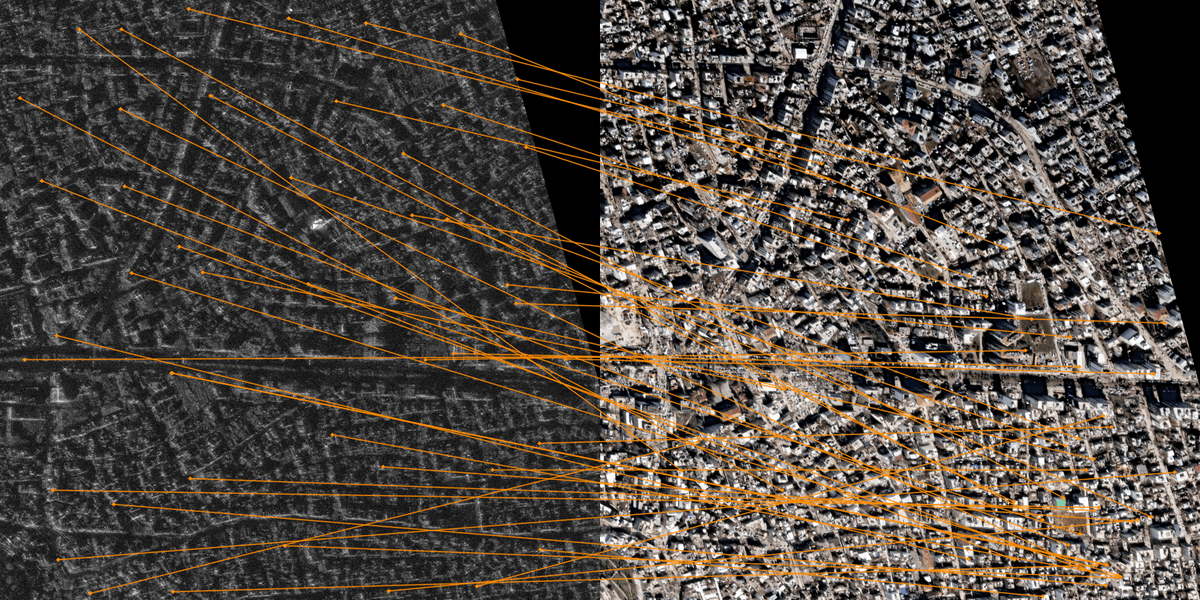
When a hurricane hits, clouds usually block optical satellites, leaving Synthetic Aperture Radar (SAR) as the only usable eye in the sky. Aligning fresh SAR imagery to existing optical basemaps, a step called cross-modal registration, is a bottleneck for producing georeferenced damage maps. A new study asks a blunt question: do the image matchers we already have off the shelf work for this, or does the community need to build SAR-specific tools?
The authors run a zero-shot bake-off of 24 pretrained matcher families against optical-SAR pairs, with no fine-tuning and no domain adaptation. The verdict goes beyond a simple leaderboard: architectural choices in general-purpose matchers can partially substitute for explicit cross-modal training, and the deployment protocol carries as much weight as the model itself.
Why optical and SAR refuse to line up
Optical sensors record reflected sunlight and produce imagery that looks familiar. SAR sensors bounce microwave pulses off the ground, and the result is dominated by speckle noise, side-looking layover distortion, and contrast that can be inverted relative to optical data. These effects create an appearance gap far larger than typical natural-image domain shifts such as day-night or indoor-outdoor variation. Classical descriptors like SIFT and phase congruency tend to collapse under this gap, and modern deep matchers are almost exclusively trained and benchmarked on ground-level natural images.