
Rochester's OPENXRD Benchmark Reveals Mid-Sized AI Models Beat GPT-4.5 With Expert Help
OPENXRD benchmarks 74 LLMs on 217 crystallography questions, revealing that mid-sized models gain the most from expert-curated context -- and bigger isn't always better
 Pro
Takeaways
- OPENXRD benchmarks 74 LLMs and multimodal models on 217 expert-curated X-ray diffraction questions across 81 crystallography subtasks.
- Each question is tested in closed-book (internal knowledge only) and open-book (with supporting passages) modes to measure context assimilation.
- Mid-sized models (7B-70B) gain the most from expert-reviewed context, with LLaVA-v1.6-34B jumping +11.5 points; frontier models like GPT-4.5 slightly decline.
- Expert-reviewed passages outperform AI-generated ones by up to 7 percentage points even at matched token counts, proving content quality beats quantity.
- Mathematical subtasks like Bragg's Law calculations remain at 0% accuracy even with expert context, pointing to a need for symbolic solvers.
- Dataset, code, and evaluation scripts are fully open-source at github.com/niaz60/OpenXRD.
There is a growing push to deploy large language models as scientific assistants in highly specialized domains -- materials science, drug discovery, genomics. But before you can trust a model to reason about crystal structures or X-ray diffraction patterns, you need to know exactly where it breaks down. A new benchmark called OPENXRD, from researchers at the University of Rochester, is designed to answer that question precisely -- and its findings challenge some intuitions about how model size relates to usefulness.
Why crystallography is a hard test for LLMs
X-ray diffraction (XRD) is the primary experimental technique used to determine crystal structures -- how atoms are arranged inside a material. It underpins research in metallurgy, pharmaceuticals, and semiconductor design. The analysis involves Bragg's Law, structure factors, symmetry groups, and multi-step mathematical reasoning that goes well beyond what general-purpose LLMs typically encounter during training.
LLMs are increasingly being used in materials science, but the absence of standardized evaluation benchmarks has impeded progress in the field. Existing efforts like LLM4Mat-Bench -- the largest benchmark to date for evaluating LLMs on crystalline materials -- contain about 1.9 million crystal structures collected from 10 publicly available sources, but focus on property prediction rather than conceptual reasoning and knowledge integration. OPENXRD fills a different gap: it measures whether a model can actually understand and apply crystallographic concepts, especially when given a hint.
The benchmark: 217 questions, two modes, 74 models
OPENXRD evaluates 74 language and multimodal models on 217 expert-curated X-ray diffraction questions spanning 81 subtasks, then measures how performance changes when models receive carefully written supporting passages. Every question is multiple-choice with a single correct answer, reviewed and validated by a PhD-level crystallography expert. Topics range from basic crystal system definitions all the way to structure factor calculations, zone-axis notation, and symmetry-driven reflection extinctions.

Each question is evaluated under two conditions:
- Closed-book: the model answers from internal knowledge only, with no outside help.
- Open-book: the model gets a short, question-specific passage that supports reasoning without leaking the answer.
The open-book passages come in two flavors. The first is AI-generated: GPT-4.5 was prompted to write concise domain-specific summaries for each question, carefully avoiding direct disclosure of the correct answer. The second is expert-reviewed: three PhD students with 4-7 years of XRD research experience corrected technical inaccuracies, added precise terminology, and removed misleading content from those AI drafts. This two-tier design lets the benchmark directly quantify how much human expertise adds on top of AI-generated context.
The models tested span a wide range: GPT-4, GPT-5, O-series, LLaVA, LLaMA, QWEN, Mistral, and Gemini families, all evaluated in zero-shot mode with no fine-tuning on crystallography data.
The sweet spot is not the biggest model
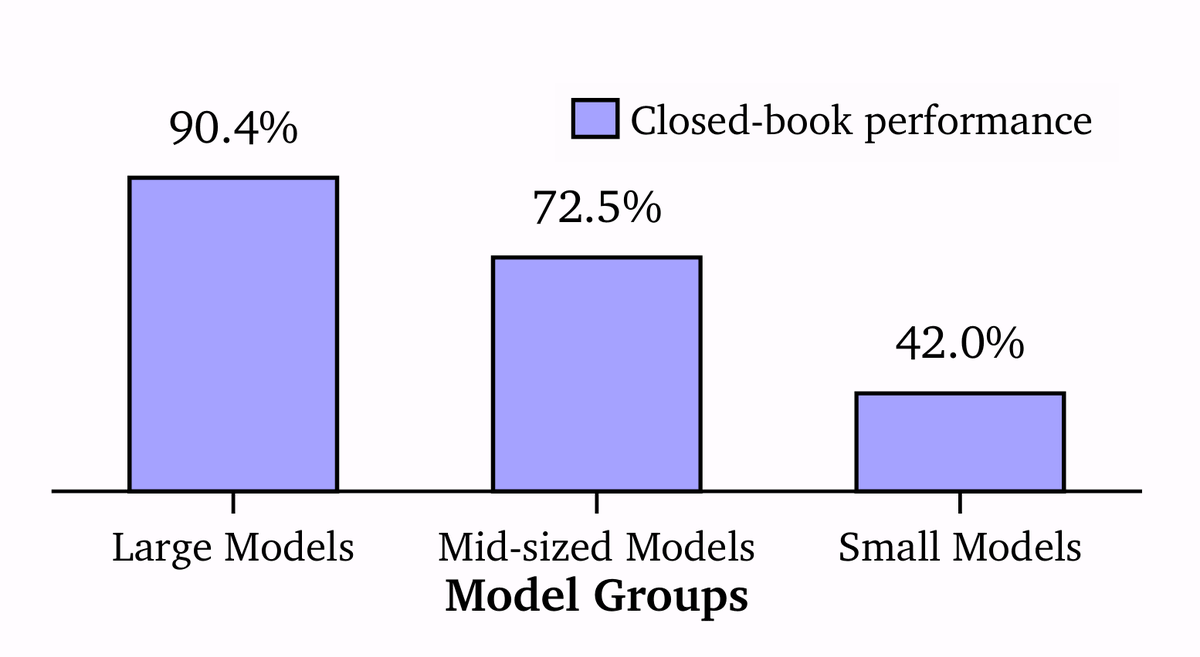
In closed-book mode, the frontier models dominate as expected. GPT-4.5-preview leads at 93.09% accuracy (202/217 questions), followed by O3-mini at 88.94% and O1 at 87.56%. Smaller LLaVA-based models struggle significantly -- LLaVA-v1.5-7B manages only 18% on its own.
But the more interesting story emerges in open-book mode. Mid-sized models, especially in the 7B-70B range, benefit the most from expert-reviewed context. Frontier models often already know enough crystallography that extra passages create saturation or interference instead of improvement.
The numbers bear this out starkly. With expert-reviewed materials:
- LLaVA-v1.6-34B jumps from 66.80% to 78.30% (+11.50 points)
- LLaVA-v1.6-mistral-7B climbs from 53.00% to 64.10% (+11.10 points)
- LLaVA-onevision-QWEN2-7B-ov-chat gains +10.10 points
- GPT-4.5-preview actually drops by 3.69 points
- O3-mini barely moves, gaining only +0.96 points
The accepted paper reports measurable drops for several frontier systems when expert-reviewed materials are added: not because the materials are wrong, but because redundant or stylistically mismatched context can disrupt an already strong internal representation. This is a real practical concern for anyone building RAG (retrieval-augmented generation) pipelines on top of frontier models -- more context is not always better.

Quality beats quantity in context
One of the cleaner findings is the gap between AI-generated and expert-reviewed passages. The expert materials are not longer -- token counts are matched -- but they consistently outperform the AI drafts. LLaVA-v1.6-34B, for instance, gained only +4.61 points with AI-generated context but +11.50 with expert-reviewed context, a difference of nearly 7 percentage points from the same token budget.
The AI-generated passages had identifiable failure modes: occasional technical inaccuracies, explanations too general for specific question nuances, and sometimes introducing distractors. One illustrative example: a model that correctly answered a question about atomic scattering factor damping in closed-book mode was flipped to the wrong answer in open-book mode because the AI passage mentioned both the correct mechanism and a plausible distractor as contributing factors.
Where even good context fails
Expert materials are not a universal fix. Subtask-level analysis reveals a clear ceiling. For LLaVA-onevision-QWEN2-7B-ov, expert context transformed several subtasks from 0% to 100% accuracy -- including Crystal Structure, Laue Patterns, Metal Structures, and Powder Diffraction. But some subtasks remained stuck at 0% regardless:
- Bragg's Law calculations -- 0% closed-book, 0% open-book
- Calculation Methods -- 0% closed-book, 0% open-book
- Diffraction Limitations -- 0% closed-book, 0% open-book
The pattern suggests that multi-step mathematical derivations require more than a text passage to fix. The model consistently selected F = 2f for a base-centered unit cell structure factor question where the correct answer is F = f, revealing it has not internalized how lattice symmetry produces systematic absences -- a gap that no amount of textual context resolved.
What this means for building scientific AI systems
The practical takeaway is a cost-efficiency argument. Mid-sized models (7B-70B parameters) gain the most from contextual materials, while very large models often show saturation or interference, and the largest relative gains appear in small and mid-sized models. A 34B model paired with expert-curated context can approach GPT-4-level performance on crystallography QA at a fraction of the inference cost.
This has direct implications for anyone building domain-specific scientific agents or RAG systems:
- Blindly adding retrieved context to a frontier model may hurt performance on tasks where the model is already well-calibrated.
- For mid-sized deployable models, investing in expert-reviewed reference material pays off significantly more than scaling up the model.
- Mathematical reasoning subtasks likely need symbolic solvers or tool-use, not just better text passages.
- The benchmark itself is a diagnostic: you can use it to identify which subtask categories your model handles well versus where it needs retrieval support.
Expert-reviewed materials provide significantly higher improvements than AI-generated ones even when token counts are matched, confirming that content quality, not quantity, drives performance. That is a finding that generalizes well beyond crystallography -- any domain where you are building a RAG pipeline should treat expert review of retrieval documents as a first-class engineering investment, not an optional polish step.
What's available
The full dataset of 217 expert-curated questions, both AI-generated and expert-reviewed supporting passages, evaluation scripts, and model implementation code are all publicly available at the OPENXRD GitHub repository. The paper includes detailed reproduction instructions. The framework currently covers text-only inputs, but the authors note that extending it to multimodal inputs -- actual XRD diffraction pattern images and crystallographic diagrams -- is a natural next step as vision-language models mature in scientific domains.