
Robust TCAV Cracks Open Black-Box Species Models for Ecologists
A new drone-derived landscape dataset and Robust TCAV bring concept-level explanations to species distribution models, revealing which habitats drive predictions.
Takeaways
- First application of concept-based XAI (Robust TCAV) to species distribution models, published on arXiv.
- New open landscape dataset: 653 patches across 15 concepts plus 1,450 random reference patches.
- Data comes from 7-band drone imagery (5 multispectral bands + LiDAR terrain and surface models) at 8 cm/pixel.
- Case study on Plecoptera and Trichoptera: pretrained ResNet-50 hit 0.90 AUC, custom CerberusCNN best from scratch.
- Natural features drive presence predictions; crops and infrastructure drive absence, with novel building/road links flagged.
- PicoViT produced near-zero TCAV scores, showing unreliable models yield meaningless concept explanations.
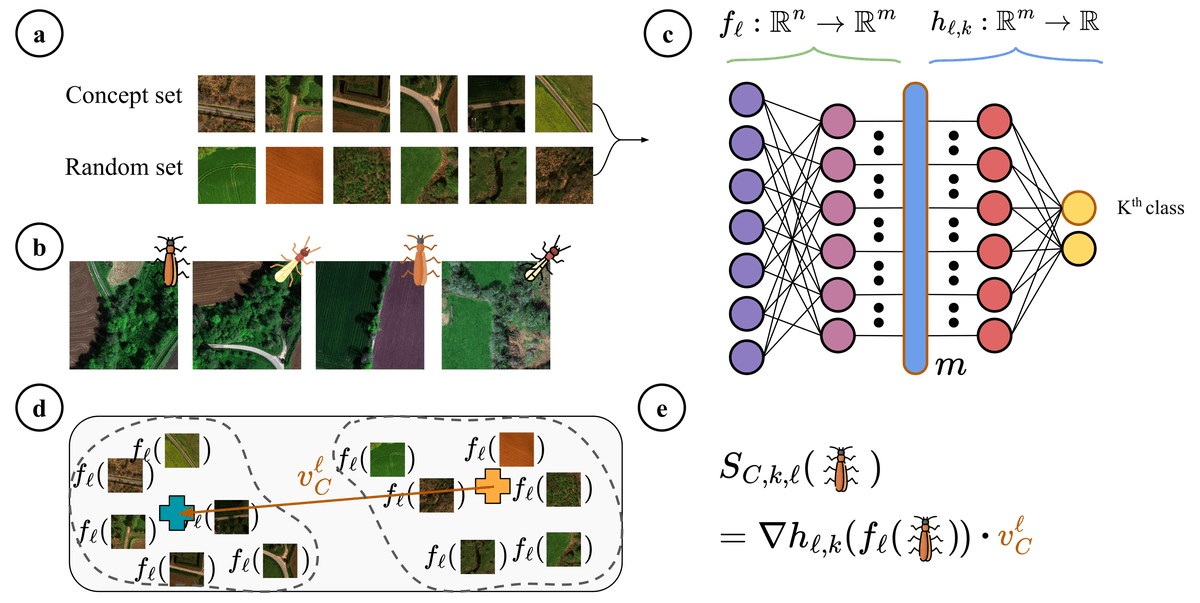
Deep learning has made species distribution models (SDMs) more accurate, but it has also turned them into black boxes that ecologists struggle to trust. A new paper introduces concept-based explainable AI for SDMs, pairing a fresh high-resolution landscape dataset with the Robust TCAV method to reveal which habitat concepts actually drive a model's predictions.
SDMs are the primary tools for mapping species, and they serve two purposes: achieving robust predictive performance and providing ecological insight into what drives distribution. The rising complexity of deep learning has made those insights harder to extract. Traditional methods like Random Forests let you inspect feature importance directly. Swap in a CNN or ViT on multispectral imagery and that transparency disappears, which becomes a problem when the output is going to inform conservation policy or invasive species management.
Why pixel-level explanations fall short
Attribution methods like LIME and SHAP have been used on tabular SDMs, but on image-based models they highlight individual pixels. Ecologists want to know whether hedgerows, wetlands, or roads matter, not which of a million pixels lit up. Concept-based XAI, and specifically Testing with Concept Activation Vectors (TCAV), addresses this by measuring how a prediction shifts along a direction in latent space that represents a human-defined concept. The catch: you need a concept dataset, and none existed for landscape ecology.