
Robotics and AI Institute Trains Robot Detectors From 15-Second Human Videos
A self-supervised robotics pipeline trains a bespoke object detector from a single human demo video, skipping the language-prompting problem entirely.
 Pro
Takeaways
- Robotics and AI Institute presents Show, Don't Tell, a self-supervised pipeline for novel object detection from human demos.
- SODC pipeline uses HOIST-Former, SAMURAI tracking, and DBSCAN clustering to auto-label demo videos.
- Fine-tunes a Faster R-CNN detector (MOD) in 3-4 minutes on 4 T4 GPUs from a single 15-second video.
- MOD beats RexOmni, GroundingDINO, and YoloWorld on novel-object mAP and mAR across three datasets.
- Human prompting study: 43% of novel objects could not be described well enough for VLMs to detect.
- Full on-robot pipeline runs on Boston Dynamics Spot; ChatGPT-4o generates the pick-and-place plan skeleton.
Getting a robot to recognize a novel object shown to it by a human is deceptively hard. Closed-set detectors fail because the object was never in their training data. Vision-language models can sometimes handle it, but only if you can describe the thing in words the model already understands. Try prompting one to find a specific piece of a custom-built construction toy and you will quickly discover the limits of natural language.
A team at the Robotics and AI Institute has a workaround: stop trying to describe the object, and instead let the robot watch a human handle it. Their paper, Show, Don't Tell: Detecting Novel Objects by Watching Human Videos, presents a self-supervised pipeline that turns a single 15-second demonstration into a working, task-specific object detector, and then runs it on a real robot performing pick-and-place sorting.
Why prompting VLMs breaks down
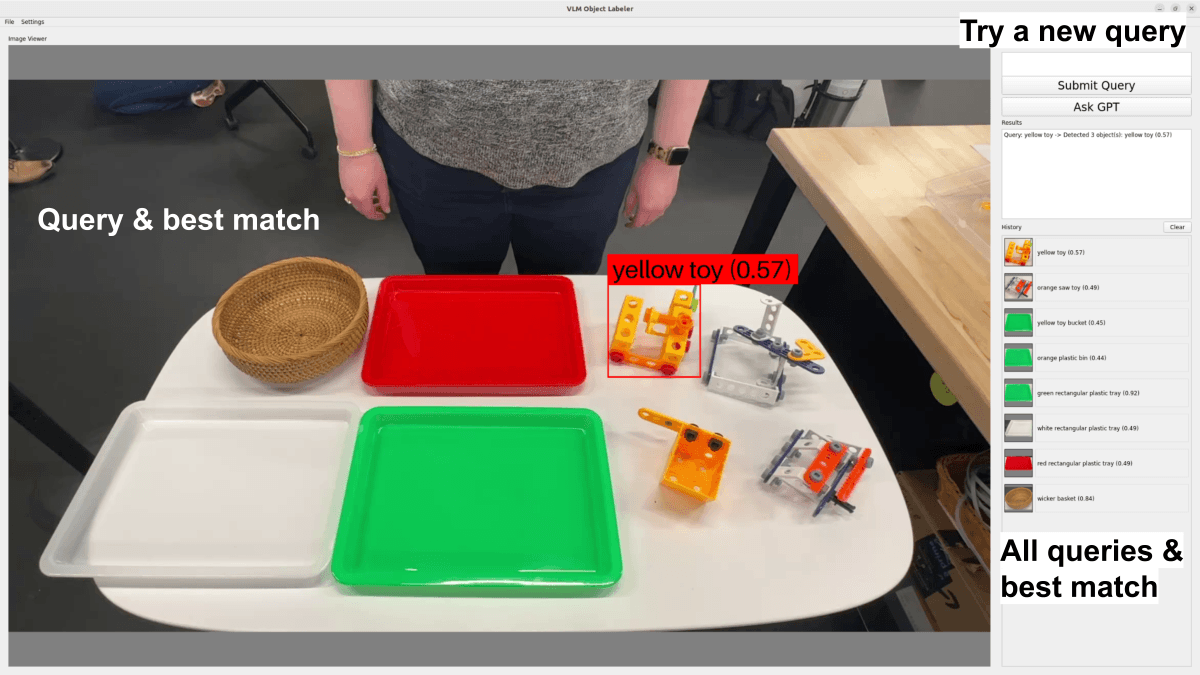
The authors ran a revealing study to justify the whole project. They gave 16 participants an interactive tool and asked them to write natural-language prompts that would let GroundingDINO or Detic detect novel construction-kit objects. Common items like a mug or a drill hit a near-perfect 99.5% success rate, with 92.4% of prompts working on the first try. The novel construction objects were a different story: only 57% ever got detected within five attempts, and 43% failed entirely.
Interestingly, longer, more detailed prompts did not help. Successful prompts on novel objects averaged 3.6 words while failed ones averaged 4.4. What did work was creative metaphorical language, calling an object a "sled" or "claw" or "shoe" rather than describing its parts. That is basically an art, not an engineering process, and it does not scale to a robot that needs to work on the job.
Show, don't tell
The core insight is to bypass language altogether. If a human is demonstrating a task on video, the objects they grasp are, by definition, the task-relevant ones. Use that grasp as a supervision signal, auto-generate a labeled dataset, and fine-tune a lightweight detector on the spot. The system has three components stitched together:
- SODC (Salient Objects Dataset Creation): Extracts grasped objects from a demo video and produces labeled bounding boxes.
- MOD (Manipulated Objects Detector): A Faster R-CNN with a ResNet50 backbone, fine-tuned on the auto-generated dataset.
- On-robot integration: An LLM-generated plan skeleton plus a scene graph that runs everything on a Boston Dynamics Spot.

How the dataset builds itself
The SODC pipeline runs in three stages. First, HOIST-Former is used as an off-the-shelf hand-object interaction detector to produce a segmentation mask for whatever the human is grasping in each frame. Every frame is treated independently since the authors found HOIST-Former's temporal labels too noisy to trust.
Second, each grasp mask is used as a seed for SAMURAI, a zero-shot mask tracker, running both forward and backward through the video. This lifts detections out of the hand-occluded frames and into clean views of the object sitting on a table. The catch: you end up with far more tracks than objects because each object gets seeded from many frames.
Third, tracks are consolidated. The pipeline runs DBSCAN twice, once spatially using bounding-box IoU as the distance metric, then temporally by comparing per-frame cluster memberships with a Jaccard score. Tracks that traverse the same spatial clusters across frames are grouped into a single object identity. The combination is robust to brief occlusions and to moments when two different objects happen to overlap in one frame.

The output is a dataset of images with clean bounding boxes and stable IDs for every object the human touched. Training the detector takes about 3-4 minutes on 4 T4 GPUs, with heavy augmentation (color jitter, random crops, affine and perspective transforms) to help it generalize to the robot's viewpoint.
The numbers
The evaluation compares MOD against three VLM baselines: RexOmni, GroundingDINO, and YoloWorld, each tested with both GPT-generated prompts and human-tuned prompts. Across three datasets (the public Meccano dataset plus two in-house sets), MOD achieves higher mean average precision and mean average recall than every baseline on the in-house datasets, at any prompt quality and any model scale.
On absolute numbers, mAP looks low across the board (0.10-0.15 for MOD on the in-house sets), but that is largely because the objects are compositionally novel assembly parts that stress-test every detector. The VLMs tend to either miss the objects entirely (YoloWorld) or get category-level hits while confusing similar instances (RexOmni, GroundingDINO). MOD, having been trained on the specific instances, disambiguates them.
Speed matters for on-robot use. MOD runs inference in about 100ms per image, tied with YoloWorld and roughly 4x faster than GroundingDINO and 10-20x faster than RexOmni.
Running it on a real robot
The full application uses ChatGPT-4o to generate a plan skeleton from the demo video, a sequence of picks and places where pick targets are referred to by MOD IDs and place targets are semantic strings like "basket" that a VLM can locate. The robot then executes the sort in a new environment, potentially with a different-shaped basket than the human used.
The whole pipeline (dataset creation, MOD training, plan generation) takes 4-7 minutes on a 15-second demo video. A scene graph aggregates detections over time with a frame-fitness check based on segmentation and per-pixel confidence scores, and enforces a group-acceptance rule so that all MOD-relevant objects must be visible simultaneously before any is committed to the graph. That last trick materially cuts inter-object confusion.
Limits and open questions
The system still needs some human supervision at deploy time. MOD can overfit to the viewpoints seen in the demonstration, so if the robot approaches an object from an unusual angle it may miss the detection and require teleoperation. Operators can also intervene to lock in a good detection or remove a spurious one. There is also the built-in assumption that only one instance of each object appears in the scene.
The authors point out that the SODC pipeline is more general than the specific MOD instantiation. The same auto-labeled dataset could feed visual prompting of a VLM, be used to build a codebook of object embeddings, or fine-tune something other than Faster R-CNN. And the "objects of interest" signal does not have to be grasping. Anything that seeds a sparse mask, gaze fixation, an attention heatmap, could plug into the same tracking-and-clustering machinery.
The result is a practical answer to a specific but common problem: how to make a robot recognize things that no one has bothered to name yet.