
RoboStream Gives Robot Brains Persistent 3D Memory, Hitting 90.5% Success
A training-free framework gives vision-language planners persistent 3D memory, jumping long-horizon success rates from 11% to 44% on real-world block tasks.
 Pro
Takeaways
- RoboStream adds persistent 3D memory to VLM planners without any fine-tuning, using object-centric tokens and a causal scene graph.
- Hits 90.5% on long-horizon RLBench vs 28% for SoFar and 26.5% for VoxPoser.
- Scores 44.4% on hard real-world block building; SoFar and VoxPoser both stall at 11.1%.
- On hide-and-restore under occlusion, RoboStream-235B reaches 88.9% while baselines score 0%.
- Ablation shows removing the causal graph collapses success from 90.5% to 14.5% at 235B scale.
- Works with frozen Qwen3-VL backbones; project page at robostream123.github.io.
Vision-language models have become the default brain behind robot planners, but ask one to stack seven blocks in sequence and it tends to fall apart. A new paper called RoboStream pinpoints why: current VLM planners treat every step as a fresh photograph, re-inferring the geometry of the scene from raw pixels and forgetting how their own actions have reshaped it. The authors propose a training-free wrapper that fixes this by giving the planner a persistent 3D memory, and the numbers are striking.
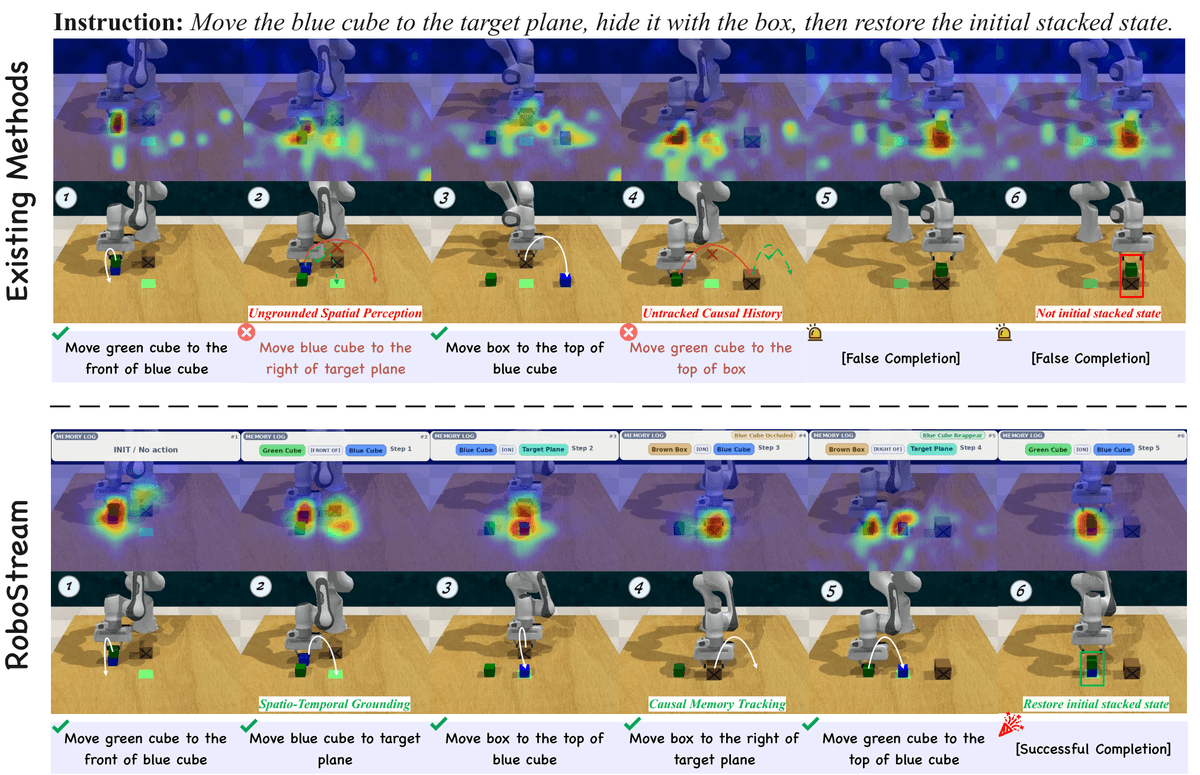
On a long-horizon RLBench suite, RoboStream hits a 90.5% average success rate. SoFar and VoxPoser, two well-known baselines, come in at 28.0% and 26.5%. On a real-world Franka arm doing hard block-building, RoboStream reaches 44.4% where both baselines are stuck at 11.1%. And on tasks that hide a block under a cup and ask the robot to restore the scene later, the baselines score literally zero.
Why VLM planners keep forgetting
The paper identifies two failure modes that compound over long sequences. The first is ungrounded spatial perception: current systems infer spatial relations implicitly from images without geometric anchoring or cross-step identity binding, forcing geometry reconstruction from raw pixels at every step where small inaccuracies accumulate into spatial hallucinations. The second is untracked causal history. Actions irreversibly alter the environment, yet existing methods keep no record linking actions to induced state transitions, so planners remain unaware of displaced objects and lose track of occluded ones entirely.
The human analogy the authors lean on is object permanence. If you put a cube under a cup, you don't forget where it went. VLM planners, working purely observation-to-action, effectively do.
Two mechanisms, no training
RoboStream introduces two components that plug into the VLM planning loop without any fine-tuning:
- Spatio-Temporal Fusion Tokens (STF-Tokens): per-object primitives that bind visual appearance to 3D geometry. Each token packages the object's masked visual features, its centroid in 3D space, a Gaussian shape descriptor along each axis, and a timestamp.
- Causal Spatio-Temporal Graph (CSTG): a scene graph over these tokens that maintains persistent object identities across steps and logs semantic events like planned displacement, unintended collision, occlusion, and subtask completion in a sliding-window memory.
Rather than traditional bounding boxes, the shape vector uses Gaussian distribution parameters and geometric extrema along each spatial axis, which captures geometric extent more completely while the joint mean-standard-deviation encoding suppresses outlier noise. Centroids come from the median of an object-specific point cloud extracted via SAM3 masks and depth.

The pipeline, step by step
- Object-centric perception: The VLM identifies task-relevant objects and emits open-vocabulary descriptors, which condition SAM3 to produce per-object masks. Depth turns those masks into 3D point clouds.
- Token fusion: For each object, masked patches with high IoU against the mask are aggregated into a visual embedding, then serialized alongside the centroid and Gaussian shape into a single language-space token sequence.
- Graph update: New STF-Tokens are merged into the CSTG, where nodes carry a sliding-window buffer of past tokens and edges encode pairwise distance and directional offset. Events are detected by comparing tokens across the window.
- Causal reasoning: The VLM receives the CSTG plus the current annotated observation and performs chain-of-thought spatial verification, checking action preconditions before generating a semantic action directive.
- Deterministic execution: The semantic directive is resolved into a 6-DoF pose by looking up the referenced object's geometry in the graph, keeping semantic reasoning separate from precise coordinate extraction.
What the ablations actually show
The ablation study is where the real story lives. On the 235B backbone, stripping the CSTG drops average success from 90.5% to 14.5%. Stripping only the STF-Tokens costs 11 percentage points. Removing both yields 12%. This shows that STF-Tokens still provide marginal improvement in short-horizon spatial accuracy even when long-horizon logic fails, but their full potential is unlocked only when coupled with the CSTG, where CSTG ensures correct action sequencing and STF-Tokens ensure each step is executed with deterministic spatial precision.

Perhaps more interesting for practitioners: an 8B RoboStream substantially beats a 235B baseline without the memory scaffolding. Even the smallest variant substantially exceeds much larger baselines, demonstrating that spatio-temporal reasoning and structured memory are more critical for physical consistency than simply increasing parameter scale.
Where it fits, and where it breaks
RoboStream is aimed squarely at long-horizon manipulation where preconditions matter: multi-step assembly, disassembly, and any task where objects get occluded mid-sequence. It runs on top of any capable VLM (the paper uses Qwen3-VL at 8B, 32B, and 235B) without fine-tuning, which makes it appealing if you already have a manipulation stack built around a frozen model.
The limitations are honest. As a decoupled planner-executor, failures in any submodule cascade: roughly 20.7% of real-world failures come from object parsing and detection errors under color-similar distractors or severe occlusion, 16.3% from inaccurate placement pose offsets, 14.1% from unstable grasps, 5.4% from motion planning, and 43.5% from the VLM itself producing spatial hallucinations or forgetting states. Runtime is also non-trivial. On an A100 with the 8B backbone, a single planning step averages 7.6 seconds, dominated by VLM inference. That is fine for research and slow assembly tasks, but not for reactive control.
Code and a full project page are teased at the RoboStream website, though a public repo has not yet been released alongside the paper. For anyone working on VLM-based manipulation, the ablation table alone makes a compelling case: persistent memory and geometric anchoring may be doing more work than the next backbone upgrade.