
Rmax-RAVI-UCB Finally Cracks Infinite-Horizon RL's Hardest Open Problem
A new algorithm delivers the first computationally efficient, rate-optimal regret bound for infinite-horizon linear MDPs, closing a longstanding gap in RL theory.
 Pro
Takeaways
- First computationally efficient, rate-optimal algorithm for infinite-horizon discounted linear MDPs.
- Regret scales as sqrt(d^3 * H^3 * K), matching the known lower bound in epsilon.
- Combines UCB exploration bonuses with Rmax-style transitions to an artificial heaven state.
- Output policy is compact: one d-dim vector plus a d x d covariance matrix.
- Guarantees hold under adversarial rewards, enabling application to imitation learning.
- New imitation-learning-from-features-alone algorithm achieves matching upper and lower bounds.
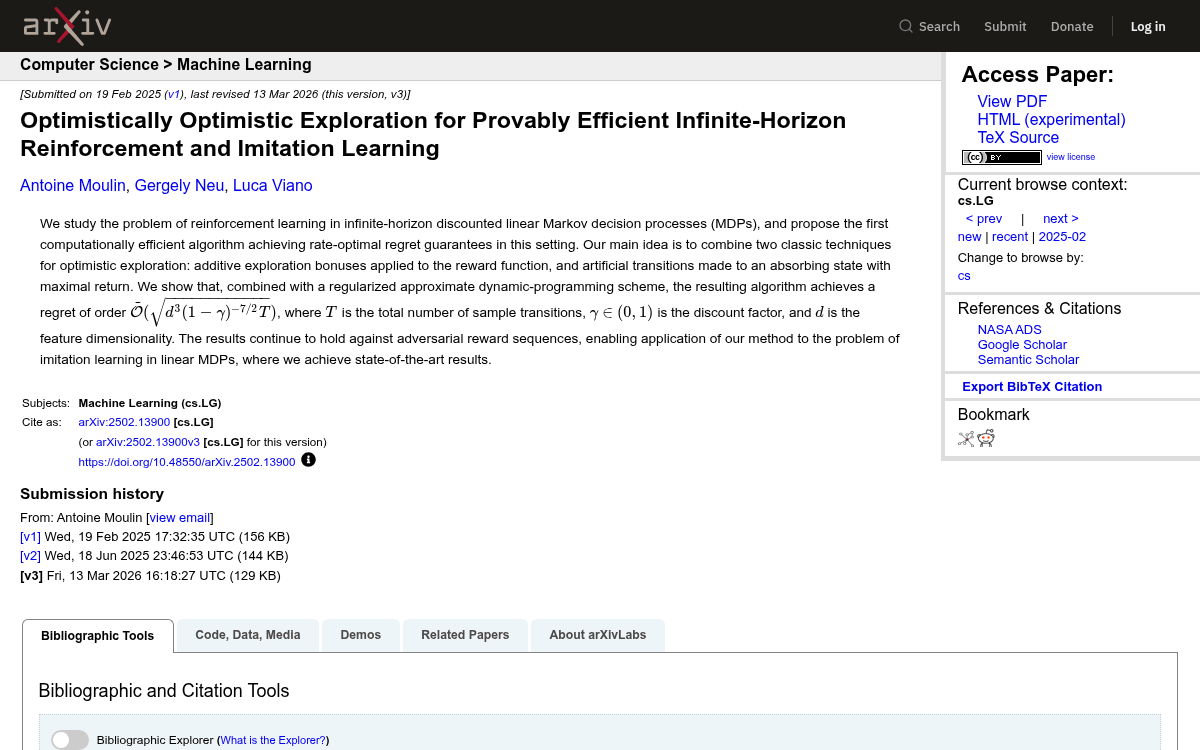
Reinforcement learning theory has spent years chasing a specific prize: a computationally tractable algorithm that provably learns near-optimal policies in infinite-horizon discounted linear Markov decision processes, at the best possible rate. A new paper from Antoine Moulin, Gergely Neu, and Luca Viano, presented at the Annual Conference on Learning Theory, finally delivers one. The algorithm, called Rmax-RAVI-UCB, combines two ideas from very different eras of RL theory to sidestep a technical roadblock that has stalled progress since 2019.
The gap that would not close
Linear MDPs, introduced by Jin et al. in 2019, model the transition kernel and rewards as linear functions of a known feature map. This class became a standard testbed for RL theory because it captures large state spaces while remaining analyzable. Hundreds of follow-up papers have studied variations of this model, but practically all of them retained one major limitation of the original work: it only applies to finite-horizon MDPs. Generalizations to the more challenging (and practically much more popular) infinite-horizon MDP models have so far remained very limited, yielding only highly impractical methods or suboptimal performance guarantees.
The infinite-horizon discounted setting is the version most practitioners care about, since it corresponds to learning a single stationary policy that maximizes discounted return. Prior algorithms for this setting either burned unreasonable amounts of compute or gave regret bounds that scaled worse than the theoretical lower bound.
Two flavors of optimism, one algorithm
The core technical trick is to layer two classic exploration mechanisms on top of a regularized dynamic programming scheme:
- First-degree optimism. Standard upper-confidence-bound bonuses are added to the reward function, following the recipe from linear bandits and Jin et al.'s finite-horizon analysis.
- Second-degree optimism. The team resurrects an idea from the Rmax algorithm of Brafman and Tennenholtz (2002): whenever a state-action pair is poorly explored, they inject an artificial transition to a fictional "heaven" state that yields maximal return forever.
Why bother with both? The authors explain that empirical estimates in linear MDPs tend to have extremely high variance in under-explored states, which can only be offset with very large additive exploration bonuses. Their Rmax-style scheme counteracts these large bonuses by effectively swapping out the possibly over-optimistic estimates obtained via additive bonuses with more reasonably sized estimates. In short, the bonus term pushes exploration in the right direction, and the heaven state keeps the value estimates from blowing up.
Concretely, the ascension probability into heaven is set as a sigmoid of the exploration bonus, so highly uncertain state-action pairs get replaced by a bounded optimistic value while well-explored ones use the ordinary least-squares model estimate. This is combined with the regularized approximate value iteration procedure from Moulin and Neu's earlier work.
The regret bound
The main theorem gives, with high probability, a regret of order roughly sqrt(d^3 * H^3 * K) + sqrt(d * H^{9/2} * K * log|A|), where d is the feature dimensionality, H = 1/(1 - gamma) is the effective horizon, and K is the number of episodes. Translated to sample complexity, learning an epsilon-optimal policy needs on the order of (H^3 * d^3 + H^{9/2} * d * log|A|) / epsilon^2 episodes.
Two things make this bound notable:
- The
1/epsilon^2scaling matches the known lower bound from Azar et al. (2012), so this is the first rate-optimal result for a computationally efficient algorithm in this setting. - The output policy is a single softmax parameterized by a
d-dimensional vector and ad x dcovariance matrix. Contrast this with most competing methods that use clipped value functions requiring the entire history of parameters to store and sample from.
Why a compact policy matters
The compactness of the final policy is not a cosmetic detail. Most other known algorithms making use of softmax policies crucially rely on clipped value-function estimates that cannot be stored or sampled from efficiently, as they require storing the entire history of parameter vectors and exploration bonuses. That history-dependence has been the source of both impractical implementations and suboptimal regret. The Rmax-style truncation replaces clipping with a smoother mechanism that keeps values bounded without inflating the effective policy class.
Adversarial rewards and imitation learning
The regret bound holds even when the reward function is chosen adversarially between episodes. That property is what enables the paper's second contribution: an algorithm called FRA-IL for imitation learning from features alone. Here the learner sees only feature vectors of expert states, not the expert's actions. This matters because in robotics, a features-only dataset describing a manipulation task can be collected easily via cameras and sensors, whereas collecting actions on top of features is more challenging as it requires knowledge of the internal dynamics of the observed robots. Another example is learning to drive from video footage of a car without steering-wheel signals.
FRA-IL runs Rmax-RAVI-UCB against a reward player that uses projected online gradient descent to fit rewards matching the expert's feature expectations. The paper proves it produces an epsilon-suboptimal policy with about d^3 * H^{9/2} / epsilon^2 MDP interactions and W_max^2 * H^2 / epsilon^2 expert samples. Matching lower bounds show both scalings are optimal in epsilon, and that purely offline learning is impossible when actions are not observed.
What this is and is not
This is a theory paper. There is no released code, no benchmark numbers, and the experiments section is essentially the regret proof itself. If you build applied RL systems, the immediate takeaway is architectural rather than practical: the heaven-state trick is a clean alternative to value clipping when you need bounded estimates without exploding policy complexity.
The authors are candid about limitations. The H^{9/4} factor in the regret bound is probably loose, and extending the technique to the undiscounted average-reward setting has so far failed. But the reintroduction of Rmax-style reasoning into modern linear-MDP analysis is likely to influence the next round of algorithms that try to close those remaining gaps.