
RLDP Beats Complex Zero-Shot RL Methods With a Simpler Two-Parameter Recipe
A regularized latent dynamics objective matches or beats complex zero-shot RL baselines while staying robust when data coverage is poor.
 Pro
Takeaways
- RLDP trains BFM state features using latent next-state prediction plus an orthogonality regularizer instead of Bellman backups.
- Naive latent prediction causes mild feature collapse where cosine similarity between states drifts up during training.
- The single orthogonality term keeps features diverse, preserving the span of representable reward functions.
- Matches FB, PSM, and HILP on DeepMind Control and SMPL humanoid zero-shot benchmarks.
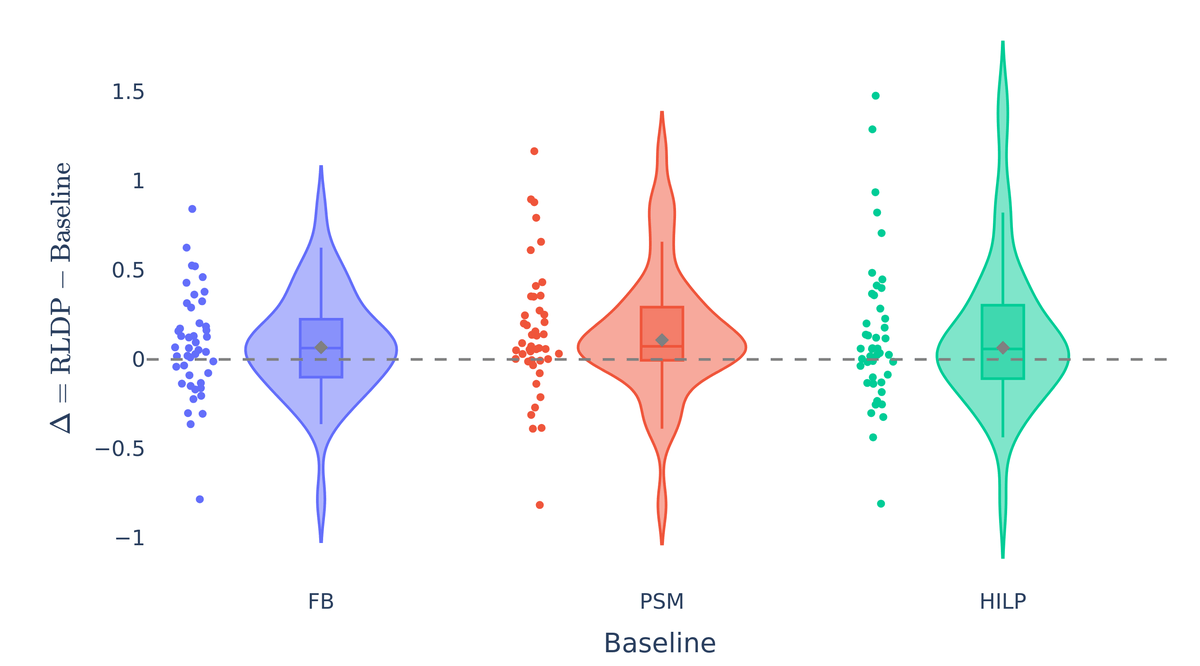
- Beats all baselines on 5 of 6 low-coverage D4RL locomotion tasks where Bellman-based methods break down.
- Full method and pseudocode available in the arXiv paper from Alberta, UT Austin, and UMass.
Behavioral Foundation Models promise a compelling deal: pretrain once on reward-free data, then hand the agent any new reward function at test time and get a near-optimal policy without further training. The catch is that this only works if the learned state features can actually express the reward you throw at them, which has pushed the field toward increasingly elaborate representation-learning recipes. A new paper from Alberta, UT Austin, and UMass Amherst argues that most of that complexity is unnecessary.
The team introduces Regularized Latent Dynamics Prediction (RLDP), a stripped-down alternative that trains state features by predicting the next state in latent space and adding a single regularizer to keep features from collapsing into near-duplicates. The result matches or surpasses state-of-the-art complex representation learning methods for zero-shot RL, and prior approaches perform poorly in low-coverage scenarios where RLDP still succeeds.
Why feature span is the whole ballgame
A BFM works by learning a state feature map and a policy conditioned on a latent task vector z, where any reward is approximated as a linear combination of the state features. At test time, given any reward function, the near-optimal policy is obtained zero-shot by solving for the z that makes the linear combination match the reward. That means the set of rewards you can solve optimally is exactly the span of your feature vectors. If features collapse toward each other, that span shrinks, and the BFM stops being general.
Existing top methods like Forward-Backward representations, PSM, and HILP handle this by learning features that predict successor measures, which capture the discounted distribution of future states a policy visits. Unfortunately, learning state representations by estimating successor measures requires iteratively applying Bellman evaluation or optimality backups, both of which are known to result in a variety of learning difficulties. Because the state representation is trained from a batch of offline data, unless chosen carefully, the policies may select out-of-distribution actions, leading to incorrect generalization and degenerate representations.
The simpler recipe
RLDP swaps Bellman backups for pure latent dynamics prediction. You train an encoder that maps states to a d-dimensional latent, plus a dynamics model that predicts the next latent from the current latent and action. Roll this forward for H steps and match against the encoded ground-truth future states. Because there's no policy in the loss, you avoid the out-of-distribution action problem entirely.

The problem is that naive latent prediction has a trivial solution: map everything to the same vector. Even with the stop-gradient tricks borrowed from self-supervised learning, the authors observed something subtler. While the solutions do not collapse, there is an increase in feature similarity over the course of learning, which they refer to as a mild form of collapse. That mild collapse still eats away at feature span, which quietly kills zero-shot performance.
Their fix is one extra loss term. They project features onto a hypersphere and penalize the cosine similarity between pairs of encoded states, so the final objective is just latent dynamics prediction plus a weighted orthogonality regularizer.

They also prove a theoretical result: minimizing the RLDP loss upper-bounds the prediction error of successor measures for any Lipschitz-valued policy. In other words, even though the objective never touches Bellman backups, the features it produces are provably useful for the successor-measure machinery that BFMs rely on downstream.
How it holds up on benchmarks
The authors benchmark against FB, PSM, and HILP across three setups: offline DeepMind Control tasks from the ExoRL suite, online zero-shot RL on a 358-dimensional SMPL humanoid using Meta's metamotivo dataset, and low-coverage D4RL locomotion tasks.
- Offline DMC: RLDP is competitive with FB and PSM across Walker, Cheetah, Quadruped, and Pointmass. It notably wins on Quadruped-Jump (733 vs 567 for FB) and Cheetah walk-backward.
- Humanoid: Across 45 SMPL tasks, RLDP is roughly on par with baselines on aggregate, winning on some tasks like raise-arms and lie-on-ground while all methods struggle on rotation and crawl tasks.
- Low-coverage D4RL: This is where RLDP pulls ahead. RLDP outperforms all baseline methods in 5 out of 6 tasks, and the overall mass of the violin lies above zero with a positive IQM.

Ablations confirm both components matter. For zero regularization the average return decreases compared to positive regularization, and orthogonality regularizer with lambda equal to 1 performs best. Removing the hyperspherical normalization on the dynamics head also degrades results, especially on Quadruped and Pointmass.
What this actually buys you
The practical story is that if you're building a BFM for a domain where your offline data doesn't densely cover the state-action space, methods that rely on Bellman backups over hypothetical policies will bootstrap on garbage. RLDP sidesteps that because its representation objective never queries a policy. You give up some peak performance in a few tasks where FB or PSM happen to be well-tuned, but you gain reliability across dataset regimes and a much simpler codebase, with essentially two hyperparameters to tune: the encoding horizon H and the regularization coefficient lambda.
The paper doesn't come with an accompanying open-source release referenced in the text, though the methodology and full pseudocode are laid out in the appendix in enough detail to reimplement on top of any existing FB-style BFM stack. For teams working on generalist robotic controllers or humanoid BFMs, RLDP is worth trying as a drop-in replacement for the representation-learning step before committing to a heavier successor-measure objective.