
Riemannian MeanFlow Shrinks Curved-Space AI Sampling to a Single Step
A new one-step generative model extends MeanFlow to spheres, tori, and rotation groups, cutting sampling from many ODE steps to a single network call.
 Pro
Takeaways
- Riemannian MeanFlow extends one-step MeanFlow generation to curved spaces like spheres, tori, SO(3), and SE(3).
- Average velocity is defined via parallel transport, yielding an intrinsic MeanFlow identity for supervision.
- Training uses log-map tangent representations and Jacobian-vector products, avoiding Christoffel symbols entirely.
- PCGrad-based multi-task optimization mitigates gradient conflicts between the two decomposed loss terms.
- Matches or beats G-LSD baseline on Earth, protein torsion, RNA, SO(3), and SE(3) grasping benchmarks.
- One-step DNA promoter generation reaches MSE 0.030, matching 100-step Fisher Flow Matching.
Flow matching has made generative modeling on curved spaces like spheres, tori, and rotation groups practical, but sampling still hurts. You train a velocity field, then integrate an ODE step by step to draw samples. On a manifold, each step needs geometric bookkeeping, and quality typically demands dozens of evaluations. A new paper, Riemannian MeanFlow (RMF), collapses that loop into a single forward pass.
The trick is to port MeanFlow, the Euclidean one-step generator from Geng et al., onto Riemannian manifolds. Naively that doesn't work, because velocities on a manifold live in different tangent spaces at every point and can't just be averaged. RMF gives a geometrically clean way to define and learn an average velocity anyway, then falls back to plain Euclidean autodiff at training time.
Why straight-line intuition breaks on a sphere
In Euclidean space, the average velocity over an interval is simply displacement divided by time. MeanFlow replaces the instantaneous velocity with an average velocity field, enabling one-step generation without iteratively solving an ODE at inference time. Train a network to predict that average, and you can jump from noise to sample in one call.
On a curved manifold, this definition collapses. Instantaneous velocities lie in point-dependent tangent spaces and must be compared under the Riemannian metric, so averaging vectors from different points is not even well-defined. Riemannian Flow Matching handles training just fine using closed-form geodesics, but sampling still requires numerically integrating the learned ODE on the manifold, which can be slow and may require many solver steps for high-quality samples.

Parallel transport as the fix
RMF defines the average velocity by parallel-transporting every instantaneous velocity along the trajectory back to a common tangent space, then averaging there. Parallel transport is the standard geometric tool for sliding a vector along a curve while keeping it "as parallel as possible" under the manifold's connection. From this definition, the authors derive a Riemannian MeanFlow identity that relates the average velocity to the instantaneous velocity via a covariant derivative along the path, which turns an intractable integral into a local supervision signal.
The practical trick is avoiding the messy geometry. Rather than working with Christoffel symbols and covariant derivatives directly, RMF represents nearby points through the logarithm map into the tangent space at the current point. That turns the required derivative into a plain Jacobian-vector product that any autograd framework can compute. Training reduces to sampling (x0, x1, r, t), forming x_t via the geodesic interpolation Exp_{x1}(kappa(t) Log_{x1}(x0)), and regressing the network against a JVP-based target.
Two loss terms that fight each other
Expanding the squared error in the RMF objective splits it into two components: a flow-matching-style term that pushes the network toward the instantaneous velocity, and a cross term that enforces the average-velocity identity. In practice the gradients of these two terms often point in opposite directions. The authors verify this by tracking the cosine similarity between the two gradient vectors during training, and it dips well below zero on real data.

Their fix is to treat the decomposition as a two-task learning problem and apply PCGrad, which projects each gradient onto the orthogonal complement of the other whenever they conflict. The result, called RMF-MT, adds only a couple of inner products per step. RMF also supports classifier-free guidance for conditional generation by combining conditional and unconditional predictions in the shared tangent space.
How it holds up in practice
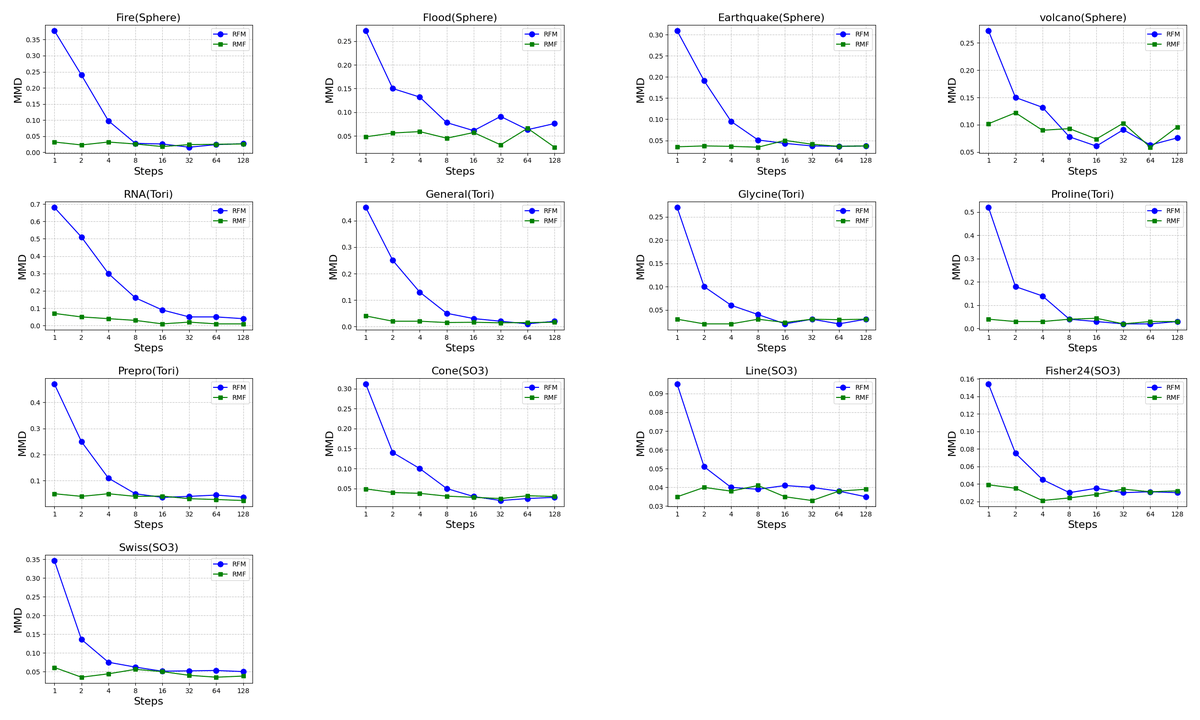
The team evaluates on four manifold families using Maximum Mean Discrepancy with a geodesic RBF kernel at one sampling step (1 NFE):
- Sphere (Earth disaster data on S2): RMF wins on Volcano at 0.092 MMD, and RMF-MT takes Flood at 0.048, beating Riemannian Flow Matching (0.272-0.377) by a wide margin.
- Torus (protein and RNA torsion angles): RMF-MT matches or beats the strongest baseline G-LSD on Glycine, Proline, PrePro, and wins outright on the 7D RNA backbone dataset at 0.07 MMD.
- SO(3) synthetic rotation datasets: RMF-MT achieves the best MMD on Fisher and Line, and improves consistently over vanilla RMF.
- SE(3) robotic grasping from the ACRONYM dataset: RMF hits a 65% grasp success rate at one step, versus 3.2% for RFM and 60% for G-LSD.
A hyperspheres ablation up to S127 suggests the method scales with intrinsic dimension. Euclidean MeanFlow degrades badly past d=64, while RMF stays stable. On a real high-dimensional promoter DNA task (1024x4), RMF matches Fisher Flow Matching's MSE using a single step instead of 100.
The caveats worth knowing
The tangent-space JVP surrogate isn't exact. The paper proves the discrepancy grows with local curvature, path speed, and interval length squared, meaning long-range one-step generation on highly curved regions can accumulate bias. Practically, this means shorter intervals or a few-step regime may be safer on strongly curved manifolds. Also, conflict-aware optimization isn't always a win. On the tiny 827-sample Volcano dataset, plain RMF beats RMF-MT, and on SE(3) grasping, RMF-MT fits the pose distribution better but yields lower physical success, likely because grasp validity depends on collision geometry rather than distribution matching.
The authors don't currently link a public code release in the paper, though the geodesic operators rely on the open-source Geomstats library, which should make reproduction relatively straightforward for anyone already working with Riemannian generative models.