
Rice University's FLASK Plans Robot Arm Trajectories in 90 Microseconds
A new sampling-based motion planner uses differential flatness and CPU vectorization to produce dynamically feasible robot trajectories in microseconds.
 Pro
Takeaways
- FLASK plans dynamically feasible robot trajectories in microseconds to milliseconds on consumer CPUs, no GPU needed.
- Uses differential flatness to turn nonlinear BVPs into closed-form polynomial solutions.
- SIMD parallelism enables fast collision checking on multiple states along each polynomial local path.
- Works with any sampling-based planner; demonstrated with RRT-Connect and SST* variants.
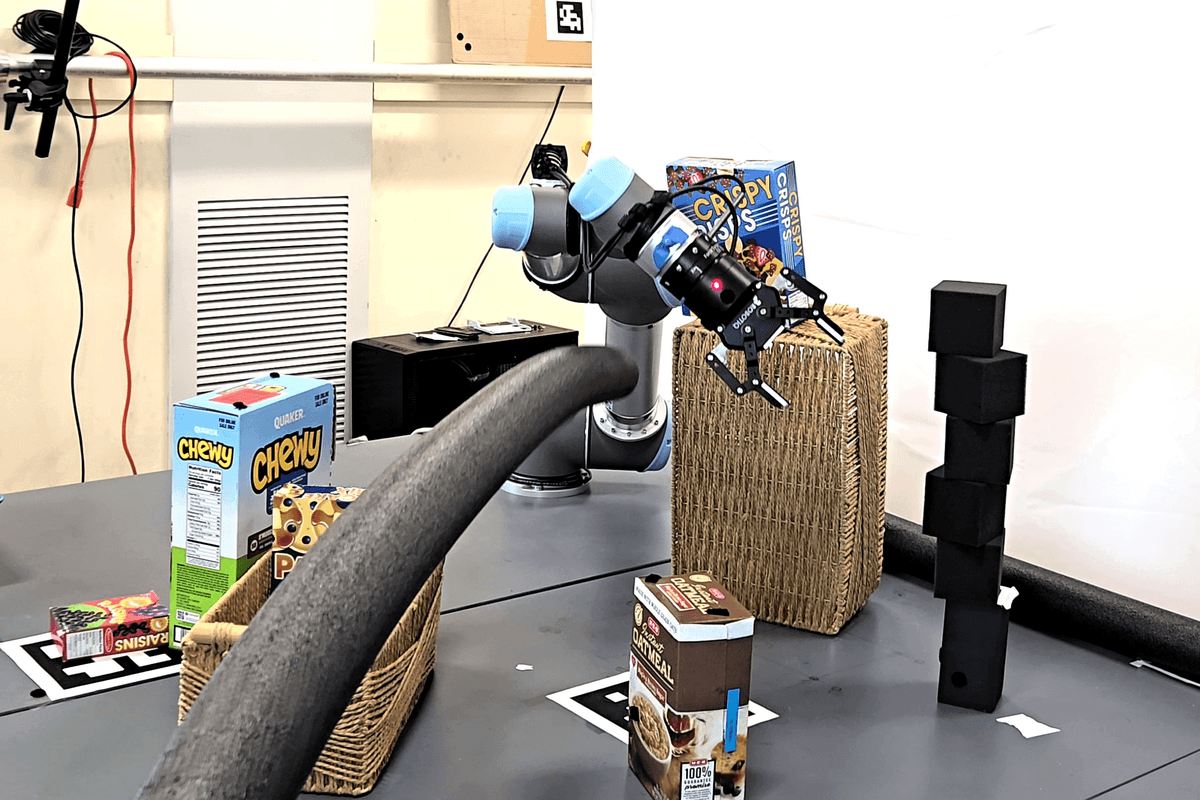
- UR5 pick-and-place with moving obstacles plans in ~90 microseconds, ~40 microseconds simplification.
- Preserves probabilistic exhaustivity and asymptotic optimality guarantees; code to be released publicly.
Motion planning is one of those problems where the demos look easy but the numbers are ugly. Getting a real robot arm to move safely through cluttered shelves, avoiding both static and moving obstacles, usually means either running a slow optimizer or accepting a geometric path that the robot can't actually track without overshooting into a box. A team at Rice University's Kavraki Lab has released FLASK, a sampling-based kinodynamic planner that produces dynamically feasible trajectories in microseconds to milliseconds by combining a classic control-theory trick with modern CPU vectorization.
FLASK stands for "Differential Flatness-based Accelerated Sampling-based Kinodynamic Planning" and works for a broad class of differentially flat systems including manipulators, ground vehicles, and quadrotors. On a UR5 arm doing a reactive pick-and-place with moving obstacles, planning takes roughly 90 microseconds and trajectory simplification another 40. That is not a typo.
Why kinodynamic planning has been stuck
Geometric planners like RRT-Connect find a collision-free path through configuration space. That works until you try to execute it: sharp corners and ignored velocity or acceleration limits mean the controller overshoots and hits things. Kinodynamic planning enforces the robot's dynamics inside the planner, so the output is a trajectory the controller can actually track.
The catch is that connecting two states under nonlinear dynamics requires solving a two-point boundary value problem, or BVP. Solving the BVP is often computationally intractable, so most kinodynamic planners take a propagation-based approach where they integrate a randomly sampled control input for a short time rather than connecting sampled states. That random sampling causes the planner to wander through state space, blowing up planning time.