
RESQ Shields Edge AI from Both Hackers and Cosmic Rays at Once
A three-stage training pipeline makes quantized neural networks resist both adversarial inputs and hardware bit-flips, with up to 12.47% reliability gains.
 Pro
Takeaways
- RESQ unifies adversarial defense and hardware fault tolerance into one training pipeline for quantized neural networks.
- Three stages sequence BPFC adversarial training, fault-aware fine-tuning with frozen critical layers, and quantization with MSB triple redundancy.
- Gains reach 10.35% for attack resilience and 12.47% for fault resilience across ResNet-18, VGG-11, EfficientNet, and Swin-Tiny.
- Critical layers identified via exponential moving average of gradient norms concentrate in early residual blocks.
- Key asymmetry: fault-aware training improves adversarial robustness too, but the reverse does not hold.
- Evaluated on CIFAR-10, CIFAR-100, and GTSRB against FGSM, IFGSM, PGD, BIM, and MIM attacks.
Deploying neural networks at the edge has always come with two nasty problems that researchers usually treat as separate. Adversaries can craft imperceptible input perturbations that fool your classifier, and cosmic-ray-induced bit-flips can silently corrupt weights sitting in memory. A new framework called RESQ tackles both at once, and the results reveal a surprising asymmetry between the two problems.
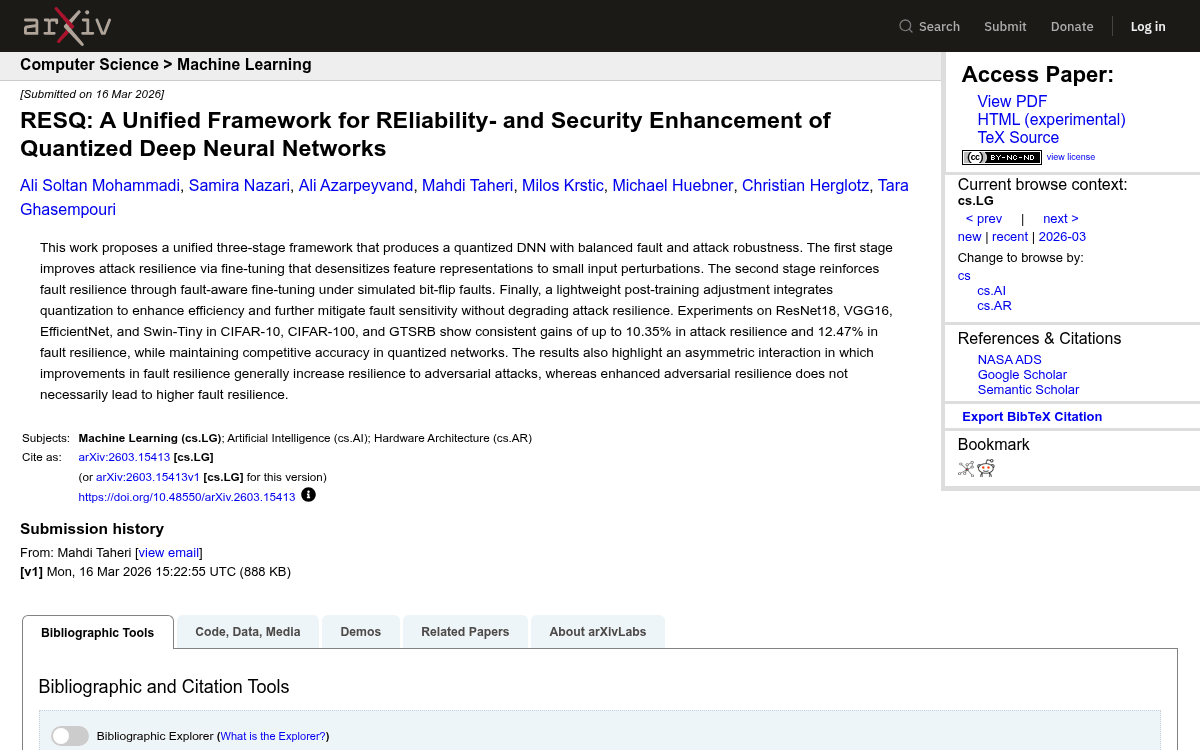
The authors propose a unified three-stage framework that produces a quantized DNN with balanced fault and attack robustness. Across four architectures and three datasets, they report consistent gains of up to 10.35% in attack resilience and 12.47% in fault resilience, while maintaining competitive accuracy in quantized networks. More interestingly, the pipeline exposes an interaction that most prior work has ignored.
Two threats, one model
Quantized networks are attractive for edge deployment because low-precision weights slash memory and energy costs. But shrinking the numerical representation makes each bit count more. Reducing precision introduces numerical instabilities, such as larger relative changes in weight values after small perturbations, increased sensitivity to bit flips in the most significant bits, and abrupt shifts caused by quantization-level boundaries. That fragility applies to both threat models.
The catch that motivates this work is that fixes for one problem tend to hurt the other. The authors' findings indicate that adversarial fine-tuning can reduce fault tolerance and that fault-aware training does not always preserve adversarial robustness. Training a model to ignore small input perturbations tends to make it more sensitive to weight perturbations, and vice versa.
The pipeline, stage by stage
RESQ threads that needle by ordering four training phases carefully:
- Stage 0 - Clean training with mixup. A standard pretraining pass using linearly interpolated sample pairs to smooth the decision boundary before any resilience objectives kick in.
- Stage 1 - Adversarial resilience via BPFC. The network learns to suppress sensitivity to LSB perturbations using BPFC, reducing vulnerability to adversarial attacks that operate on visually imperceptible bit changes. Bit Plane Feature Consistency forces the pre-softmax activations to match between an input and a version with its lowest bits stripped, pushing the model to rely on high-magnitude bits that adversaries cannot easily touch without being seen.
- Stage 2 - Fault-aware fine-tuning with frozen critical layers. The model injects random bit-flips into weights during forward passes at a configurable Bit Error Rate, and learns to produce consistent outputs anyway. The twist: layers most important for adversarial robustness are frozen so the fault training does not undo the previous stage.
- Stage 3 - Quantization plus MSB redundancy. A binary search picks the smallest bit width that meets accuracy and reliability thresholds, then the most significant bits get triplicated with majority voting at inference.
The critical-layer identification is a nice touch. An Exponential Moving Average of gradient norms is maintained for each layer, and layers whose smoothed gradient magnitudes exceed a threshold get frozen during Stage 2. The most critical layers are predominantly located in the early residual blocks, which form the core feature-extraction pathway and play a major role in preserving the adversarial invariances learned during BPFC.
The asymmetric finding
The most interesting result is not the headline percentage but the direction of the trade-off. Improvements in fault resilience generally increase resilience to adversarial attacks, whereas enhanced adversarial resilience does not necessarily lead to higher fault resilience. Fault-aware training does double duty; adversarial training does not.
That asymmetry has a practical implication. If you can only afford one form of hardening, fault-aware fine-tuning gives you a partial adversarial defense for free, while the reverse is not true.
Results across architectures
The framework was validated on ResNet-18, VGG-11, EfficientNet-B0, and Swin-Tiny across CIFAR-10, CIFAR-100, and GTSRB traffic signs. The fault-resilience numbers are the most striking. For ResNet-18 at the highest tested bit error rate, the accuracy increases from 9.99% to 74.71%. Swin-Tiny at BER 0.005 climbs from 44.50% to 62.46%. Even architectures with strong intrinsic tolerance, like EfficientNet, gain several percentage points.
Adversarial gains are also substantial on the weaker architectures. Q-FA-VGG11 improves from 36.92% to 50.94% under FGSM at epsilon 0.1, and Q-FA-EfficientNet jumps from 58.39% to 86.35% under the same attack at its own perturbation budget. Clean accuracy stays close to baseline throughout, with the exception of Swin-Tiny on CIFAR-100, which drops from 85.30% to 73.12% after the full pipeline.
Who should care
The target scenario is narrow but important: safety-critical edge deployments where both threat models are real. Think autonomous driving perception stacks, industrial robotics, or defense navigation systems where a bit-flip from radiation and a crafted adversarial patch are both non-hypothetical failure modes. The framework relies on well-known building blocks like BPFC and the earlier FORTUNE memory protection scheme, so integrating it into an existing training pipeline is more about staging the phases correctly than inventing new machinery.
Limitations worth flagging. The paper does not release code, evaluations top out at CIFAR-scale datasets, and the Swin-Tiny result shows that transformer-based vision models pay a real clean-accuracy tax under this pipeline. The adversarial evaluation also sticks to standard first-order attacks like FGSM, PGD, and BIM rather than adaptive attacks designed against the specific defense. Still, as a first serious attempt to unify fault and adversarial hardening for quantized networks, the asymmetric-resilience finding alone is worth internalizing.