
Researchers Tie AI Model Weights to Silicon so Stolen Copies Become Worthless
Researchers propose binding neural network weights to a chip's manufacturing fingerprint so stolen models fail to run on cloned hardware.
 Pro
Takeaways
- New scheme binds neural network weights to a chip's unclonable hardware fingerprint to block model theft.
- Selected weight bits are XOR-encrypted with a key derived from a Physically Unclonable Function on the target device.
- A fuzzy extractor with public helper data handles PUF noise so the key regenerates reliably across temperature and aging.
- Encrypting roughly 20 percent of weights is reported to cause significant accuracy degradation on cloned hardware.
- Related PUF-based schemes for binarized networks have already been broken by key-recovery attacks, raising security questions.
- Published in Springer LNBIP volume 505; no open-source reference implementation is provided.
Stealing a trained neural network can be as simple as copying a file. If a competitor clones the industrial hardware running your model, the weights ride along, and years of training data plus proprietary tuning walk out the door. A group of researchers from the Software Competence Center Hagenberg propose a countermeasure that makes those stolen weights numerically worthless on any chip other than the original one.
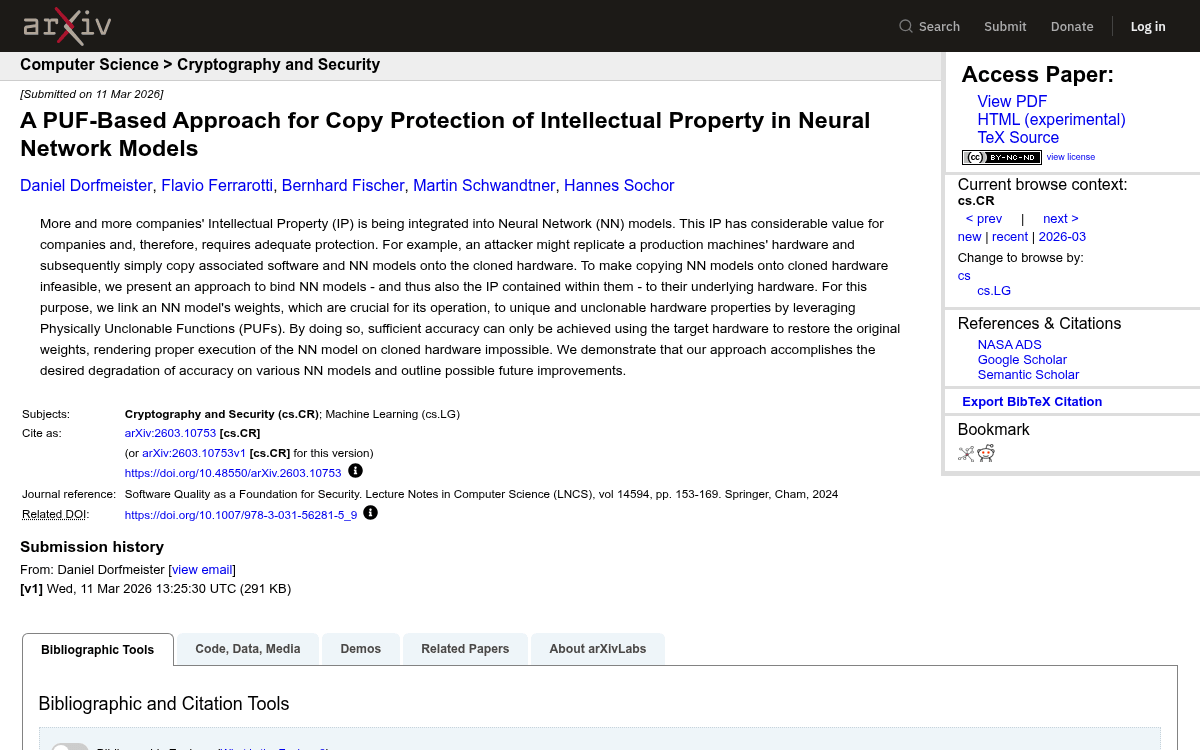
Their paper, A PUF-Based Approach for Copy Protection of Intellectual Property in Neural Network Models, argues that as more company IP gets baked into neural networks, protection is needed against attackers who replicate production hardware and simply copy the associated software and NN models onto the cloned hardware. Their fix is to tie the model's weights to physical quirks of the silicon it was trained to run on.
Turning silicon noise into a decryption key
The core primitive is a Physically Unclonable Function, or PUF. During chip fabrication, tiny random variations in gate delays, SRAM startup states, or ring oscillator frequencies produce a fingerprint that is unique to each die and effectively impossible to duplicate, even by the manufacturer. A PUF-based circuit can generate a unique and repeatable binary key based on manufacturing variations that are practically impossible to replicate. That key becomes a device-specific secret without ever being written to storage.
There is one catch: PUF responses are noisy. Temperature, voltage, and aging can flip bits between reads. The standard remedy is a fuzzy extractor, which stores public helper data alongside the device so that a slightly noisy PUF read can still be corrected back to the exact same key every time. The authors lean on this construction to make the binding reliable in the field.
Encrypting the weights that matter
The scheme works by binding the model to its underlying hardware by linking the network's weights to unique and unclonable hardware properties, so that sufficient accuracy can only be achieved when the target hardware restores the original weights. In practice, the authors XOR the binary representation of selected weights with bits derived from the PUF key. On the intended device, the PUF regenerates the key, the XOR reverses cleanly, and inference proceeds normally. On a cloned device, the PUF produces a different key, the weights decrypt to garbage floats, and accuracy collapses.
The pipeline looks roughly like this:
- At enrollment, read the PUF and generate a key plus public helper data.
- Pick a fraction of the model's weights, cast them to their bit representation, and XOR selected bits with the key.
- Ship the model with the helper data. The PUF key itself never leaves the chip.
- At inference, reconstruct the key from a fresh PUF read plus helper data, XOR the ciphertext bits back, and cast to float.
A useful property: you do not need to encrypt every weight. The authors report that encrypting a modest slice of parameters is enough to wreck the model. Their experimental discussion mentions that helper data for the model in one experiment at 20 percent encrypted weights already yields a significant degradation of the model. That matters because encryption and decryption add compute, and touching fewer weights keeps inference latency close to the unprotected baseline.
Where this fits, and where it breaks
PUF-based binding is aimed squarely at edge and embedded deployments: industrial controllers, medical devices, automotive ECUs, and any product where the hardware itself ships to customers or competitors who might reverse-engineer it. It is not designed to protect cloud-hosted models, defend against model extraction via API queries, or stop insider attacks that dump keys from a live device. It is a hardware-anchored copy protection layer, not a general DRM system.
The approach also sits in an active and somewhat contested research area. Similar schemes have been proposed for binarized neural networks on memristive crossbars, and a device-bind, key-storageless permute-diffusion encryption approach was published in 2022. Not all of them hold up: Rajendran et al. proposed a PUF-based scheme that secured BNN weight and bias matrices by swapping columns based on device PUF key bits, and a follow-up paper demonstrated it was vulnerable to a PUF-key recovery attack that recovered the secret weight and bias matrices. Any concrete instantiation of the Dorfmeister scheme will need similar scrutiny, particularly around whether the fraction of encrypted bits is high enough to prevent partial-recovery attacks and whether the helper data leaks structural information.
The real contribution
The headline is copy protection, but the more interesting piece is treating a neural network like any other piece of software that can be licensed to a specific device. The authors point out that a rather neglected aspect is that NN models can easily be copied and used without authorization, and that a pre-trained model is not fundamentally different from classical software beyond the fact that it is learned instead of programmed. Framing model IP as a software piracy problem opens the door to a large body of existing hardware-rooted licensing techniques, including PUF-FSM binding and pay-per-device licensing that FPGA vendors already use.
The paper itself is published in Springer's Lecture Notes in Business Information Processing, volume 505, and no reference implementation or model release is mentioned. Anyone wanting to reproduce this will need to wire up their own PUF, fuzzy extractor, and encryption layer, which is a nontrivial hardware engineering exercise but a well-trodden one for teams already shipping secure elements or FPGA-based accelerators.