
Researchers Reshape Swarm Robots in Sublinear Time Without Extra Assumptions
A new centralized algorithm reconfigures any connected amoebot structure into a line segment in O(√n log n) rounds, without metamodule assumptions.
 Pro
Takeaways
- New algorithm reconfigures any amoebot structure into a line segment in O(√n log n) rounds. Paper
- First sublinear universal reconfiguration in the geometric amoebot model without metamodule assumptions.
- Bonus result: spirals collapse to a line segment in constant time, independent of size.
- Introduces reusable constant-time primitives: tunneling, shearing, parallelogram, triangle, trapezoid.
- Result is centralized only; distributed versions face Ω(D) diameter lower bounds.
- Open-source AmoebotSim 2.0 supports simulating joint-movement algorithms.
Programmable matter sits somewhere between a physics thought experiment and a real engineering target: a swarm of identical robotic modules that collectively change shape on command. A new theoretical result pushes that goal a meaningful step closer by showing that shape reconfiguration can be done in sublinear time using only the intrinsic physics of the model, with no extra scaffolding assumptions.
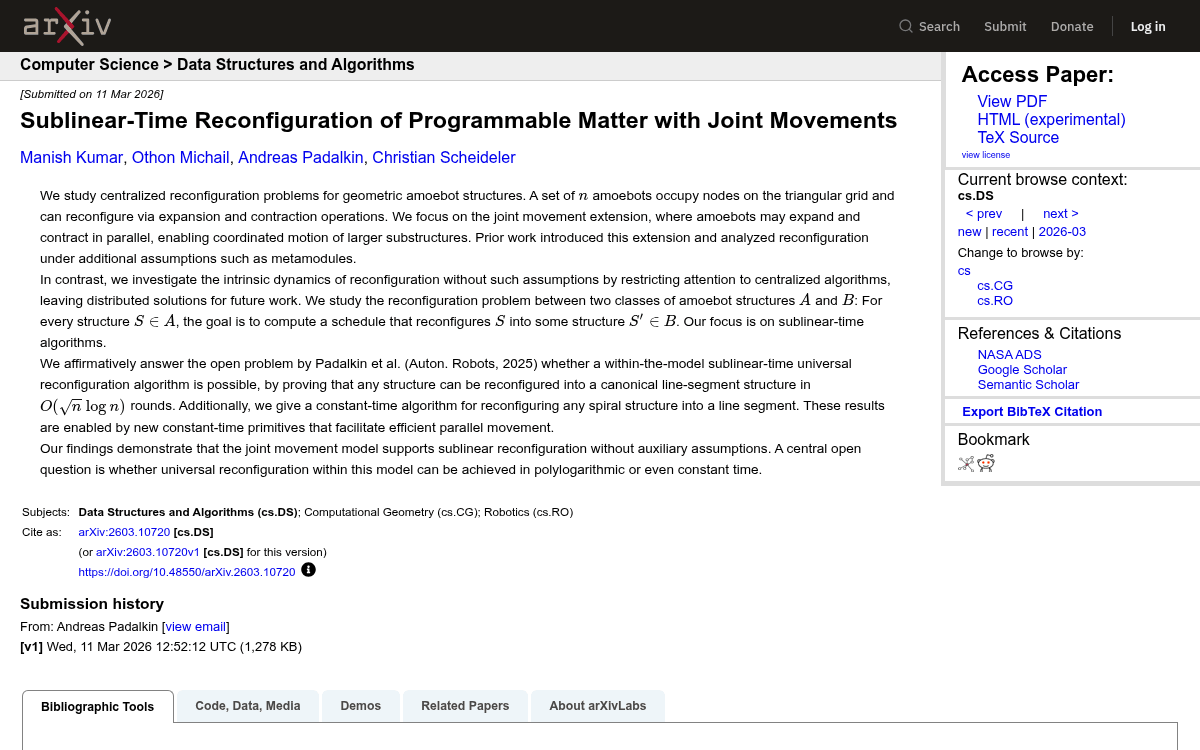
The paper, Sublinear-Time Reconfiguration of Programmable Matter with Joint Movements, tackles the geometric amoebot model, where a set of n robots (called amoebots) is placed on a triangular grid and can expand into empty adjacent nodes or contract back. The authors prove that any connected structure of n amoebots can be reshaped into a canonical line segment in O(√n log n) rounds, and give a constant-time algorithm for a useful subclass.
Why linear time was the wall
In the classic amoebot model, communication and motion are strictly local. That gives a hard floor: many problems in this model have a natural lower bound of Ω(D) rounds, where D is the diameter of the structure. For a blob of a million modules, that means a million rounds just to propagate a decision from one side to the other.
To break that wall, prior work introduced the joint movement extension, where the way amoebots move is altered so that one module expanding or contracting can push or pull an entire connected substructure with it. A single local operation can now displace a linear-sized set of modules in one round, which the authors call a linear-strength operation.
The catch: earlier fast algorithms leaned on metamodules, meaning small pre-arranged clusters of amoebots used as building blocks. That let researchers borrow algorithms from other modular robot models but sidestepped the question of how strong the base model really is. This paper drops that crutch.
The result, in one sentence
Given any connected amoebot structure with a centralized scheduler, you can compute a movement schedule that turns it into a straight line of contracted amoebots in O(√n log n) synchronous rounds. Because reconfiguration is reversible and the line serves as a canonical intermediate form, this immediately gives a universal any-to-any reconfiguration algorithm at the same asymptotic cost.
This settles an open question from the Padalkin et al. 2025 Autonomous Robots paper on whether sublinear universal reconfiguration is achievable without auxiliary assumptions.
How the algorithm works
The universal algorithm is a three-stage pipeline that funnels arbitrary structures through progressively simpler canonical forms:
- Arbitrary → Bounded(√n). Merge sparse rows together until no row has fewer than √n amoebots. Since there can be at most √n such packed rows, the structure now fits within √n rows. This is the expensive step, costing O(√n log n) rounds.
- Bounded → Monotone. Run a sweep-line combing algorithm borrowed from Aloupis et al.'s work on crystalline robots, dropping disconnected column segments downward one row at a time. Costs O(k) where k is the row bound.
- Monotone → LineSegment. Apply the new Monotone2LineSegment routine, which shears columns onto the x-axis using a small state machine of rewrite rules. Runs in a flat 16 rounds regardless of size.
The whole thing is glued together by a small library of constant-time movement primitives the authors introduce: tunneling (moving a chain of amoebots along a path via handovers), shearing (rotating a line segment onto a different axis without rotating what it is attached to), and parallelogram, triangle, and trapezoid primitives that reshape occupied sides of a polygon in place. Each runs in O(1) rounds and preserves the relative position of designated connection points, which is what lets them be composed safely.
Spirals collapse in constant time
The second headline result is a Spiral2LineSegment algorithm that reconfigures any simple spiral with 120-degree corners into a line segment in O(1) rounds, independent of size. The naive unrolling approach costs O(c) rounds where c is the number of corners, because the outermost segment has to participate in every shear. The constant-time version instead builds a monotone base line straight through the spiral using the parallelogram and trapezoid primitives, cuts the arcs against that base line, and shears all the arms onto the y-axis in parallel.
That non-trivial subclass of paths collapsing in constant time is what makes the authors optimistic that polylogarithmic or even constant-time universal reconfiguration might eventually be within reach.
What is actually new here
- First within-the-model sublinear universal reconfiguration. Every previous fast result required metamodules or other structural assumptions layered on top of the amoebot model.
- A reusable primitive library. The tunneling, shearing, parallelogram, triangle, and trapezoid primitives are constant-time building blocks that future amoebot algorithms can compose.
- A path to polylog time. The authors identify that pushing step one from O(√n log n) down to polylog n, or routing arbitrary structures directly into the Rhombical class, would immediately yield a polylogarithmic universal algorithm.
Caveats worth knowing
This is a centralized result. A global scheduler is assumed to know the full structure and dictate every move. Distributed versions where amoebots only see their neighbors are explicitly left as future work, and they face the diameter lower bound unless combined with the reconfigurable circuit extension for fast global communication.
The model also assumes linear-strength actuation: a single amoebot can, in principle, drag a linear-sized chunk of the structure. That is a reasonable abstraction for microrobotic systems in low-viscosity fluids or DNA nanotechnology, but not a free lunch for macroscale robots that have to fight friction and gravity.
Trying it yourself
There is no code release attached to the paper, but the same Paderborn group maintains AmoebotSim 2.0, an open-source simulator that supports the reconfigurable circuit and joint movement extensions of the model, provides a rich graphical interface, flexible simulation features, an extensive API, and comprehensive documentation. The paper's acknowledgements credit two implementers for coding up the algorithms, so working reference implementations exist even if they have not been publicly released. If you want to prototype amoebot algorithms today, AmoebotSim 2.0 is the natural starting point.