
Researchers Prove When AI Model Collapse Is Mathematically Unsolvable
New learning-theoretic framework proves when a model training on its own outputs fundamentally breaks, and when clean filtering can save it
 Pro
Takeaways
- New paper formalizes model collapse via a replay adversary in the language generation in the limit framework.
- Uniform generation is unaffected by replay; same sample complexity as the standard setting.
- Non-uniform generation breaks under replay even for countable hypothesis classes.
- Witness Protection algorithm generates any countable class in the limit under replay using only membership queries.
- Proper generation breaks with just four hypotheses, showing deployed-model reuse is theoretically fragile.
- Results justify data cleaning, watermarking, and output filtering as necessary, not just useful.
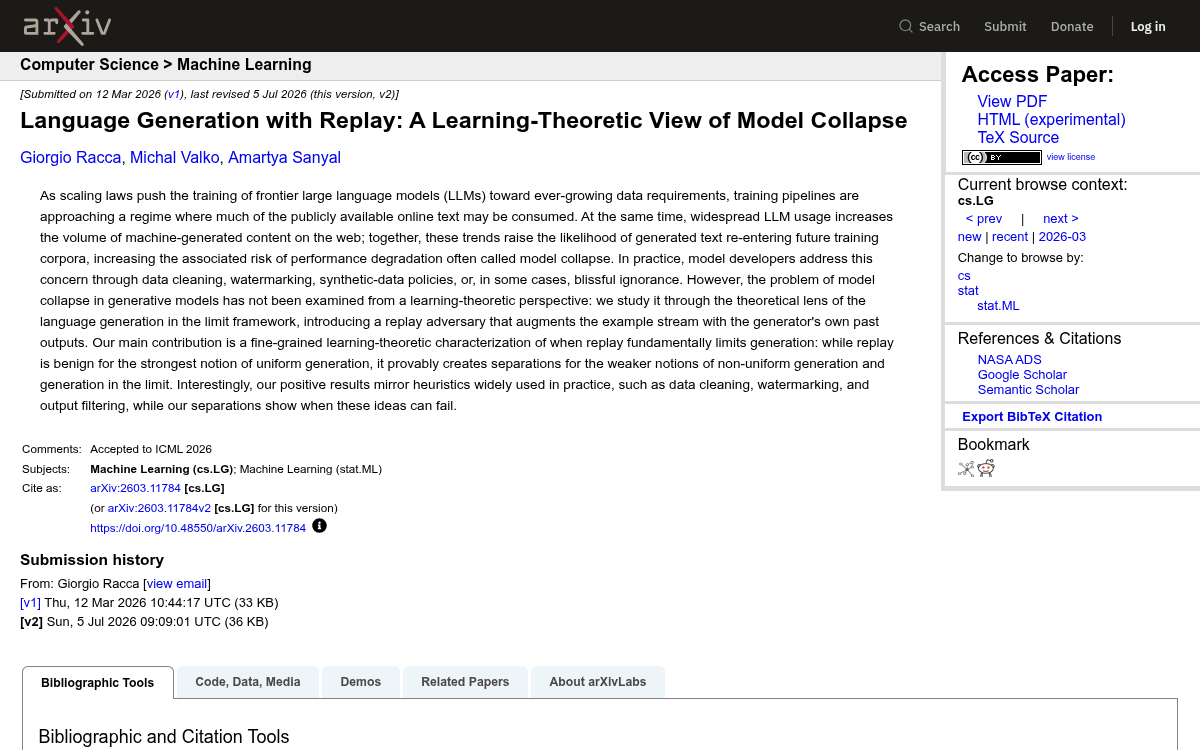
Model collapse, the gradual degradation that occurs when generative models train on their own outputs, has mostly been studied empirically. A new paper titled Language Generation with Replay: A Learning-Theoretic View of Model Collapse takes a very different approach, asking a theoretical question: when does feeding a model its own past outputs make generation provably impossible, and when is it merely an inconvenience that can be filtered away?
The answer depends on how strong a guarantee you demand from your generator. For the strictest notion, replay is essentially free. For weaker notions, it introduces a hard barrier that no algorithm can cross, no matter how much compute or data you throw at it.
The setup: a game with a poisoning adversary
The authors build on the language generation in the limit framework from Kleinberg and Mullainathan, which abstracts away architectures and treats generation as an interactive game. An adversary secretly picks a target language from a known class, then streams valid examples one at a time. The generator has to eventually produce an infinite sequence of previously unseen elements that all belong to the target language.
The replay twist is minimal but consequential: in addition to valid examples from the target language, the adversary may inject the generator's own previous outputs into the example stream. This is the abstract version of synthetic content leaking back into future training corpora, which recent work has shown to be responsible for model collapse.
Crucially, in this framework the contamination rate is not fixed by the adversary in advance. It is endogenously determined by the generator. Whatever mistakes the model makes today can be turned into poisoned training data tomorrow.
Four notions, four verdicts
The paper works through four increasingly demanding notions of generation. The results split cleanly:
- Uniform generation (fixed sample budget for the whole class): uniformly generatable with replay if and only if it is uniformly generatable in the standard setting, with the same sample complexity.
- Non-uniform generation (budget can depend on the target): replay breaks it. There is a countable binary hypothesis class that is not non-uniformly generatable with replay, even though every countable class is non-uniformly generatable in the standard setting.
- Generation in the limit (no pre-computed bound): countable classes survive, but the authors construct an uncountable class that is generatable in the limit without replay yet not generatable in the limit with replay.
- Proper generation (must output a hypothesis, not just an element): even a finite class of just four hypotheses becomes ungeneratable under replay.
Witness Protection: an algorithm that filters implicitly
The positive result for countable classes is proved constructively. The authors introduce an algorithm called Witness Protection (WP) that generates in the limit under replay using only membership queries, the same minimal oracle access used by the original Kleinberg and Mullainathan result.
The idea is to distinguish examples that can be trusted from examples that might be replayed hallucinations. WP maintains a sure set of examples that cannot possibly be explained as replays of past outputs, and only uses those to prune inconsistent hypotheses. The algorithm also refuses to emit certain witness elements, minimal distinguishing points between competing hypotheses. If a witness later shows up in the input stream, the generator knows it was not a replay (because it never output it) and can safely use it to eliminate a candidate.
In short, WP behaves like a filter that decides which inputs to trust based on its own output history. The theoretical framing makes explicit what practitioners have been doing heuristically.
Why the separations matter
The negative results are more revealing than the positive ones. The hard instance for non-uniform generation is a class where an adversary can force the generator into a corner: after enough rounds, the generator's own outputs constrain it to a finite set that has already been fully enumerated in the input stream, leaving no valid fresh element to output.
For proper generation, the four-hypothesis counterexample is striking because the class is finite. The generator commits to some hypothesis on the first round, and the adversary uses that commitment plus replay to construct an example sequence consistent with two different targets whose supports intersect only in a region the generator can never converge to.
These are not pathological edge cases in an obscure formalism. They correspond to concrete failure modes: models locked into a shrinking distribution, or models unable to distinguish which of several plausible sources their training data came from.
What this justifies in practice
The authors are explicit that their algorithms embody the same heuristics developers already use. Algorithm 2 treats potentially replayed instances as misleading and discards them. By considering a deterministic generator, we implicitly assume access to the information needed to identify such instances. That access is exactly what watermarking, data provenance tracking, and synthetic-data filtering are supposed to provide.
The separations then tell you when those heuristics are not enough. If your hypothesis class only satisfies a weak notion of generatability, no amount of filtering will save you from a sufficiently adversarial replay pattern. And if you need proper generation, meaning the model itself must be identifiable and not just its outputs, then even tiny classes can collapse.
Caveats and open directions
This is a pure theory paper. There is no code, no model, and no benchmark. The framework assumes computationally unbounded generators, an adversarial worst case, and infinite streams. Real LLMs are stochastic, real corpora are not adversarially constructed, and real training runs are finite.
The authors note that their algorithms enforce strict constraints that may conflict with output diversity. Algorithm 1 spends a burn-in phase outputting a single dummy element, and WP explicitly avoids emitting witness elements. This is at odds with the requirement that LLM outputs remain diverse, a property often referred to as breadth in the generation literature. Reconciling replay-robustness with breadth is left as an open question, along with characterizing non-uniform generatability under replay and studying stochastic replay models.
The value here is not an algorithm to plug into your training pipeline. It is a principled account of when the model collapse problem is fundamentally solvable and when it is not, which is the kind of foundation the field has been missing.