
Researchers Prove the 4-Epoch Data Reuse Rule Breaks at Scale
New theoretical analysis shows the popular 4-epoch data reuse rule ignores dataset size, with LLM experiments confirming larger datasets tolerate more repetition.
 Pro
Takeaways
- New paper shows the popular 4-epoch data reuse rule ignores a key factor: dataset size N.
- Effective reuse rate E(K, N) grows linearly with K then saturates at a ceiling that depends on N.
- For strongly convex linear regression the saturation ceiling scales as log N; for Zipf data as a power of N.
- LLM experiments with a 0.3B model on DCLM subsets fit K approximately 0.80 log N + 5.21, r = 0.97.
- Result holds under both constant and warmup-stable-decay learning rate schedules.
- Practical guidance: larger corpora tolerate more epochs before returns collapse, small ones saturate fast.
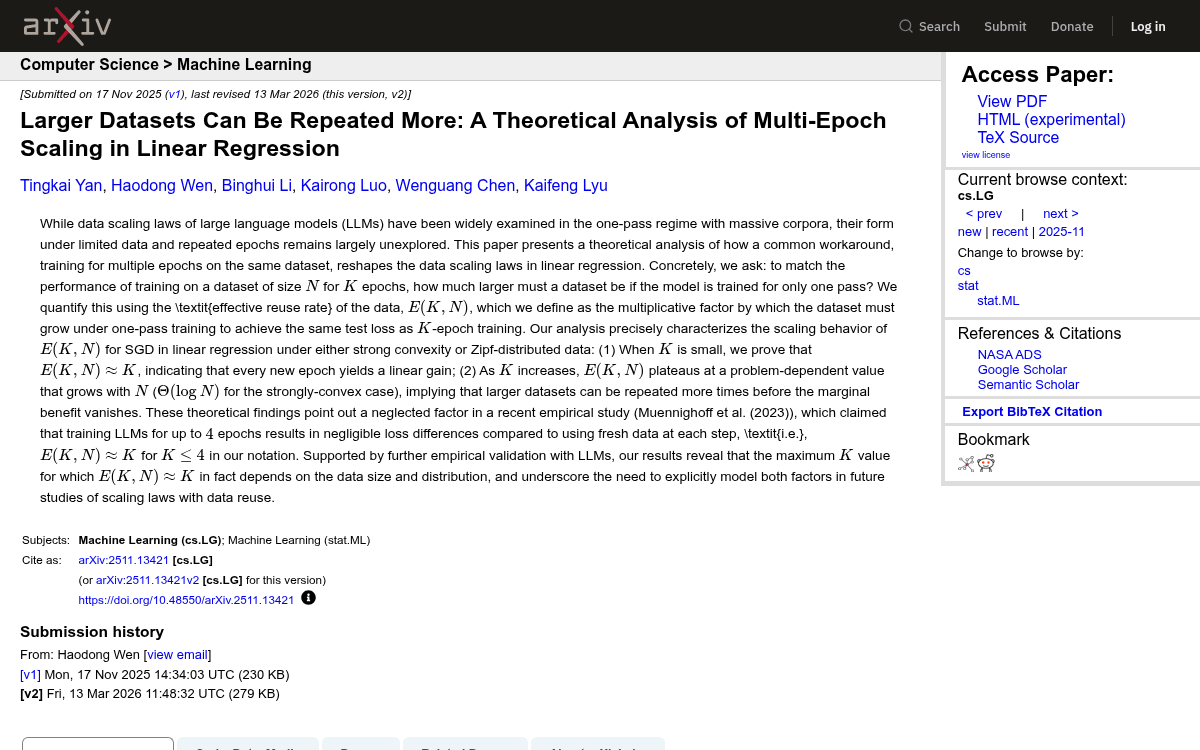
A widely cited empirical finding from Muennighoff et al. claimed that training with up to 4 epochs of repeated data yields negligible changes to loss compared to having unique data. That result has quietly become a rule of thumb for anyone stretching a limited corpus across a large training run. A new theoretical paper argues the rule is incomplete: how many times you can safely repeat data depends on how much data you have.
The paper introduces a quantity called the effective reuse rate, written E(K, N). It answers the question: if you train for K epochs on N samples, how much larger would a fresh, one-pass dataset need to be to reach the same test loss? An E(K, N) close to K means every extra epoch buys you a full pass worth of new data. An E(K, N) that flattens means repetition is no longer helping.
Why the 4-epoch rule breaks
The authors analyze stochastic gradient descent on linear regression, first under strong convexity and then under a Zipf-distributed data model that mimics the heavy-tailed feature statistics of natural text. In both settings they find the same two-regime behavior:
- When K is small relative to the dataset, E(K, N) is approximately K. Each epoch is essentially as valuable as a fresh pass.
- When K grows past a problem-dependent threshold, E(K, N) plateaus. For the strongly convex case the ceiling scales as log N; for the Zipf case it scales as a power of N.
The takeaway is that the transition point itself is a function of N. A dataset twice as large does not just delay saturation, it raises the ceiling. The prior Muennighoff formula assumed the effective epoch count was uniform across dataset sizes, which is exactly what the theory says cannot be right.
What the math actually predicts
In the strongly convex regime with a constant learning rate, the paper proves that the optimal excess risk decays like log(KN) / (KN) when K is below log N, and like 1/N once K exceeds log N. Solving for the equivalent one-pass dataset size gives E(K, N) approximately equal to K in the effective-reuse regime, and of order log N in the limited-reuse regime. Under a power-law data spectrum with parameters a and b, the saturation ceiling instead scales as N raised to the power b/(a-b), which the authors verify in simulation by fitting an exponent of 0.279, matching the predicted 2/7.
Testing it on real LLMs
To check whether the linear-regression intuition survives contact with transformers, the team pretrained a 0.3B parameter model derived from the Qwen2.5-0.5B architecture on subsets of the DCLM dataset ranging from 0.2B to 2B tokens, each for 100 epochs, plus a control run on 200B fresh tokens. All runs used a constant learning rate to match the theory.
The empirical curves reproduce both predicted regimes. For small K, E(K, N) tracks K closely, agreeing with the earlier 4-epoch finding. But the saturation point, defined as where multi-epoch training falls below 75 percent of the one-pass equivalent, shifts as N grows. Fitting the saturation epoch K against log N gives a clean relationship of roughly 0.80 log N plus 5.21, with correlation coefficient 0.97. A follow-up experiment with a warmup-stable-decay schedule and linear decay produced a similar log-N fit at correlation 0.96, suggesting the effect is not an artifact of the constant learning rate.
What this means in practice
If you are compute-bound but have a large corpus, the theory is encouraging: you can push past the folk 4-epoch limit and still get near-linear returns per epoch. If you are working with a small dataset, the ceiling arrives sooner than the rule of thumb suggests, and pouring more compute into extra epochs is largely wasted. The practical shape of the tradeoff looks like this:
| Regime | Condition | Effective reuse rate E(K, N) | What to do |
|---|---|---|---|
| Effective reuse | K much smaller than log N | Approximately K | Add epochs, they behave like fresh data |
| Limited reuse | K much larger than log N | Order log N, independent of K | Stop repeating, spend compute elsewhere |
Caveats worth knowing
The theory is proved for linear regression with constant learning rates, and the authors are careful not to claim the exact log N law holds for general LLM training. They note that learning-rate decay changes the picture: under a polynomial decay schedule, one-pass training is suboptimal by a factor of the Hessian condition number, and multi-epoch training can recover the statistical minimax rate. The paper does not release code or model checkpoints, but the experimental setup, including hyperparameters, model config, and fitting procedure, is documented in the appendices of the arXiv preprint. The broader message is that any future scaling law involving data reuse needs to condition on both K and N, not just K.