
Researchers Prove AI Leaderboards Are Broken and Tune-Before-Test Fixes Them
A new paper by Chen, Zhang, and Hardt uses game theory to prove why AI benchmarks get gamed — and how a simple fix restores honest rankings
 Pro
Takeaways
- Researchers Chen, Zhang, and Hardt formally prove that current AI benchmarks have no Nash equilibrium, explaining why labs endlessly game leaderboards.
- The paper models benchmarking as a Stackelberg game: benchmark designers set rules, then labs strategically allocate post-training resources to inflate scores.
- A protocol called tune-before-test (TbT) — giving every model the same brief fine-tuning before evaluation — is proven to restore a unique, honest Nash equilibrium.
- Empirically, TbT raises cross-benchmark ranking agreement from τ=0.52 to τ=0.76 across 24 benchmarks and 61 models.
- After just 3,000 TbT steps, a lab would need 384,668+ additional training steps to change rankings — making gaming economically irrational.
- No code or new benchmark is released; the contribution is a formal theoretical framework with one empirical case study, published at the ICLR 2026 Workshop on AI for Mechanism Design.
AI leaderboards are supposed to tell you which model is best. In practice, they increasingly tell you which lab is best at gaming the evaluation. A new arXiv paper by Yatong Chen, Guanhua Zhang, and Moritz Hardt takes the first principled, mathematical look at why this happens , and proves that a recently proposed protocol called tune-before-test can fix it.
The leaderboard arms race
Influential benchmarks incentivize competing model developers to strategically allocate post-training resources toward improvements on the leaderboard, a phenomenon dubbed benchmaxxing or training on the test task. The consequences are real: labs fine-tune on benchmark-like data, cherry-pick evaluation checkpoints, or exploit scoring formats to climb leaderboards , often at the expense of practical capability , resulting in models that look impressive on paper but underperform when deployed on tasks the benchmarks were supposed to represent.
The trust damage is accumulating. As of mid-2026, one industry observer has not met an engineer who chooses a model from a leaderboard. The problem is not just cultural , it is structural. And until now, nobody had formally proved why the incentive structure breaks down.
Benchmarking as a game , literally
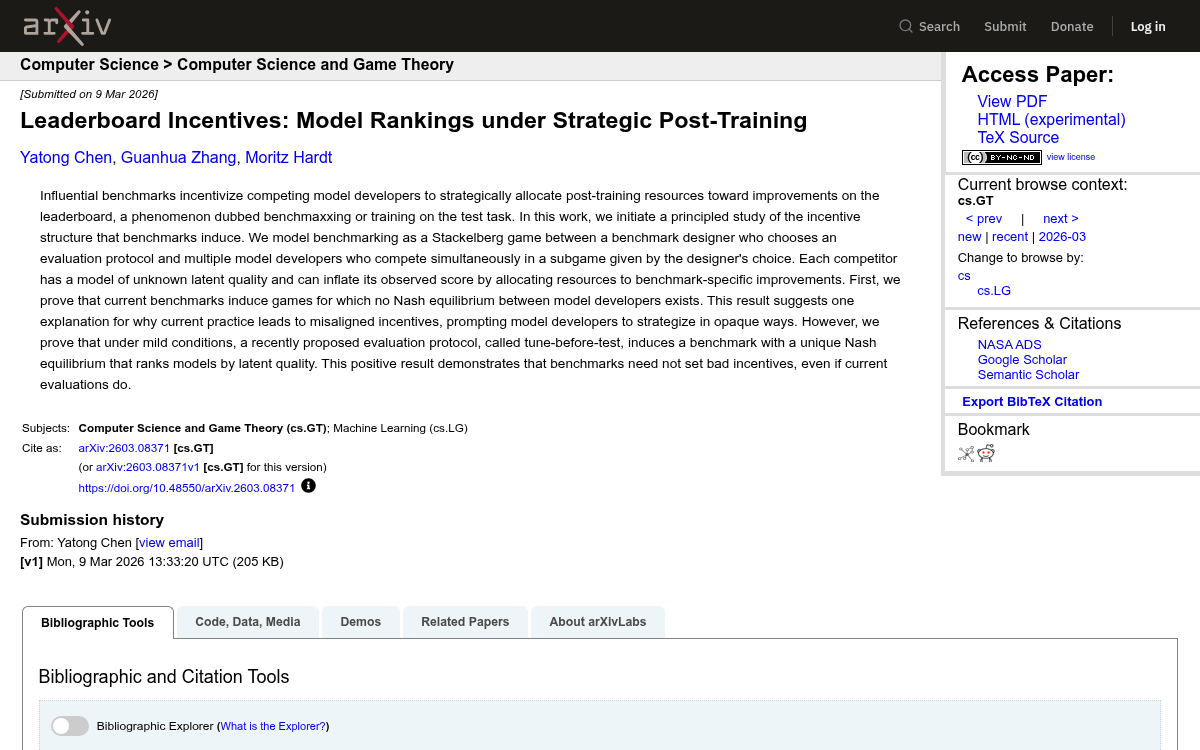
The authors initiate a principled study of the incentive structure that benchmarks induce, modeling benchmarking as a Stackelberg game between a benchmark designer who chooses an evaluation protocol and multiple model developers who compete simultaneously in a subgame given by the designer's choice. Each competitor has a model of unknown latent quality and can inflate its observed score by allocating resources to benchmark-specific improvements.
Two concepts are central here. A Stackelberg game is a sequential strategic interaction where one player (the leader , here, the benchmark designer) commits to a strategy first, and others (the followers , model developers) respond optimally. A Nash equilibrium is a stable outcome where no player can improve their position by changing strategy unilaterally. In a well-designed benchmark, you would want the Nash equilibrium to be: every lab just trains the best model it can.
What makes the incentive design problem challenging is that the benchmark creator has no control over the utility each model developer has for gains on the leaderboard, does not know latent capabilities, and cannot limit how much effort model developers invest.
The core result: current benchmarks have no stable equilibrium
The authors prove that current benchmarks induce games for which no Nash equilibrium between model developers exists. This result suggests one explanation for why current practice leads to misaligned incentives, prompting model developers to strategize in opaque ways.
This is a significant finding. When no Nash equilibrium exists, there is no stable resting point for the competition. Labs keep escalating their benchmark-specific optimizations in an endless cycle, because any strategy can be undercut by a competitor doing more targeted post-training. The leaderboard becomes a moving target that rewards gaming over genuine capability.
The fix: tune-before-test
The evaluation protocol the authors study tunes each model on the same small amount of task-specific data before evaluation. The intuition is that a small amount of task-specific preparation levels the playing field by washing out minor benchmark-specific tweaks.
The idea is that if every model gets the same brief fine-tuning on the benchmark's training split before being tested, then the advantage of having secretly pre-optimized for that benchmark shrinks dramatically. The evaluation shifts from asking "who already prepared for this?" to asking "who learns this best given the same starting point?"
Previous work showed empirically that this intervention, called tune-before-test (TbT), leads to consistent model rankings across a wide range of benchmarks. The authors' main result adds a game-theoretic justification: tune-before-test creates incentives that lead to rankings by latent quality at equilibrium.
The empirical evidence for TbT is striking. After TbT, average cross-benchmark agreement jumps from a Kendall's τ of 0.52 to 0.76, consistently across all 24 benchmarks. Train-before-test also reduces the model-score matrix to essentially rank one, indicating that model potential is dominated by one latent factor, uncovered by train-before-test. In other words, there really is a single underlying capability dimension , and TbT is what reveals it.
Why this is harder to game than it sounds
Surprisingly, a small amount of data suffices to realize the same effect as orders of magnitude more training. The paper backs this up with a concrete empirical case study: after applying tune-before-test with only 3,000 steps, a model developer would have to invest at least 384,668 additional training steps to change model rankings. That asymmetry is the mechanism. TbT raises the cost of gaming so high that it is no longer worth doing , and the Nash equilibrium collapses to honest competition.
What this means in practice
The paper was published at the ICLR 2026 Workshop on AI for Mechanism Design and Strategic Decision Making. It does not release code or a new benchmark, but its implications are concrete for anyone who builds or relies on evaluations:
- Benchmark designers now have a formal justification for adopting TbT as a protocol , not just an empirical heuristic, but a provably incentive-compatible mechanism.
- Model developers operating under a TbT benchmark can stop the arms race: the equilibrium strategy is to train a genuinely better model, not to optimize for the test.
- Practitioners selecting models should treat any leaderboard without a standardized preparation protocol with skepticism. Benchmark numbers are increasingly seen as no longer trustworthy indicators of LLM performance , even if inflation preserves relative ranking, absolute scores mislead about production readiness.
- Evaluation infrastructure teams at organizations like Hugging Face or HELM could adopt TbT as a default, since the fine-tuning overhead is modest and the ranking stability gains are large.
The limits
The paper's model makes simplifying assumptions: it treats latent model quality as a fixed scalar, models post-training effort as a single continuous variable, and assumes developers best-respond rationally. Real labs operate under messier constraints , compute budgets, multi-objective training, and proprietary data pipelines that do not map cleanly onto the theoretical framework. The authors acknowledge that the game-theoretic model is a stylized abstraction, and the empirical validation is a single benchmark case study rather than a broad sweep.
There is also a chicken-and-egg problem: TbT only works as an incentive fix if the benchmark authority actually enforces it. If some evaluators adopt it and others do not, the fragmented landscape of leaderboards continues to reward gaming on the non-TbT evaluations. The theory is clean; the coordination problem is not.
Still, having a formal proof that the current benchmark regime is game-theoretically broken , and that a specific, deployable fix restores honest equilibrium , is a meaningful step toward evaluation infrastructure that the field can actually trust.