
Researchers Hide AI Ownership Stamps in Weights That Survive Fine-Tuning Attacks
A new white-box watermarking method injects chaotic sequences into neural network weights and uses genetic algorithms to prove ownership after fine-tuning attacks.
 Pro
Takeaways
- New white-box watermarking method embeds chaotic sequences into DNN weights to prove ownership. Read the paper.
- Uses the logistic map with parameters (r, x_0, epsilon) as a sensitive, hard-to-forge signature.
- Verification runs a genetic algorithm to recover the chaotic parameters from weight differences.
- Survives fine-tuning attacks on MNIST and CIFAR-10 with negligible accuracy loss (0.9945 to 0.9957 on MNIST).
- Auxiliary detection via weight density plots and activation-based logistic regression classifiers.
- Limited to white-box access, CNN image classifiers, and single-sequence (not multi-bit) watermarks.
Training a modern neural network is expensive, and once the weights leave your servers, there is very little stopping someone from copying, fine-tuning, and reselling your work. A new research paper proposes a way to stamp ownership directly into the weights of a trained model using chaotic sequences, then recover that stamp later with a genetic algorithm, even after an attacker has tampered with the model.
The technique is a white-box watermarking scheme, meaning the owner needs access to the suspect model's internal parameters to verify their claim. The authors show the watermark survives fine-tuning attacks on both MNIST and CIFAR-10 with negligible impact on accuracy, and they back the recovery process with two extra verification signals: weight density plots and a lightweight logistic regression classifier trained on hidden activations.
Why watermarking neural networks is hard
Traditional software has licenses and access controls. Neural networks are just files of floating-point numbers that anyone can copy, fine-tune, and repackage. That has pushed researchers toward watermarking approaches similar to those used for images and audio, but with tighter constraints. A good DNN watermark has to satisfy three properties at once:
- Fidelity: the model's task accuracy must not drop.
- Robustness: the mark must survive fine-tuning, pruning, and quantization.
- Security: an attacker who knows the general method still cannot detect, remove, or forge it.
Most prior work, going back to Uchida et al.'s 2017 method, relies on adding a regularization term during training so that certain weights encode a fixed binary pattern. The problem is that handcrafted or static watermark signals leave a fingerprint that can be smoothed away by adversarial fine-tuning or overwriting.
Chaos as a signature
The core idea in the new paper is to replace the static bit pattern with a chaotic sequence generated by the logistic map, a classic one-line recurrence:
x_{n+1} = r * x_n * (1 - x_n)When r sits between roughly 3.57 and 4.0, this simple equation produces a deterministic but wildly unpredictable sequence. Two initial values that differ by 0.0001 diverge into completely different trajectories within a few dozen steps. That sensitivity is the security property: without the exact triple of parameters (r, x_0, epsilon), no attacker can reproduce the sequence.
Embedding is intentionally simple. The authors pick an intermediate layer, generate a chaotic sequence with the same length as that layer's weight tensor, and add it in with a small scaling factor:
w_i' = w_i + epsilon * c_iA short round of fine-tuning on the original training data then absorbs the perturbation. In their experiments they used r = 3.9, x_0 = 0.5, and epsilon = 0.01, with the fine-tuning learning rate dropped by 10x from the original training run.
Recovering the mark with a genetic algorithm
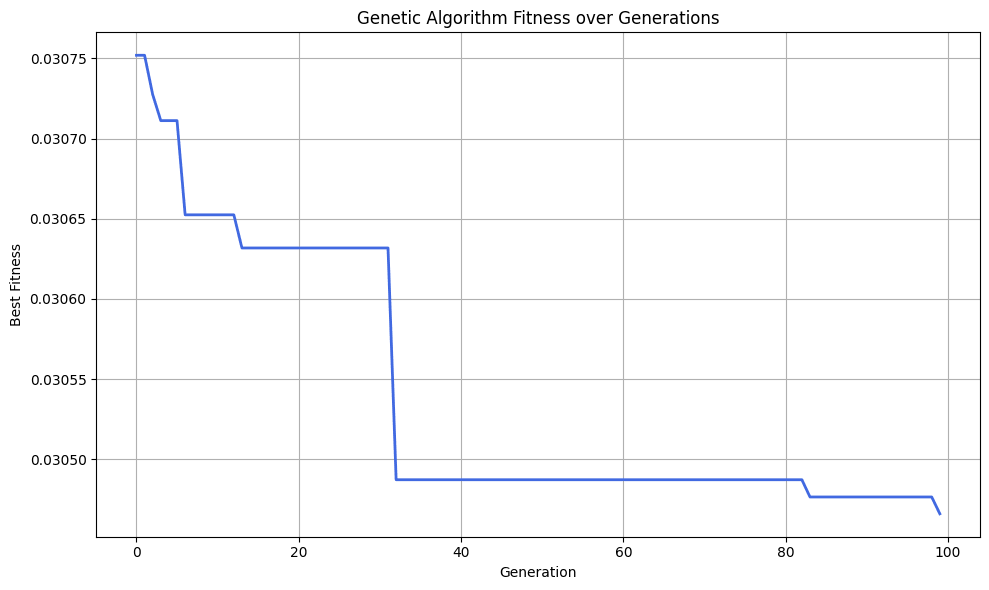
Verification is where things get interesting. Because fine-tuning shifts the weights, you cannot just subtract the watermarked weights from the suspect model and read off the sequence. Instead, the authors compute the weight difference delta_W between the reference watermarked model and the suspect model, then search for the chaotic parameters that regenerate a sequence closest to delta_W.
That search is non-linear and noisy, so they use a genetic algorithm with:
- Latin Hypercube Sampling to initialize a diverse population of
(r, x_0, epsilon)triplets. - A fitness function that blends mean squared error (weight 0.97) and correlation distance (weight 0.03) between the candidate and extracted sequences.
- Tournament selection, blend crossover, Gaussian mutation, and elitism to evolve the population across generations.
If the recovered parameters land within a tight tolerance of the originals, ownership is confirmed. Otherwise, the model does not carry that watermark.

How well does it hold up
The authors evaluate on MNIST and CIFAR-10 with CNNs. Fidelity is essentially free: MNIST accuracy actually ticks up slightly from 0.9945 to 0.9957 after watermarking, and CIFAR-10 drops only from 0.7326 to 0.7279. That marginal MNIST gain hints at a regularization side-effect from the injected noise.
Under the fine-tuning attack, recovery is precise. On MNIST the algorithm retrieves r = 3.911 versus a true value of 3.9, x_0 = 0.497 versus 0.5, and epsilon = 0.011 versus 0.01. CIFAR-10 shows similar tolerances. When run against a model watermarked with a different random chaotic sequence, the GA fails to converge to the true parameters, keeping false positives away.
Two auxiliary checks reinforce the verification:
- Weight density plots show fine-tuned watermarked models keeping distributions almost identical to the original watermarked model, while a randomly watermarked model produces a visibly shifted curve.
- A logistic regression classifier trained on flattened activations from the watermarked layer distinguishes original, watermarked, and fine-tuned models with near-perfect accuracy: one misclassification out of 7,920 samples on MNIST and one out of 29,049 on CIFAR-10.

Where it falls short
The method is honest about its limits. A few worth calling out:
- White-box only. It assumes you can pull weights out of the suspect model. If a competitor is only exposing an API, this technique cannot help you.
- CNNs and image classification only. Transformers, RNNs, and generative models are untested. Chaotic embedding into attention matrices or embedding tables may behave differently.
- Single-sequence, not multi-bit. You get a yes/no ownership signal, not a payload. You cannot embed a creator ID or license terms directly.
- Only fine-tuning was stress-tested. Pruning, quantization, and watermark overwriting attacks are left for future work.
- Verification cost. The GA search adds compute per ownership check, and this could get impractical for very large models or long sequences.
Where it fits
The most natural use case is post-training watermarking of models you plan to distribute in weight form: open-weight checkpoints, models shared with partners under NDA, or fine-tuned domain models sold to enterprise customers. Because it requires no changes to the training pipeline and no access to the original training data, it can be applied to legacy or third-party models already in production.
There is no code release accompanying the paper, but the approach is straightforward enough that a working prototype is a couple of hundred lines of NumPy plus a genetic algorithm library like DEAP. If you already publish model weights and are worried about downstream misuse, chaos-based watermarking is worth a look as a lightweight ownership signal that a fine-tuning attacker probably cannot scrub out.