
Researchers Force Chest CT AI to Diagnose Lung Disease Without Gender Bias
A CVPR 2026 challenge submission uses adversarial training to strip gender signals from CT scan features while classifying four lung conditions.
 Pro
Takeaways
- Paper submitted to the PHAROS-AIF-MIH Fair Disease Diagnosis Challenge at CVPR 2026
- Classifies chest CT into Healthy, COVID-19, Adenocarcinoma, Squamous Cell Carcinoma with per-gender macro F1 scoring
- Combines attention-based Multiple Instance Learning on a ConvNeXt backbone with a Gradient Reversal Layer
- Uses focal loss, label smoothing, stratified 5-fold CV, oversampling, and flip test-time augmentation
- Reaches 0.685 mean validation score, best single fold 0.759 on the challenge metric
- Code released at github.com/ADE-17/cvpr-fair-chest-ct
A new research paper tackles a subtle but consequential problem in medical AI: models that quietly learn to diagnose better on one gender than another. The work, submitted to the Fair Disease Diagnosis Challenge at the PHAROS-AIF-MIH Workshop at CVPR 2026, proposes a training recipe that forces a chest CT classifier to forget the patient's gender while still identifying lung disease across four categories.
The challenge itself sets the stakes. Aditya Parikh and Aasa Feragen describe a task where CT scans must be classified into four categories, with performance measured as the average of per-gender macro F1 scores, explicitly penalizing gender-inequitable predictions. A model that scores 0.9 on men and 0.5 on women loses to one that scores 0.7 on both. That scoring rule is the whole point: the competition aimed to promote robust performance across different healthcare settings and equitable outcomes across demographic groups.
Two problems tangled together
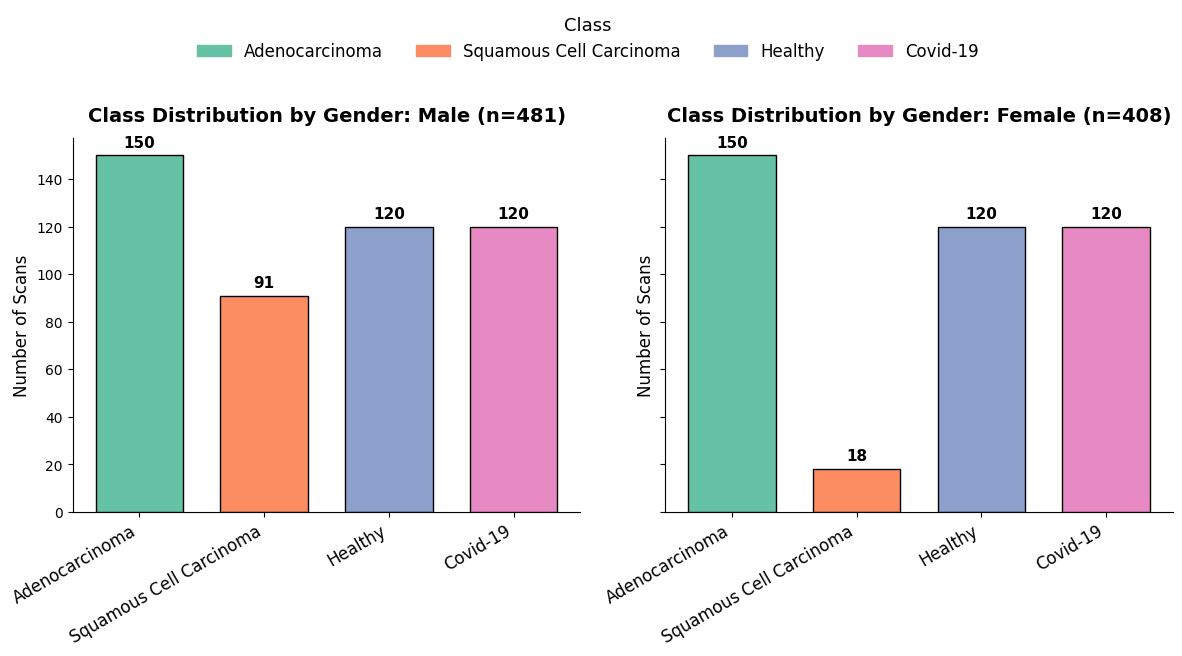
Chest CT volumes contain hundreds of axial slices, but the actual disease signal (a tumor, a patch of ground-glass opacity) may occupy only a handful of them. On top of that sparse-signal problem, the training data is unevenly distributed across the joint of disease class and gender, so a naive classifier can shortcut its way to good average accuracy by leaning on demographic cues.

Attention over slices, adversary over gender
The authors build their solution around two ideas working in tandem. First, an attention-based Multiple Instance Learning (MIL) head sits on top of a ConvNeXt backbone. In MIL, the model treats the whole CT volume as a bag of slice-level features and learns, without any slice-level labels, which slices to weight heavily when making a diagnosis. Second, a Gradient Reversal Layer (GRL) is bolted onto the scan representation and trained to predict gender, but the reversed gradient pushes the backbone to produce features that a gender classifier cannot exploit.
The full recipe, as summarized in the paper's technical description, includes:
- A ConvNeXt image backbone shared across all slices in a scan
- Attention-based MIL pooling that learns per-slice importance without slice labels
- A Gradient Reversal Layer that adversarially suppresses gender-predictive structure in the pooled representation
- Focal loss with label smoothing to fight class imbalance and overconfidence
- Stratified 5-fold cross-validation over joint (class, gender) strata
- Targeted oversampling of the most underrepresented subgroup
- Ensembling of all five fold checkpoints with horizontal-flip test-time augmentation and out-of-fold threshold optimization
Focal loss, originally introduced for dense object detection, down-weights easy examples so the model spends its capacity on the hard, rare cases. Label smoothing softens the one-hot targets so the network does not become overconfident on the majority subgroups.
Numbers on the leaderboard
On the challenge's fairness-weighted metric, the model reaches a mean validation competition score of 0.685 with a standard deviation of 0.030, and the best single fold hits 0.759. For context, the third-place entry in the same task, from a separate team using a 2.5D plus 3D ensemble, reached a best Macro F1-score of 0.633 with improved performance balance across genders, which suggests the gender-adversarial approach is competitive on this specific benchmark.

What is actually useful here
The real contribution is less a specific number and more a reusable pattern: use MIL to handle sparse signal across many slices, and use gradient reversal to strip a protected attribute out of the learned representation. That combination is portable to any volumetric medical imaging problem where a demographic variable (age, gender, scanner vendor, hospital site) leaks into features and skews performance across subgroups.
The limitations are honest ones. The score gap between folds (0.685 mean, 0.759 best) hints that the method is sensitive to which subgroups end up in the validation split, which is exactly what you would expect when the underlying data is severely imbalanced. Adversarial debiasing also trades a bit of raw accuracy for group parity, so this is not the recipe you want if fairness is not a constraint. And the evaluation is confined to one challenge dataset with four lung conditions and a single protected attribute; nothing here has been shown to generalize to other modalities or other demographics.
Code and reproducibility
All training and inference code is publicly available at github.com/ADE-17/cvpr-fair-chest-ct, including the fold splits, threshold optimization logic, and ensembling scripts. For anyone working on medical image classification where subgroup fairness is part of the acceptance criteria, it is a compact reference implementation of the MIL-plus-GRL pattern on a modern ConvNet backbone.