
Researchers Find Steering AI Personality Neurons Barely Changes What Models Say
New arXiv paper probes where Big Five personality traits live inside LLMs and shows that steering internal representations does not fully steer what the model actually says.
 Pro
Takeaways
- New arXiv paper locates Big Five personality traits inside instruction-tuned LLMs using probing and neuron-level interventions.
- Trait information is linearly decodable from layer 20 percent onward across Llama-3, Gemma, Mistral, and Qwen2.5.
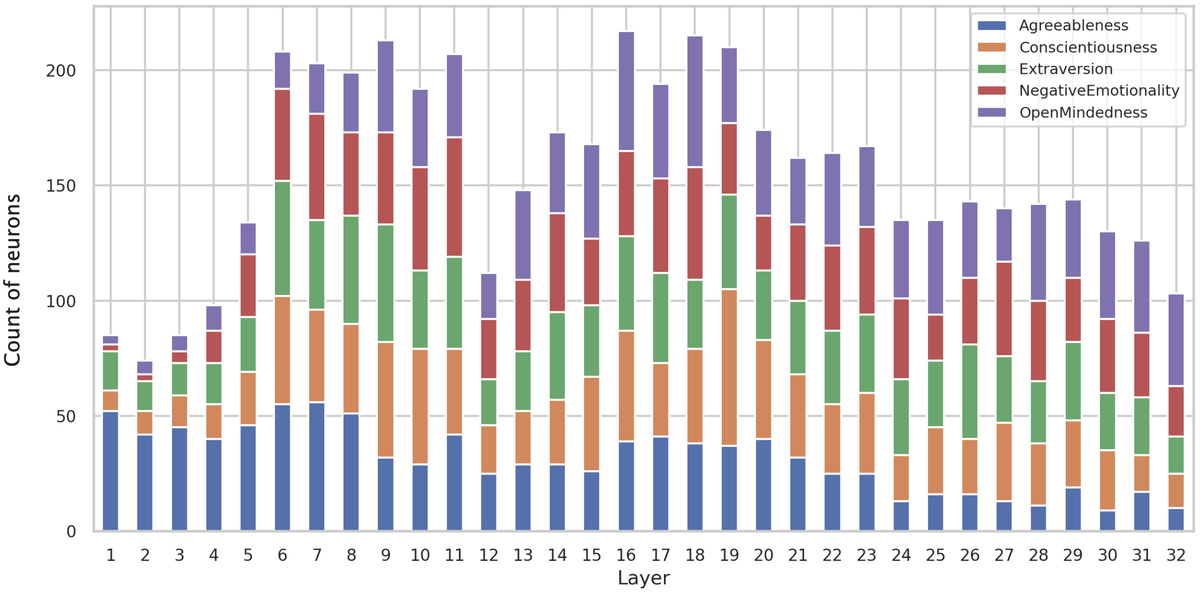
- Concept-selective neurons concentrate in mid layers and show minimal overlap across traits, indicating largely separate circuits.
- Boosting and suppressing top 30 percent of trait neurons shifts linear probes with over 0.8 targeted success rate.
- Same interventions on generation reach only about 50 percent success, with cross-trait spillover, especially toward Extraversion.
- Findings expose a gap between representational control and behavioral control relevant to persona-editing and alignment work.
A new arXiv paper by Yuto Harada and Hiro Taiyo Hamada sits between psychology and mechanistic interpretability: if a language model can imitate a personality, where inside the network does that personality live, and can you push it around by editing a handful of neurons? Concept-selective neurons can be identified and manipulated, but the shift they produce on internal representations does not fully carry over to what the model generates, exposing a real gap between reading a concept off a model and steering its behavior.
The work, Psychological Concept Neurons, targets the Big Five personality framework, the standard psychology taxonomy of Extraversion, Agreeableness, Conscientiousness, Negative Emotionality, and Open-Mindedness. Prior research has shown LLMs can role-play personalities or infer them from user text, but almost all of that evidence is behavioral. This paper goes inside the weights.
Three questions, one questionnaire
The authors organize the study around three research questions: where trait concepts emerge across depth, which neurons are selective for each trait, and whether intervening on those neurons can causally steer outputs. As their probe data they use the Big Five Inventory 2 (BFI-2), a validated psychology questionnaire, treating domain prediction from each item as a 5-way classification task.

Experiments run on four instruction-tuned 7 to 8B models: Meta-Llama-3-8B-Instruct, Gemma-7B-it, Mistral-7B-Instruct, and Qwen2.5-7B-Instruct, with Llama-3 used as the primary target for the fine-grained neuron work. The methodology has three moving parts: