
Researchers Finally Crack the Math Behind Crowdsourced Labeling Votes
New closed-form math turns delta-margin voting from a crowdsourcing heuristic into a design calculus for quality control in high-stakes labeling.
 Pro
Takeaways
- Delta-margin voting collects votes until one label leads by delta, common in high-stakes labeling pipelines.
- Paper models it as an absorbing Markov chain using Gambler's Ruin theory.
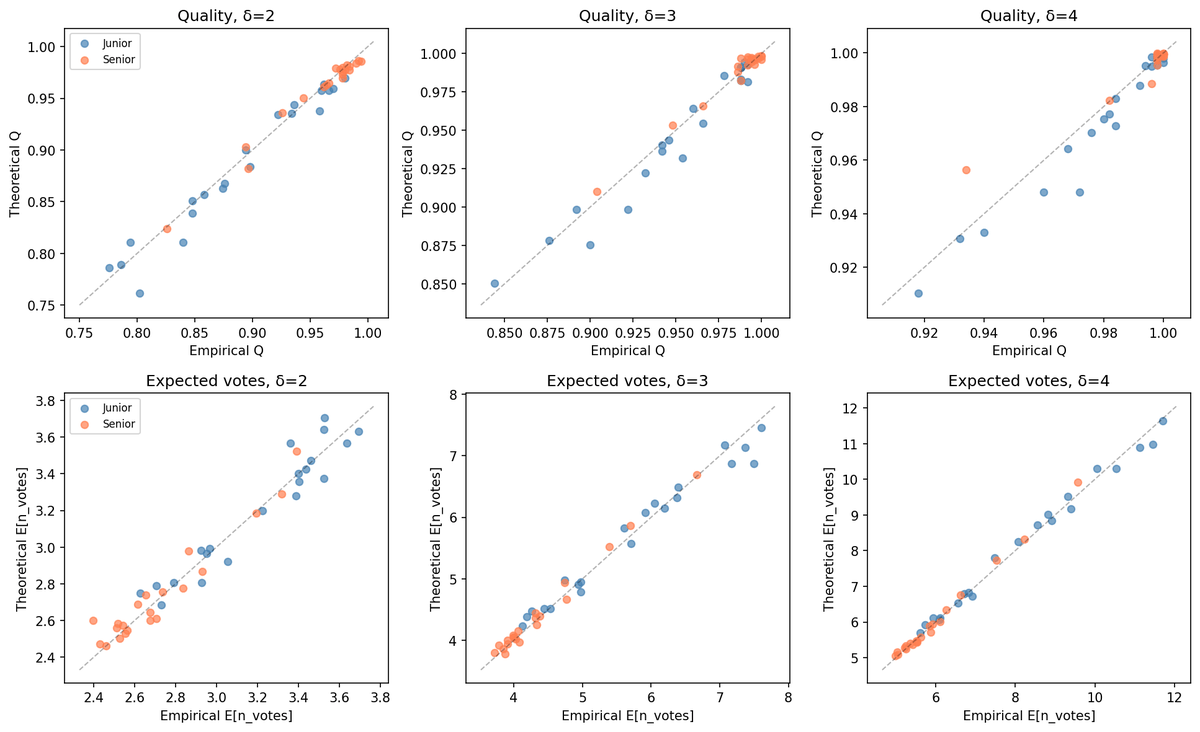
- Gives closed-form accuracy, expected votes, variance, and full stopping-time distribution.
- Bayesian extension with Beta and mixture-of-Betas priors enables live cost and quality monitoring.
- Cost calibration equalizes quality across worker pools with different accuracies and sets fair pay.
- Validated on two real crowdsourced datasets; full paper on arXiv.
If you have ever built a labeling pipeline for fraud, medical, or moderation data, you have probably run into a practical question: how many humans do we ask before we trust a label? A popular answer is delta-margin majority voting, where you keep collecting votes until one option leads the others by a fixed margin. The scheme is simple in code but painful in planning, because nobody could tell you exactly what accuracy or cost to expect. A new paper by Boyarskaya and Ipeirotis fixes that with a full closed-form theory.
The vote everyone uses but nobody could size
The paper targets a very specific consensus rule. Delta-margin majority voting collects votes sequentially until one candidate label exceeds alternatives by a predetermined threshold delta, offering stronger confidence in uncertain cases than simple majority voting. That extra scrutiny is why teams reach for it in high-stakes applications such as fraud detection, medical diagnostics, and content moderation, and in labeling pipelines that feed downstream models.
Despite widespread adoption, the approach has lacked rigorous theoretical foundations, leaving practitioners to lean on heuristic estimates for critical performance metrics like expected accuracy and resource requirements. Teams set delta by feel, guess how many votes they will need, and back into a budget. Crowdsourcing lore even had its own name for it: the scheme, widely discussed among the Mechanical Turk community in its early days, was sometimes called strong plurality.