
Researchers Expose How Carbon Audits Hide AI's Real Lifetime Emissions
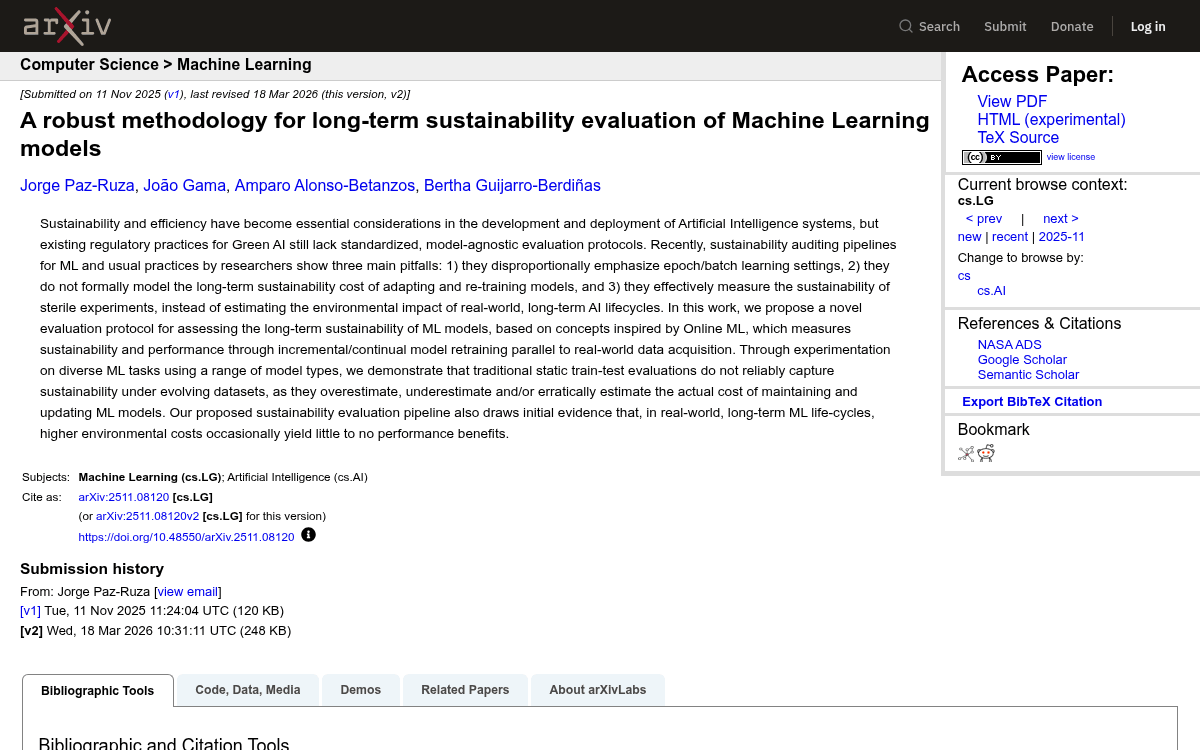
A new prequential evaluation protocol reveals that standard train-test carbon audits systematically misestimate the real long-term emissions of ML models in production.
 Pro
Takeaways
- New protocol measures ML carbon emissions across the full retraining lifecycle, not one-off training runs.
- Static holdout audits underestimate real emissions while cross-validation tends to overestimate them.
- Approach is inspired by prequential streaming evaluation and works for both batch and online models.
- Tested on 9 datasets across classification, regression, recommendation, and anomaly detection tasks.
- Some models show exponential emissions growth for marginal or zero accuracy gains long-term.
- Open-source Python tool available at github.com/Kominaru/eclair, wraps CodeCarbon.
Most Green AI reports measure the wrong thing. They tell you how much carbon a training run emitted on a frozen dataset, then quietly ignore that real models keep learning, keep serving predictions, and keep being retrained for years. A new paper from researchers at Universidade da Coruña and the University of Porto argues this gap systematically distorts which models look sustainable, and it does so in ways that can hide exponential emissions growth behind marginal accuracy gains.
Their proposal, published on arXiv, is a model-agnostic evaluation protocol borrowed from streaming ML that measures sustainability the way models are actually used: incrementally, over time, with retraining folded into the accounting.
Why current carbon audits miss
The authors identify a structural problem in how sustainability gets reported. Existing pipelines disproportionately emphasize epoch and batch learning settings, do not formally model the long-term cost of adapting and retraining models, and effectively measure the sustainability of sterile experiments rather than real-world AI lifecycles.
Regulation is starting to demand better numbers. The EU AI Act treats sustainability as an ethical property of AI systems but does not specify measurement protocols, and the proposed US AI Environmental Impacts Act would require studying compute and datacenter emissions without prescribing how. Even the recent UNE 0086:2025 specification, which the authors describe as the first certifiable standard for AI environmental impact assessment, has real gaps. It assumes strictly separable and time-disjoint training and inference phases, which breaks down for any continual or adaptive learning system. It also leans heavily on LLM-specific metrics like per-batch and per-epoch emissions that do not apply to most of the ML landscape.