
Researchers Expose How AI 'Forgetting' Methods Just Rephrase Sensitive Data
New research shows popular LLM unlearning methods only appear to erase knowledge, secretly relocating it into paraphrased responses that evade standard metrics.
 Pro
Takeaways
- Researchers identify the squeezing effect: GA and NPO unlearning shifts probability mass to semantically related paraphrases.
- Standard metrics like ROUGE and Truth Ratio miss this failure, reporting success while sensitive knowledge persists in rephrased form.
- Proposed bootstrapping framework suppresses both target responses and the model's own high-confidence generations (model beliefs).
- BS-T operates at token level via soft targets over top-k predictions; BS-S augments training with sampled high-likelihood sequences.
- Beats NPO, RMU, SimNPO, WGA on TOFU, MUSE, and WMDP across Llama 2/3 and Zephyr models.
- Code merged into OpenUnlearning; paper on arXiv.
A new paper from researchers at the University of Macau, Hong Kong Baptist University, RIKEN, KAUST, and NII argues that the dominant approach to erasing knowledge from large language models has been quietly failing all along. The methods look like they work on benchmark scoreboards, but the sensitive information they claim to remove is still there, just wearing a different sentence.
The team calls this phenomenon the squeezing effect, and they show it up across popular unlearning objectives including gradient ascent (GA) and negative preference optimization (NPO). To fix it, they propose a bootstrapping framework that forces the model to unlearn not only the labeled target response but also its own most confident rephrasings of that response. Code has been merged into the OpenUnlearning benchmark suite.
Why the ROUGE score was lying to you
LLM unlearning is meant to remove specific pieces of knowledge (private data, copyrighted text, dangerous know-how) from a trained model without retraining from scratch. The standard recipe applies gradient ascent on a forget set to push down the likelihood of specific target responses, sometimes combined with regularization on a retain set. Compared with alternatives such as harmful content detectors or in-context defenses, unlearning is less vulnerable to circumvention, jailbreaks, or re-training attacks for open-source LLMs.
The authors dig into a Llama 3.2 1B model unlearned on the TOFU benchmark and find two failure modes that classical metrics hide:
- GA collapse. After gradient ascent, the model output degenerates into repeated tokens like "always always always...", producing Probability, ROUGE-L, and Truth Ratio scores of essentially zero. The metrics scream success while the model is broken.
- NPO rephrasing. With NPO, asked what language an author writes in, the original response "typically writes her books in English" becomes "She mainly writes in English." ROUGE-L drops to 0.20, but the sensitive fact (English) is fully preserved.

The squeezing effect, mechanistically
The mechanism is a direct consequence of the softmax constraint. Since the conditional probabilities for a given input must sum to one, lowering the likelihood of the target response inevitably increases the likelihood of some alternative candidates. That extra mass does not distribute uniformly, it concentrates on the high-likelihood neighborhood, which by pre-training generalization contains paraphrases and near-duplicates of the original response.
The researchers verify this empirically by tracking log-probability dynamics of high-, mid-, and low-likelihood response groups during training. Both GA and NPO initially amplify the likelihood of high-probability responses when suppressing targets, confirming that mass is redistributed into nearby semantic neighborhoods. Although GA's aggressive updates eventually degrade the model and diminish this effect, NPO maintains the squeezing pattern in a more stable manner. In other words, NPO is a more disciplined paraphraser, which is exactly the wrong behavior when the goal is forgetting.
Bootstrapping: suppress the model's beliefs, not just the label
The core insight is that the model's own high-confidence predictions (its beliefs) precisely mark where probability mass will escape to. So the objective should penalize both the labeled target and those alternatives. The authors instantiate this idea at two granularities:
- BS-T (token level). At each position, replace the one-hot target with a soft target that mixes the original label with the model's stop-gradient top-
kpredictions. The loss then pushes down the target token and its high-probability neighbors in one shot. Setting the mixing weightλ_BSTto zero recovers standard GradDiff. - BS-S (sequence level). For each forget prompt, sample
Nhigh-confidence continuations from the model using temperature decoding, then add these(prompt, sampled response)pairs to the forget set. This suppresses entire harmful trajectories rather than isolated tokens.
Both variants plug into existing objectives like NPO, WGA, or GradDiff. The paper also provides a theoretical treatment via a learning-dynamics decomposition (softmax Jacobian, kernel term, residual), showing that BS-T's residual adds a λ · q term over the top-k belief set, which spreads forgetting pressure across the whole neighborhood rather than creating a new peak elsewhere.

Results across TOFU, MUSE, and WMDP
The team runs experiments on three benchmarks covering fictional-privacy (TOFU), copyrighted long-form text (MUSE), and hazardous-domain knowledge (WMDP), across Llama 3.2 1B/3B, Llama 3.1 8B, Llama 2 7B-Chat, and Zephyr-7B. On TOFU under the 10% forget setting, BS-S delivers the best aggregate score, and BS-T typically finishes second while running faster. On WMDP with Zephyr-7B, Both BS-T and BS-S achieve lower scores on Bio (0.26) and Cyber (0.28/0.27) compared with NPO (0.27/0.30) and RMU (0.29/0.27), while also attaining higher MMLU retention (0.52 and 0.54 vs. 0.44–0.48 for most baselines) except for RMU (0.55).
On MUSE-Books, the contrast is starkest: our bootstrapping methods drive both VerbMem and KnowMem to zero while preserving more utility than other approaches that also fully forget the target content. Beyond the raw numbers, the authors introduce an LLM-as-a-judge protocol (Gemini 2.5 Flash) scoring outputs on Naturalness and Similarity, and BS-T and BS-S beat baselines on both, which is the harder test since standard metrics were the problem in the first place.
Practical takeaways and caveats
If you are building or evaluating unlearning pipelines, the paper suggests a few concrete moves:
- Do not trust ROUGE, Probability, or Truth Ratio alone. Add an LLM-judge or human check for paraphrased leakage, especially on NPO-based methods.
- When forgetting private or copyrighted content, use BS-S if you can afford the extra sampling overhead. Its memory footprint grows linearly with
N, and gains saturate aroundN=5on a single 80GB GPU. - Use BS-T when latency matters. It only changes the loss (soft target with stop-gradient top-
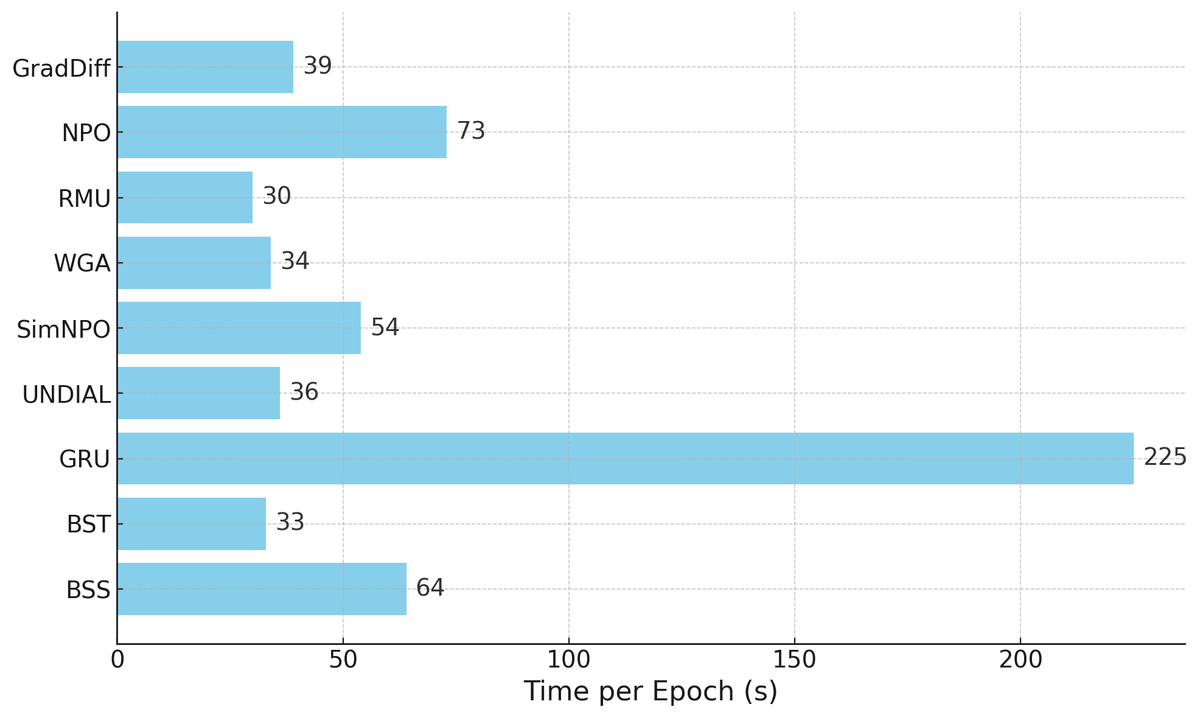
k), so throughput is close to lightweight baselines like RMU and WGA.
The limitations are honest. The bootstrapping coefficient λ is the most influential hyperparameter and typically needs model- and dataset-specific tuning. The theoretical analysis covers the off-policy BS-S variant, but the on-policy version (resampling during training) breaks the teacher-forcing assumption of the learning-dynamics framework and remains unexplained formally. Still, exposing spurious unlearning as a systematic outcome of softmax normalization, rather than a corner case, is likely to reshape how the field evaluates forgetting going forward.