
Researchers Build PPMT to Stop Cloud Translators From Leaking Private Data
A new benchmark tackles the risk of leaking sensitive names, companies, and figures when sending text through cloud translation APIs.
 Pro
Takeaways
- New task PPMT protects private named entities during machine translation inference without touching model architecture.
- Three annotated benchmark datasets released: WMT18, WMT20, and a financial-domain corpus with entity-level privacy labels.
- Privacy Exposure Rate (PER) metric measures leakage in both uploaded text and returned translations.
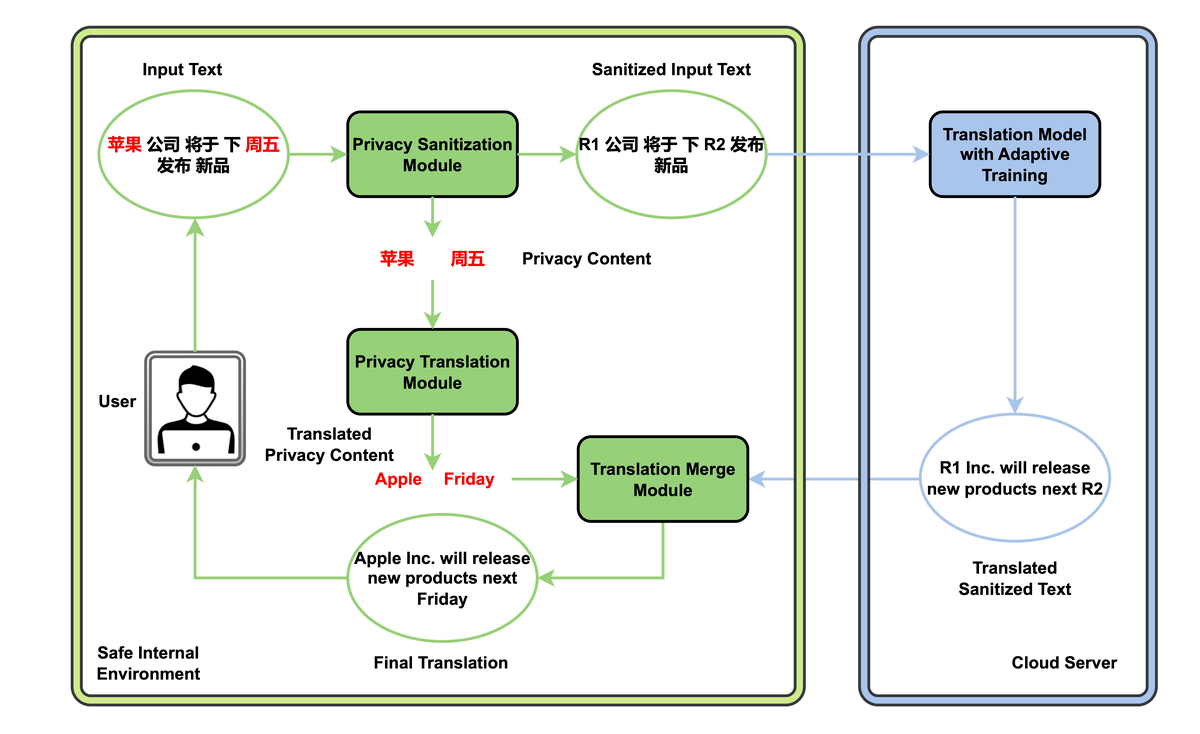
- Split-translate-merge framework uses placeholder replacement, adaptive training, and client-side merging to keep entities off the server.
- Tag-based method: 20.9 SacreBLEU vs 22.8 baseline, 21s client latency vs 1802s for local Qwen3-8B.
- Main weakness is NER accuracy in the implicit setting, where PER climbs to around 0.2. Read the paper.
Every time a company employee pastes confidential text into an online translator, the raw content leaves the internal network and lands on someone else's server. A new paper argues that machine translation has been surprisingly slow to address this, and proposes a formal task, three annotated datasets, and a working framework to fix it.
The authors introduce Privacy-Preserving Machine Translation (PPMT), a task focused on protecting private information during the inference stage of a translation model rather than during training. While privacy protection during the inference stage of NLP models has received attention through sanitization methods, secure multiparty computation, and local differential privacy, these techniques have mostly been applied to text classification, summarization, and question answering rather than machine translation. That gap is the paper's starting point.
Why translation is a leaky pipe
The motivating scenario is concrete. There was an incident at the Norwegian oil company Statoil where private information was leaked due to the use of online translation tools, which has led some financial institutions to prohibit employees from using external online translators. If your text contains a customer name, a merger target, or an unreleased product code, uploading it to a public API is a compliance problem.
Defining what counts as private is the hard part. The authors narrow the scope pragmatically: they limit privacy content to named entities including person names, locations, organizations, quantities, and time. That covers roughly 80% of the sensitive spans they observed in real text while keeping annotation tractable.

The split-translate-merge framework
The proposed benchmark method keeps the cloud translation model at arm's length from private content. A privacy sanitization module replaces private terms like the Chinese words for "Apple" and "Friday" with placeholders such as R1 and R2, while those private terms are translated separately by a privacy translation module that the cloud model never sees. A merge module then stitches the two translations back together on the client side.
Three sanitization strategies are compared:
- Entity-based placeholder: swap the private entity for a random entity of the same type (person for person, place for place) so the sentence still reads as natural language.
- Dictionary-based placeholder: swap in a fixed entity drawn from a small translation dictionary, giving the cloud model a predictable output to align against.
- Tag-based placeholder: replace the entity with a symbolic tag like
<PINFO0>that the translation model is trained to pass through untouched.
Because dictionary and tag replacements distort the input distribution, the authors do what they call adaptive training, where named entities in the bilingual training data are replaced with translation pairs from these dictionaries or tags to construct a new training dataset used to train the translation model. They also mix the original and modified sentence pairs together as a data augmentation step so the model still handles sentences with little or no private content.
Measuring leakage: the PER metric
Standard BLEU tells you nothing about privacy, so the paper defines a Privacy Exposure Rate (PER). It counts private tokens that appear in the text sent to the cloud and in the translation returned, averages the two ratios, and reports the fraction. Lower is better, zero means nothing leaked. The three benchmark datasets combine WMT18 Zh-En, WMT20 Zh-En, and a manually collected financial-domain corpus, annotated for five entity types.
How well it works
In the explicit setting, where the user already knows which spans are private, PER drops to zero across all datasets. The translation quality cost is modest. On WMT18 Zh-En, the standard Transformer scores 22.80 SacreBLEU, while the tag-based system with adaptive training scores 21.40 for three entity types and 20.80 for five. The dictionary-based variant lands in the same range.
The more interesting numbers come from the comparison against classical privacy-preserving techniques. The authors benchmark against Embedding-LDP (local differential privacy at the embedding layer), Power-Softmax (a homomorphic-encryption based secure multiparty scheme), and locally deploying Qwen3-8B for translation. On WMT18 Zh-En:
| Method | SacreBLEU | PER | User latency |
|---|---|---|---|
| Tag-Trans (this paper) | 20.90 | 0.18 | 21.6s |
| Embedding-LDP | 18.50 | 0 | 32.3s |
| Power-Softmax | 17.40 | 0 | 58.2s |
| Qwen3-8B (local) | 23.50 | 0 | 1802.0s |
Local LLM deployment wins on quality and gives absolute protection, but at roughly 80x the client-side compute cost. The sanitization approach is the only one that keeps translation quality close to the unprotected baseline without heavy client compute.
Where it falls over
The framework has real limits that are worth naming. In the implicit scenario, where a named entity recognizer has to find the private spans automatically, PER climbs to around 0.2. This means only one of every five privacy terms is not protected, and the problem is caused by the effectiveness of automatic privacy identification tools rather than the framework itself. Swapping in a stronger recognizer, like a fine-tuned RoBERTa, meaningfully improves the numbers.
Case studies also expose two failure modes. When a private entity is missing from the phrase translation dictionary, it gets translated poorly. And over-replacement happens when the recognizer mis-tags a span, so a phrase like "100 billion yuan" can become "130 yuan" after replacement, dropping the magnitude entirely. The authors also concede that defining privacy purely through named entities misses contextual privacy, which is why they released two extended datasets covering ten entity types and contextual privacy annotations.
Why this matters
Nothing here requires modifying the architecture of a Transformer or paying homomorphic-encryption overhead. If you run an in-house translation product and want to offer a privacy mode without deploying an 8B model on every client, this framework gives you a reasonable starting point: run NER on the client, replace hits with tags, send the sanitized text to your existing translation endpoint, and merge locally. The datasets will be made public after review. The bigger contribution is the benchmark itself, which finally gives the machine translation community shared datasets, a defined metric, and reference baselines for a problem that production teams have been solving ad hoc for years.