
Renmin University's Two-Stage YOLOv8 Pipeline Cuts Drone Wildfire Detection Compute by 10x
A lightweight pipeline pairs a learned frame selector with an attention-boosted YOLOv8, cutting compute up to 23x while keeping wildfire detection accurate.
Takeaways
- Two-stage UAV wildfire pipeline: learned frame selector plus attention-augmented YOLOv8 detector.
- Station point mechanism uses future anchor frames to stabilize the policy network's decisions.
- Cuts FLOPs 23x on HMDB51 and 9x on FLAME while matching or beating accuracy.
- YOLOv8+ResCBAM hits 66.6% mAP@50 on the Fire & Smoke dataset; ECA variant is free at inference.
- Trained with Gumbel-Softmax to avoid slow RL convergence on the discrete action space.
- Not strict real-time: future-frame dependency introduces latency; causal variants left for future work.
Running heavy vision models on a drone flying over a burning forest is a losing battle. Onboard GPUs are tiny, batteries are finite, and most video the UAV streams back contains no fire at all. A new paper from researchers at Renmin University, Kyoto University, and Tohoku University tackles this with a two-stage pipeline that first discards boring footage, then runs a beefier detector only on the frames that matter.
The paper, Two-Stage Framework for Efficient UAV-Based Wildfire Video Analysis, extends the authors' IROS 2024 conference work. The core idea is straightforward: detect the presence of fire in UAV video streams first, and only localize the source once fire is confirmed. Everything else is engineering to make each of those two steps cheap.
Why frame-by-frame inference is the wrong default
Wildfires are rare events in any given frame, but standard detectors process every frame identically. That wastes compute on empty forest canopy and, worse, drains the drone before it reaches the actual incident. Existing frame-selection methods like AdaFrame, which uses a memory-augmented LSTM to guide selection, or SMART and MGSampler, were designed for benchmarks like ActivityNet and Kinetics. Aerial wildfire video looks different: sparse informative frames, drifting smoke, and camera shake from wind gusts.

Stage 1: a policy that decides how much to skip
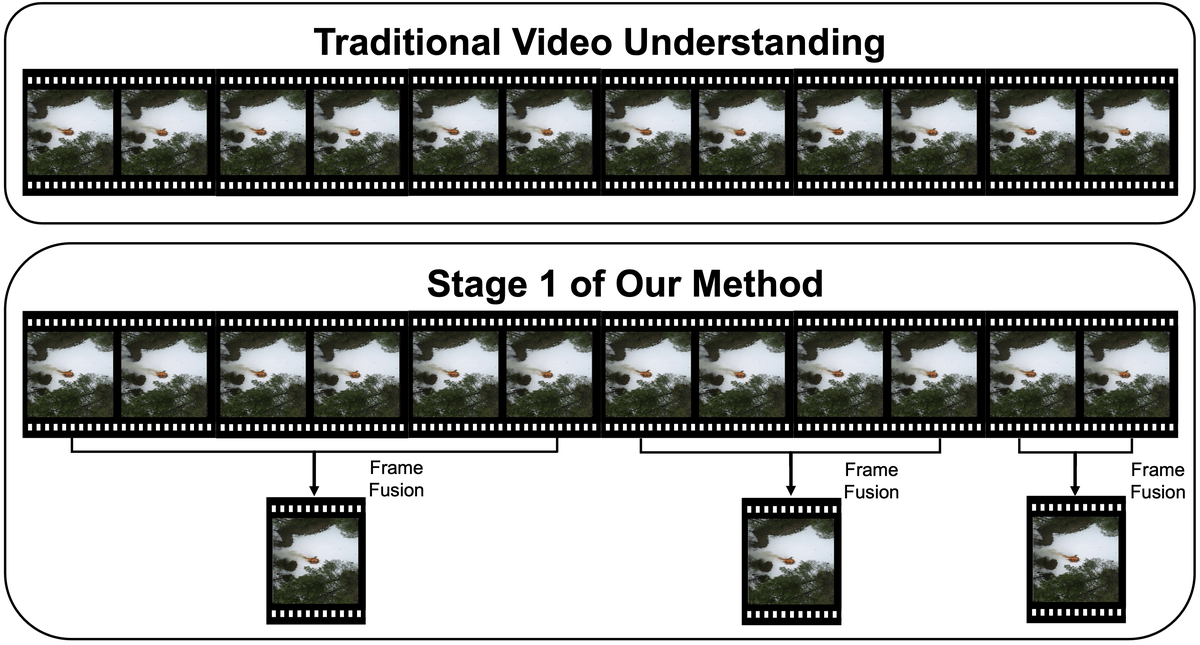
Stage 1 is where the compression happens. Each incoming clip passes through a MobileNetV2 backbone, then a GRU builds temporal context. A small policy network chooses an action from the set