
Renmin University's GenRecEdit Fixes Broken AI Recommendations Without Retraining
A training-free editing framework injects cold-start item knowledge into generative recommenders, restoring near-zero accuracy at 9.5% of retraining cost.
 Pro
Takeaways
- GenRecEdit adapts NLP model editing to fix cold-start collapse in generative recommenders, where accuracy on new items nears zero.
- The framework injects cold-start semantic-ID patterns as editable knowledge without retraining the model.
- Three components: position-wise pseudo interactions, locate-then-edit with probing classifier, and One-One triggering at inference.
- Achieves updates in 9.5% of retraining time while dropping only 6.5% on warm-item NDCG@10.
- Tested on three Amazon 2023 Review categories against SASRec, TIGER, LC-Rec, and SpecGR baselines.
- Code released at github.com/Starrylay/GenRecEdit; paper accepted at SIGIR 2026.
Generative recommenders were supposed to solve the cold-start problem. Instead, researchers from Renmin University of China have documented a failure mode they call cold-start collapse, where recommendation accuracy on newly introduced items drops to near zero even though the model was designed to handle them. Their fix, GenRecEdit, borrows a page from language model editing and injects new item knowledge into a frozen recommender in a fraction of the time retraining would take.
The collapse nobody wanted to admit
Generative recommendation (GR) turns each item into a short sequence of discrete semantic ID tokens, then trains a sequence-to-sequence model to autoregressively generate the next item's tokens. In theory this should generalize to unseen items because their semantic IDs can be constructed offline from content. In practice, when cold-start items are introduced after training, recommendation accuracy on cold-start items can drop to nearly zero.
Digging into why, the authors found two revealing patterns. Well-trained GR models can often correctly generate the first semantic ID token of cold-start items, indicating substantial latent potential for cold-start recommendation. But regardless of whether the final recommendation is correct, GR models exhibit a strong bias toward generating seen semantic ID patterns. The model knows the rough category of a new item but keeps completing sequences with token combinations it saw during training.

The obvious fix, retraining or finetuning on cold-start interactions, breaks down in practice. Feedback on brand-new items is sparse, incremental training is slow, and full retraining is prohibitively expensive for catalogs that turn over hourly, like news feeds or short-video platforms.
Borrowing a trick from language model editing
In NLP, model editing has become a popular way to inject facts into a large language model without retraining it. Approaches like ROME and MEMIT treat the feed-forward layers as key-value memories and compute a targeted rank-one update to W_out that swaps one factual association for another. The team wondered whether cold-start items could be treated the same way, as editable knowledge.
Two problems block a direct port. First, edits in NLP anchor on a subject-object binding ("The American president is Donald Trump"), letting the editor localize a subject representation and steer decoding toward a target object. GR sequences are just chains of anonymous semantic IDs, with no explicit subject. Second, edits usually target stable multi-token phrases like proper names, but the semantic ID pattern of a cold-start item was never seen at training, so there is no reliable co-occurrence signal to latch onto.

How GenRecEdit actually works
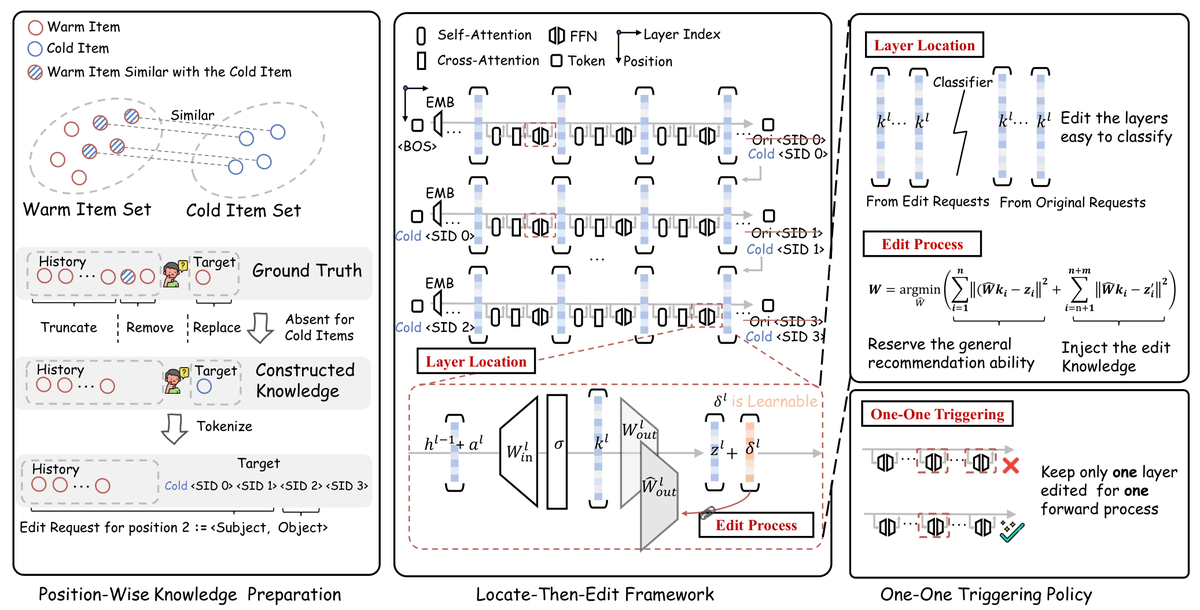
GenRecEdit sidesteps both issues with three components:
- Position-wise knowledge preparation. For each cold-start item, the system encodes its metadata with Sentence-T5, finds the top-k most similar warm items by cosine similarity, and borrows the interaction histories that preceded those warm items. Those synthetic sequences become pseudo edit requests of the form
<subject, object>, where the subject is the interaction history plus the SID prefix and the object is the next single token. - Locate-then-edit. For each of the four SID positions, a linear probing classifier is trained to discriminate cold-start activations from original-training activations at every layer. For each position, we take the top-1 layer by accuracy as the edit layer. A closed-form least-squares update then adjusts that layer's FFN output weights to inject the new associations while a preservation term keyed on the original activations protects existing behavior, with a hyperparameter lambda balancing the two.
- One-One triggering policy. Because edits live on different layers for different SID positions, running them all simultaneously creates cross-position interference. The authors add a gating mechanism so that when decoding position p, only the edit at layer l_p fires. They prove that under a bounded interference assumption the deviation from the ideal probability is on the order of 1.5 epsilon.
What the numbers say
Experiments run on three Amazon 2023 Review categories, Video Games, Software, and Cell Phones and Accessories, with cold subsets making up 65.6%, 24.3%, and 75.5% of each test set. Baselines include SASRec, BERT4Rec, VQ-Rec, TIGER, LC-Rec, full retraining, finetuning, and SpecGR.
GenRecEdit generally posts the best overall NDCG and Recall across the three datasets while remaining competitive on the cold subset itself. The more interesting result is on the warm subset, where methods that chase cold-start gains usually forget everything else. Under the TIGER backbone on Phone, GenRecEdit incurs the smallest loss on the warm subset in terms of NDCG@10, with only a 6.5% drop. Finetuning, by comparison, drops 87% on the same metric, a textbook case of catastrophic forgetting.
On update cost, the framework is training-free at edit time. Normalized to full retraining at 100%, finetuning takes 18.1%, SpecGR's alignment 41.6%, and GenRecEdit just 9.5%. Ablations confirm the two most load-bearing pieces are position-wise knowledge preparation and the One-One triggering policy; removing either collapses performance close to zero.
Where it fits and where it does not
GenRecEdit is most useful when a GR model is already in production and the catalog changes faster than the retraining cadence. News, short video, live-streaming commerce, and any long-tail marketplace where items appear hourly are natural fits. The framework depends on being able to construct decent pseudo interaction histories for cold-start items, which in turn requires meaningful text or content metadata to embed with Sentence-T5. Items with essentially no metadata will fall back on whatever the base tokenizer can extract.
There are limits. The authors report a persistent quality gap between GenRecEdit and an upper bound that uses ground-truth cold-start histories, meaning better retrieval of pseudo neighbors is still open research. There is also a tunable trade-off between injection and preservation controlled by lambda; the paper sweeps values from 0 to 5000 and picks per-dataset optima, so operators will need to calibrate. And the framework is currently demonstrated on a T5 backbone with six decoder layers and gated-silu activations, since the default ReLU can make the key matrix low-rank and the inversion in the closed-form update ill-conditioned.
The code is available on GitHub, and the technique is scheduled to appear at SIGIR 2026. For teams already running semantic-ID-based recommenders, it is one of the first end-to-end demonstrations that the LLM-editing literature transfers to recommendation, and it does so without touching the training loop.