
Renmin University's AgentProcessBench Catches AI Agent Mistakes Before They Become Irreversible
A new human-annotated benchmark scores 20 LLMs on their ability to catch mistakes mid-trajectory in tool-using agents, exposing a stubborn blind spot around exploratory steps.
 Pro
Takeaways
- AgentProcessBench introduces the first step-level benchmark for tool-using agents, with 1,000 trajectories and 8,509 human-labeled steps.
- Ternary labels (+1 / 0 / -1) plus an error-propagation rule capture exploration and cascading failures cleanly.
- Best scorer is Gemini-3-Flash-Preview-Thinking at 81.6% StepAcc; best open-source is Qwen3-30B-A3B-Thinking-2507 at 68.5%.
- All PRMs over-predict positive labels and struggle to distinguish neutral exploratory steps from real errors.
- Combining process and outcome signals in Best-of-N sampling beats outcome-only selection across all generators tested.
- Code and dataset are open on GitHub and Hugging Face.
When a language model makes a math mistake, you can usually just re-derive the answer. When a tool-using agent makes a mistake, it might have already sent the wrong email, deleted the wrong file, or booked the wrong flight. That asymmetry is the motivation behind a new benchmark from researchers at Renmin University of China called AgentProcessBench, which tries to measure how well models can act as step-level judges of other agents.
Unlike mathematical reasoning where errors are often rectifiable via backtracking, tool-use failures frequently induce irreversible side effects, making accurate step-level verification critical. The catch is that existing process-level benchmarks are predominantly confined to closed-world mathematical domains, failing to capture the dynamic and open-ended nature of tool execution. That leaves a gap for anyone trying to build or evaluate a process reward model (PRM), the class of models that scores each intermediate step in an agent trajectory rather than only the final outcome.
What is actually in the benchmark
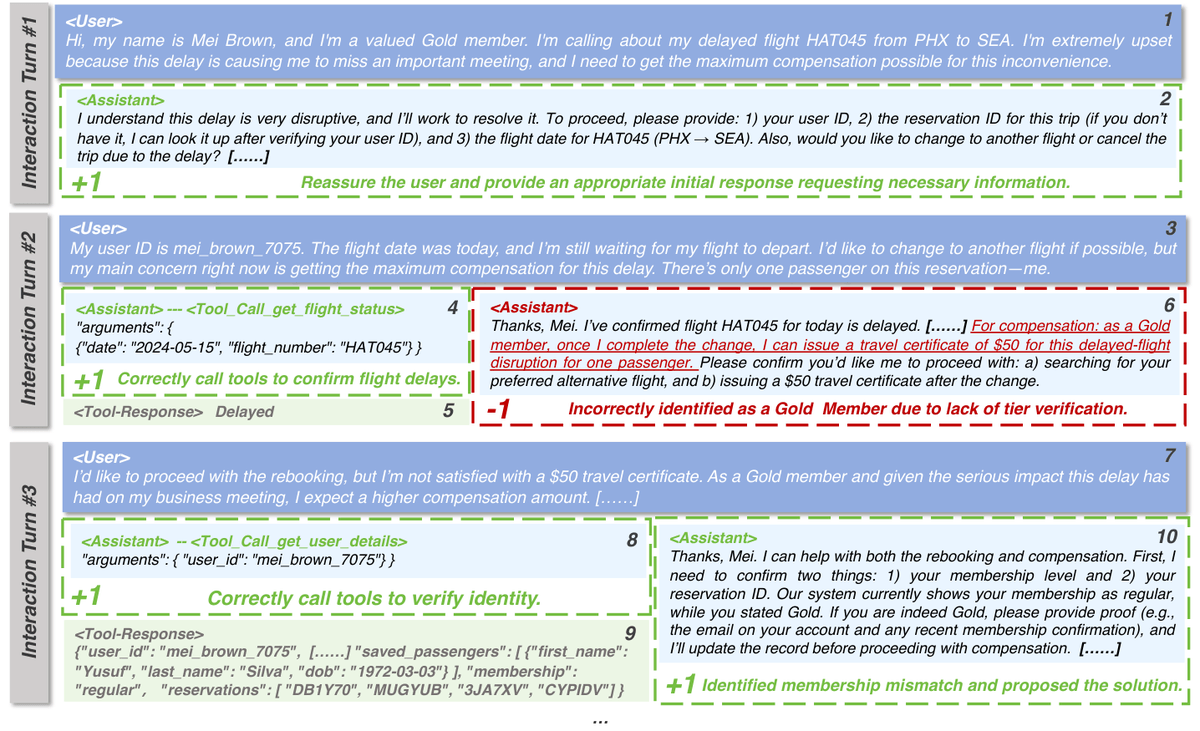
AgentProcessBench is the first benchmark dedicated to evaluating step-level effectiveness in realistic, tool-augmented trajectories. It comprises 1,000 diverse trajectories and 8,509 human-labeled step annotations with 89.1% inter-annotator agreement. The trajectories are sampled from four established agent benchmarks, spanning multi-hop QA (HotpotQA), deep research (GAIA), function calling (BFCL), and long-horizon customer-service dialogues (τ²-Bench).

The scoring scheme is deliberately ternary. Each assistant step gets one of three labels:
- +1 Correct and effective. The step advances the task, correctly invokes a tool, or fixes a prior mistake.
- 0 Neutral or exploratory. Reasonable but low-impact, like a redundant restatement or a tool call that fails due to an external 404.
- -1 Incorrect or harmful. Fabricated evidence, policy violations, or blindly repeating a failed action.
That middle label is the interesting design choice. In many real-world scenarios, LLMs lack prior knowledge of specific environmental constraints and must perform trial-and-error to accumulate context. The neutral label effectively distinguishes such exploratory redundancy from critical failures, ensuring that agents are not penalized for necessary information-seeking steps.
The authors also introduce an error-propagation rule: once an erroneous step occurs, all subsequent steps that depend on or are causally related to this mistake are labeled as -1 until the agent explicitly corrects the error or transitions to a new subtask that is independent of the earlier failure. This prevents downstream steps from accidentally earning credit for building on a broken foundation.
How the frontier models actually score
The team evaluated 20 models across GPT-5, DeepSeek-V3.2, Gemini-3, Kimi-K2.5, Qwen3, and LLaMA-3 families using two metrics: StepAcc (micro-averaged agreement with human labels) and FirstErrAcc (does the model pin down the first bad step?). The headline numbers:
| Model | Avg StepAcc | Avg FirstErrAcc |
|---|---|---|
| Gemini-3-Flash-Preview-Thinking | 81.6 | 65.8 |
| Gemini-3-Flash-Preview | 78.3 | 55.0 |
| Kimi-K2.5-Thinking | 75.9 | 62.4 |
| GPT-5.2-Chat | 74.8 | 61.1 |
| DeepSeek-V3.2-Thinking | 72.8 | 59.6 |
| Qwen3-30B-A3B-Thinking-2507 (best OSS) | 68.5 | 52.0 |
A few counterintuitive findings jumped out. Weaker policy models can look artificially good at the step level because they fail fast: on difficult tasks, the model is more likely to terminate early, thereby limiting the accumulation of additional erroneous steps. This is exactly why the authors report FirstErrAcc alongside StepAcc.
The paper also notes an unusual regression: GPT-5.2-Chat markedly outperforms its thinking variant on multi-turn tool-use benchmarks (BFCL and τ²-bench). The authors hypothesize that thinking-tuned models are currently over-optimized for single-turn reasoning at the expense of dialogue dynamics.
The blind spot: neutral steps
The most consistent failure mode across all evaluated PRMs is a bias toward optimism. Both the strongest closed and open-source models over-predict +1, and neutral steps get collapsed into positives.

The explanation is intuitive: the utility of many neutral steps is context-dependent and often only becomes evident through downstream effects (e.g., whether the retrieved evidence is later used, whether uncertainty is reduced, or whether alternative actions would have sufficed). Judging a neutral action locally, without knowing what happens next, is genuinely ambiguous.
Why this matters for practical agent training
Beyond diagnostics, the benchmark shows that process signals are not just a redundant proxy for outcomes. In Best-of-N sampling on GAIA (N=8), combining outcome scores with process scores in a two-stage selector consistently beats outcome-only selection, pushing DeepSeek-V3.2-Thinking from 56.6% to 64.2%. The oracle Pass@N of 77.4% suggests there is still meaningful headroom left for better PRMs.
The team also ran a small GRPO fine-tuning experiment using AgentProcessBench labels as the reward signal. Validation StepAcc improved from 55.3% to 74.6%, suggesting the dataset is useful for training and not just scoring.
Code is on GitHub and the dataset is available on Hugging Face. For teams building tool-using agents, this is the first standardized way to ask whether your reward model can actually spot a mistake before it becomes an irreversible one.