
ReDimNet2 Beats 324M-Param Models Using Only 12.3M Parameters
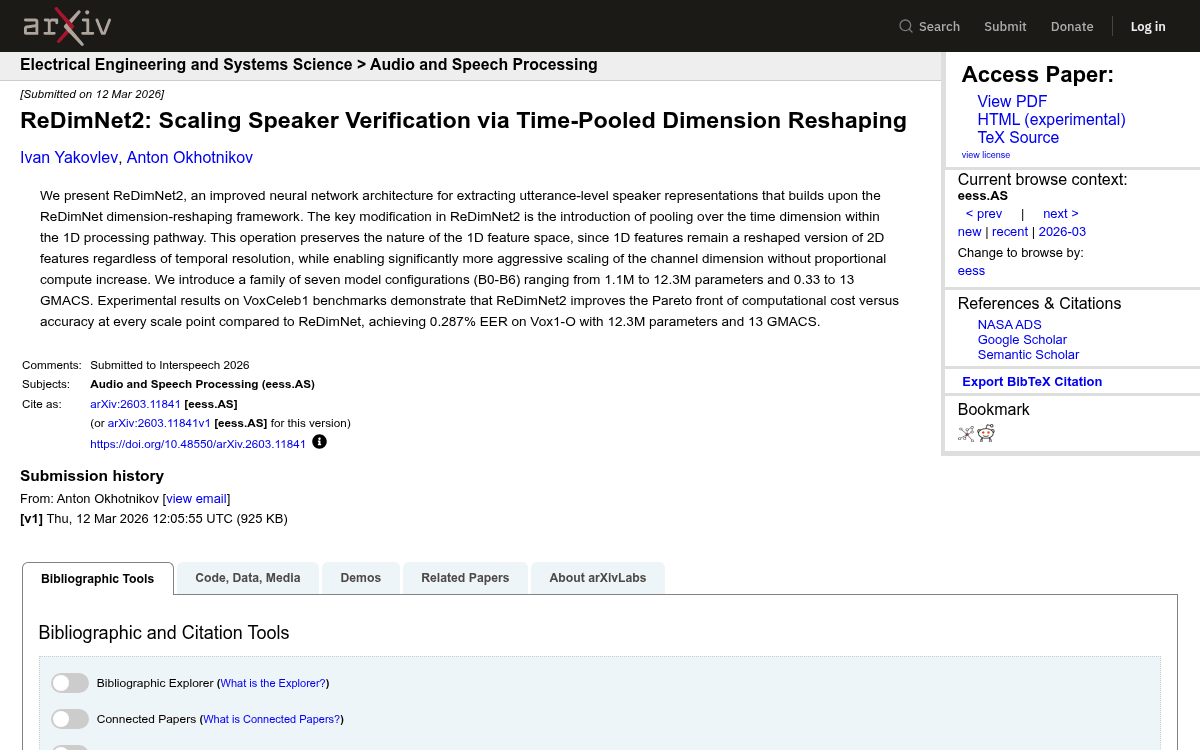
A single architectural tweak, pooling over time inside the 1D pathway, lets ReDimNet2 push speaker verification error to 0.29% EER on Vox1-O.
 Pro
Takeaways
- ReDimNet2 adds time-pooling to the 1D pathway of ReDimNet, unlocking wider channels at the same compute.
- Seven configurations B0 to B6 span 1.1M to 12.3M parameters and 0.33 to 13 GMACs.
- B6 reaches 0.29% EER on Vox1-O, a 28% relative gain over ReDimNet-B6 with 36% fewer GMACs.
- Outperforms WavLM (324M) and approaches W2V-BERT 2.0 (587M) at up to 48x fewer parameters.
- Out-of-domain gains hold on SITW, VOiCES, and VoxCeleb1-B protocols.
- Code and pretrained weights released at github.com/PalabraAI/redimnet2.
Speaker verification models have been stuck in an awkward tradeoff for a while. The dominant architectures either process audio as a 1D time signal (cheap, fast) or as a 2D time-frequency map (accurate, expensive), and hybrid designs have to bolt the two together. ReDimNet solved that elegantly by reshaping features back and forth between the two views. Its successor, ReDimNet2, keeps the same trick but fixes the scaling wall the original hit when researchers tried to make it wider.
The result is a family of seven models from 1.1M to 12.3M parameters that beats the original at every point on the compute-versus-accuracy curve, with the largest configuration reaching 0.29% EER on Vox1-O and 0.99% on Vox1-H with only 12.3M parameters and 13 GMACs.
The scaling wall in the original design
The original ReDimNet leaned on dimensionality reshaping between 2D feature maps and 1D signal representations, enabling joint use of 1D and 2D blocks, with a topology that preserves the volume of channel-timestep-frequency outputs to enable efficient residual aggregation. In plain terms, every 2D feature map in the network has the same total size C times F times T, so it can be flattened into a 1D sequence and added back to any other stage as a residual.
The catch is that the design forbids any stride along the time axis. The key modification in ReDimNet2 is the introduction of pooling over the time dimension within the 1D processing pathway. This operation preserves the nature of the 1D feature space, since 1D features remain a reshaped version of 2D features regardless of temporal resolution, while enabling significantly more aggressive scaling of the channel dimension without proportional compute increase. Without time reduction, doubling the channel count doubles the cost of every 1D block, which made wider models prohibitively expensive.
The one-line insight
The authors noticed something the original architecture missed: reshaping between 1D and 2D does not actually care about the length of the time axis. As long as C times F stays consistent, you can shrink T however you want and the residual connections still line up (after a cheap upsample at the point where stages get combined).

Concretely, ReDimNet2 reuses the same strided conv2d that already handled frequency downsampling, but applies it along the time axis at intermediate stages. Time-pool stages halve T without touching channels or frequency bins, softly relaxing the volume constraint. Every stage still processes features at its own reduced temporal resolution, and nearest-neighbor upsampling only happens at the final aggregation step, so the compute savings inside each block are preserved.
The savings compound in an interesting way. The 1D blocks get cheaper because their sequences are shorter. But the 2D blocks also get cheaper, because when the shorter 1D sequence is reshaped back into 2D, the spatial extent of the resulting feature map shrinks too. That freed budget is spent on wider channels, which is where the accuracy actually comes from.
Numbers on VoxCeleb
The paper introduces seven configurations B0 through B6, ranging from 1.1M parameters at 0.33 GMACs up to 12.3M at 13 GMACs. Every one of them Pareto-dominates its ReDimNet counterpart. A few highlights:
- B6 hits 0.29% EER on Vox1-O, a 28% relative improvement over ReDimNet-B6, while using 36% fewer GMACs and 18% fewer parameters.
- B6 outperforms WavLM (324M params) and approaches W2V-BERT 2.0 (587M params) at roughly 48x fewer parameters.
- B3 at 2.7 GMACs beats ECAPA2 on Vox1-O while using about 69x less compute.
- Even the smallest B0 drops Vox1-O EER from 1.16% to 1.04%.
Out-of-domain results hold up too. On SITW, VOiCES, and VoxCeleb1-B, B6 edges out its predecessor on all three sets, so the time-pooling does not appear to trade generalization for efficiency.
Caveats worth knowing
Training stability is not uniform across the family. The smaller configurations (B0 through B3) are essentially deterministic across seeds, but the larger ones drift more, with B6 showing about 0.05 percentage-point standard deviation on Vox1-O EER across runs. If you plan to train from scratch at the top of the range, budget for extra regularization or hyperparameter sweeps.
The other honest limitation is that this is still purely a supervised speaker embedding model. It will not match the raw ceiling of massive self-supervised systems like W2V-BERT 2.0 trained on VoxBlink2 plus VoxCeleb2, which reaches 0.14% on Vox1-O. What it does offer is roughly that class of accuracy at a fraction of the compute, which matters for anything running on-device or at scale.
Where it fits in practice
Speaker embeddings from ReDimNet-family models have already shown up as building blocks in several adjacent systems. ReDimNet's compact and accurate speaker embeddings have since been adopted in diverse downstream tasks: speaker conditioning for zero-shot text-to-speech synthesis, speaker similarity evaluation in speech enhancement and speech generation, and as a compact speaker encoder for personal voice activity detection. ReDimNet2 is a drop-in improvement for any of these pipelines, and the smaller B0 to B2 configurations are cheap enough for real-time or edge deployment.
Code, training recipes, and pretrained weights are available on the official GitHub repository, with all models trained on VoxCeleb2-dev.