
ReasonMap Exposes How AI Models Fail Basic Transit Map Planning
A new benchmark tests whether multimodal models can actually read subway maps, exposing a surprising gap between open and closed source reasoning models
 Pro
Takeaways
- ReasonMap benchmarks fine-grained visual reasoning on 1,008 QA pairs from 30 high-resolution transit maps.
- OpenAI o3 leads at 63.02% short-question accuracy; even top models miss nearly 40% of questions.
- Open-source base models beat their reasoning-tuned variants; the pattern reverses for closed-source models.
- Masking the map degrades performance sharply, confirming answers require real visual grounding not language priors.
- A GRPO RL baseline nearly doubles Qwen2.5-VL-7B accuracy under cross-city evaluation.
- Failures stem mostly from grounding and spatial reasoning, not OCR, per capability analysis.
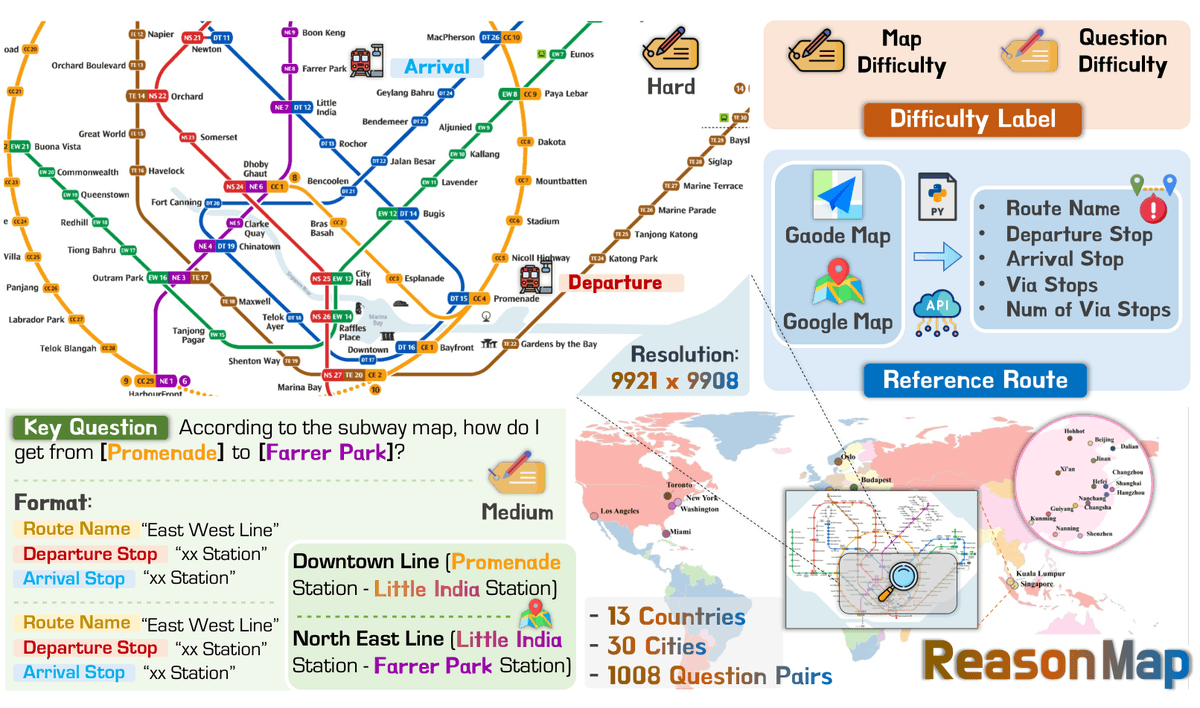
Ask a modern multimodal model to solve a geometry proof or answer questions about a chart and it will often do well. Ask it to plan a subway route from one station to another using a high-resolution transit map, and things fall apart quickly. That is the finding behind ReasonMap, a new benchmark that stress-tests the fine-grained visual reasoning of MLLMs on something humans do every day: reading a metro map.
The team argues that most existing multimodal reasoning benchmarks lean on either symbolic math or coarse scene understanding. Datasets like MathVQA, MMMU, and MathVerse primarily assess symbolic or mathematical reasoning where visual understanding plays a limited role, while VisuLogic, VisualPuzzles, and V*Bench require detailed perception but minimal planning or spatial reasoning, and CityBench, DriveBench, and MapBench take a step toward spatial reasoning while remaining coarse in granularity. Transit maps sit in the awkward middle: they demand pixel-level perception of line colors and station labels, plus multi-step planning over transfers.
What ReasonMap actually contains
The benchmark is small on paper but dense in pixels. ReasonMap comprises 1,008 human-verified question-answer pairs spanning 30 cities across 13 countries, where each instance includes a map, two stops, two questions (short and long), multiple reference routes, and two difficulty labels for map and question difficulty. The maps themselves are the differentiator. According to the paper, average resolution is roughly 5,839 by 5,449 pixels, dwarfing typical benchmark images that live around 600 by 400.
Questions come in three templates: one short question that asks only for the route name and endpoints, and two long variants that ask either for the number of via stops per segment or for the explicit list of intermediate stations. Difficulty is graded by counting transfers. Routes with no transfers are labeled easy, those with one transfer as medium, and all others as hard.

How answers get scored
Rather than string-matching a final answer, ReasonMap uses a two-level scheme. Correctness is a strict pass or fail: the departure and arrival stops must match, every route name in the answer must exist in the ground-truth metro data, and consecutive segments must share a valid transfer station. On top of that, a graded map score awards partial credit. Matching the endpoints is worth one point, the route name two, and each correct segment endpoint one, with additional components for long questions that either compare via-stop counts through absolute error or compute an intersection-over-union between the predicted and reference via-stop sets.
Because the metrics are rule-based and non-differentiable, the authors argue standard supervised fine-tuning cannot directly optimize for them, so they build a reinforcement learning baseline instead. They fine-tune Qwen2.5-VL-3B and 7B using Group Relative Policy Optimization, the same RL algorithm behind DeepSeek's math reasoning work, with two reward signals: a binary accuracy reward and a format reward that penalizes unparseable outputs.
The counterintuitive result
Sixteen models were evaluated, split into base and reasoning variants across open and closed source families. The headline finding flips a common assumption. Among open-source models, base variants outperform their reasoning-tuned counterparts, whereas the opposite trend is observed in closed-source models.
Concretely, Qwen2.5-VL-72B-Instruct scored the best weighted accuracy among open models at 26.65 percent on short questions, while reasoning-tuned open models like Kimi-VL-A3B-Thinking (5.47 percent), Skywork-R1V-38B (6.86 percent), and QvQ-72B-Preview (9.03 percent) all landed dramatically lower than their base counterparts. On the closed side, OpenAI o3 topped the chart at 63.02 percent short-question accuracy and 59.11 percent on long questions, well above GPT-4o's 41.15 percent and 42.80 percent.
The authors' explanation is worth pausing on. They point to recent work arguing that reinforcement learning biases models toward high-reward responses and limits exploration, and note that most open-source reasoning MLLMs are fine-tuned mainly on math, physics, and logic, which reinforces domain-specific behavior. Case analyses show the open reasoning models often engage in trial-and-verification loops that introduce visual confusion, sometimes finding the correct route and then overriding it during self-reflection. Closed-source reasoning models tend to self-correct within the chain instead, which the authors attribute to stronger visual grounding.
Testing whether models actually look at the map
A recurring concern with multimodal benchmarks is that models cheat by relying on language priors, essentially answering from memorized world knowledge without looking at the image. ReasonMap tests this directly by masking the visual input and re-running the evaluation. Most models degrade, and the drop is larger for closed-source systems. Doubao-115 falls by more than 20 points on short-question accuracy without the map, and Doubao-415 drops from 43.14 percent to 21.53 percent. Meanwhile Qwen2.5-VL-3B actually improves slightly when the image is removed, suggesting it was leaning on priors all along.

Common failure modes
Error analysis surfaces a small set of recurring problems worth knowing about if you plan to build or evaluate on this kind of task:
- Visual confusion between similar lines. Models mistake Line 9 for Line 16 when colors or layouts are close, an error observed even in o3 and Doubao.
- Format violations. Some responses contain the correct route but deviate from the required structure, making them unparseable.
- Hallucination. Models occasionally repeat their own answer or invent content, such as claiming to have generated an image.
- Refusals. Skywork-R1V-38B in particular declines to answer some queries outright.
- Grounding over OCR. A capability breakdown shows OCRBench scores do not correlate with ReasonMap accuracy, and most failures come from grounding and spatial planning rather than reading text.
Does RL fine-tuning help?
Yes, meaningfully. Under a cross-city setup where training and test maps are disjoint, GRPO fine-tuning raised Qwen2.5-VL-7B's short-question accuracy from 13.28 percent to 26.22 percent and long-question accuracy from 7.12 percent to 26.04 percent, while also reducing token usage. That is a large jump from a relatively small training set, and it lands the 7B model near Qwen2.5-VL-72B territory on this task.
Availability
The dataset, toolkit, and evaluation code are hosted on the project page, with code released under MIT and the benchmark under Apache 2.0. There is a 312-sample test split and a training set for the remaining questions, along with per-city map difficulty labels for slicing results. If you are working on visual grounding, spatial planning, or RL post-training for MLLMs, ReasonMap is a useful and unusually punishing target: even the strongest reasoning model available today gets nearly four out of ten short questions wrong.