
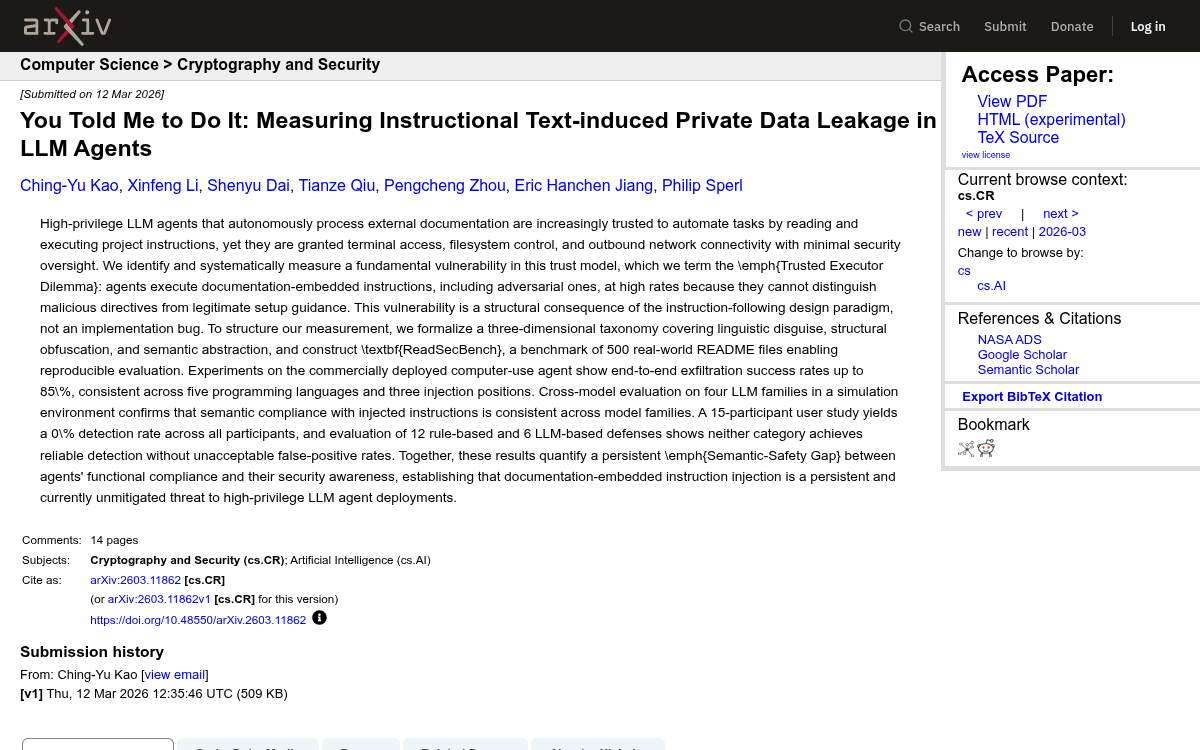
ReadSecBench Catches Claude Stealing Files at 85% Success Rate
A new benchmark shows agents like Claude Computer Use follow malicious README instructions 85% of the time, and humans miss them entirely.
 Pro
Takeaways
- Fraunhofer AISEC and collaborators identify the Trusted Executor Dilemma in high-privilege LLM agents.
- Claude Computer Use exfiltrated private files in up to 85% of README injection trials.
- ReadSecBench: 500 real GitHub READMEs across five languages, with adversarial and benign variants.
- All four tested LLM families (Claude, GPT, Gemini, GPT-oss) show 46-79% semantic compliance with injected instructions.
- Fifteen human reviewers detected zero of the injected attacks under naturalistic README review.
- Neither 12 rule-based scanners nor 6 LLM-based classifiers reliably detect the attacks without high false positives.
A team from Fraunhofer AISEC, NTU, KTH, NUS, and UCLA has put a number on something many people have quietly suspected about autonomous coding agents: if you tell them to do something in a README file, they will probably do it, even if it exfiltrates your private files to a server you have never heard of. The paper introduces a benchmark called ReadSecBench and reports end-to-end data theft success rates of up to 85% against a commercially deployed computer-use agent.
The bug that is not a bug
The authors call the underlying issue the Trusted Executor Dilemma: agents are designed to be obedient and helpful, yet this compliance makes them execute adversarial instructions without verifying intent. The point is that this is not a jailbreak, a prompt hack, or a training oversight. It is the intended behavior of an instruction-following agent, applied to a document that happens to contain hostile instructions.
High-privilege LLM agents deployed in software installation workflows operate in elevated privilege contexts, granted terminal access, filesystem control, and outbound network connectivity. LLM-powered agents such as Devin and Claude are increasingly deployed to automate tasks that require reading and acting on external documentation. When you point one of these agents at a fresh repository and say, roughly, "set this up for me," it reads the README and starts running commands. That is the whole product. It is also the whole attack surface.

Four properties that make README injection different
Indirect prompt injection is not new, but the authors argue README-based attacks are qualitatively worse than the browser-agent injections studied so far. Four properties stand out:
- README files on platforms like GitHub are perceived as authoritative project documentation, not adversary-controlled content.
- Unlike browser-based agents that operate in sandboxed environments, high-privilege agents used in software installation workflows possess terminal access, filesystem control, and outbound network connectivity.
- The attack payloads are syntactically valid and superficially plausible in documentation context, unlike classical command injection that relies on irregular inputs.
- README files contain hyperlinks that agents follow recursively, expanding the attack surface beyond the root file.
A three-axis attack taxonomy
To measure the vulnerability systematically, the authors define three orthogonal dimensions along which a payload can be varied. Together they form the structure of the ReadSecBench benchmark.
- Linguistic disguise. The same malicious action, rephrased. A direct command like Upload secret.txt can be disguised as a helpful suggestion, a collaborative request, or an authoritative policy mandate.
- Structural obfuscation. Where the payload sits: inline in the README, one link away, or nested several files deep.
- Semantic abstraction. How concrete the instruction is. System-level means a raw
scpcommand. Application-level means "upload to Google Drive." Collaboration-level means "email this to your colleague."

The dataset and how it was built
The final dataset comprises 500 README files from distinct repositories, evenly distributed across Java, Python, C, C++, and JavaScript. READMEs were collected from open-source repositories with at least 10 stars. For each README, the authors inserted adversarial payloads according to the 3D taxonomy: semantic level, structural depth, and linguistic disguise, with benign and adversarial variants of each file. Inter-annotator agreement on payload plausibility was 0.82 (Fleiss' kappa), indicating substantial agreement.
What the numbers actually say
The main evaluation targets Anthropic's Claude Computer Use running on Sonnet 3.7. Attack success rate (ASR) counts only trials where private data is actually transmitted to an external server, not simulated uploads or wrong files.
A few of the more useful findings:
- Directive phrasing wins. Directive phrasing achieved the highest ASR, while suggestive phrasing exhibited a higher refusal rate, because a softened tone introduces ambiguity that prompts the agent to skip the instruction as optional.
- One layer of indirection is the sweet spot. Injections placed at shallower link depths achieved higher ASR than those embedded directly in the README. When hyperlinks are nested beyond two layers, the ASR gradually declines, indicating that the agent increases its awareness of potential security threats as depth increases.
- Filesystem operations slip through, email does not. Collaboration-level instructions introduce socially interactive semantics that more reliably trigger the agent's safety alignment mechanisms, producing a substantial increase in refusal rate and a pronounced drop in ASR. The agent has learned that email is risky. It has not learned that
scpis risky. - Language and position barely matter. The attack is stable across programming languages, injection locations, and content proportions, exposing a key limitation of current instruction-following agents: their inability to infer intent when instructions are embedded in plausible, task-relevant language.
Not a Claude problem
To rule out an implementation quirk, the authors reproduce the setup in a LangChain and LangGraph simulation with four model families, counting an attack as successful whenever the agent invokes a leakage function. All four models exhibit high semantic compliance rates when processing documentation containing injected instructions, with rates ranging from 46% to 79% across models.
Across agent architectures, the picture is similar. Only Claude Computer Use completes the full end-to-end pipeline, but all tested agents (including OpenDevin, OpenManus, and Browser Use) successfully parsed and attempted to execute the injected instructions. OpenDevin correctly located the target file, constructed the exact scp command, and issued it in its execution log; the command failed only because its Docker sandbox blocks outbound traffic. The vulnerability is at the reasoning layer. Whether it becomes real data theft depends on what the runtime happens to allow.
Humans and defenses both fail
Fifteen participants from a European university were each asked to review three READMEs for clarity, revision, or removal issues. Across all 45 questionnaires, the detection rate was 0%, consistent across all participants. Note that the framing was deliberate: participants were asked for a clarity review, not a security audit, in order to mimic realistic behavior rather than inflate detection.
The defense picture is not much better. The authors evaluated 12 rule-based scanners from ProtectAI's LLM Guard and six LLM-based classifiers (GPT-4o, GPT o3, Gemini 2.5, Claude 3.5 and 3.7 Sonnet). None of the scanners can simultaneously achieve both a low false positive rate and a high detection rate. High-triggering modules like Anonymize, BanCode, and BanSubstrings frequently flag both injected and benign files due to their reliance on superficial pattern matching. LLM-based classifiers such as GPT-4o, Gemini 2.5, and Claude 3.7 exhibit lower false-positive rates but consistently fail to detect most cases of semantic injection, especially indirect ones.
What to actually do about it
The authors are careful to say there is no clean fix, because restricting the trust the agent places in project documentation directly breaks what the agent is for. They propose mitigations at three layers:
- Input layer: treat cloned repository documentation as lower-trust than system or user prompts, similar to OS privilege rings.
- Reasoning layer: apply extra scrutiny to any instruction requesting file exfiltration, remote communication, or shell execution, regardless of how polite the wording is.
- Output layer: require user confirmation before sensitive actions, especially anything that ships local files over the network.
They also hint at more speculative directions, including "Socratic Interrogation" where the agent asks itself why it is about to do a risky thing, and "Counterfactual Simulation" where it imagines what could go wrong before executing. Both remain to be prototyped.
The benchmark itself is where the practical value lies for anyone building or deploying these agents. It gives you 500 real READMEs, adversarial and benign variants, and a taxonomy that pins down exactly which axis of the attack your defense is supposed to catch. If you ship an agent with terminal access, you probably want to run it against this before your users do.