
RAPO Beats GPT-4o at Social Conversations by Learning From User Reactions
A new reinforcement learning framework trains emotional support chatbots on simulated user reactions rather than expert rubric scores, beating strong RL baselines and GPT-4o.
 Pro
Takeaways
- RAPO trains emotional support dialogue models on simulated user reactions rather than expert rubric scores.
- Three components: Hindsight Dialogue Selection, Generative Hindsight Feedback, Scalar-Verbal Hybrid Policy Optimization.
- Generative reward model outputs both a contrastive ranking and a natural-language critique of each response.
- Critiques are folded into training via self-distillation, where the model rewrites its own failed responses.
- Beats SFT and vanilla GRPO on ESConv, EmoHarbor, and SOTOPIA; hits 8.41 goal completion on SOTOPIA.
- Main limitations: heavy compute from user simulation and inherited bias from the simulator itself.
Training a chatbot to actually console someone is harder than it sounds. The usual recipe is to score its replies against a rubric written by psychology experts, then reinforce whatever gets a high number. The result: agents that say all the textbook things, hit their reward targets, and still leave users cold. A new paper called Listening to the Echo proposes swapping that rubric-driven loop for one that listens to how the user actually reacts, and reports meaningful gains on two standard social benchmarks.
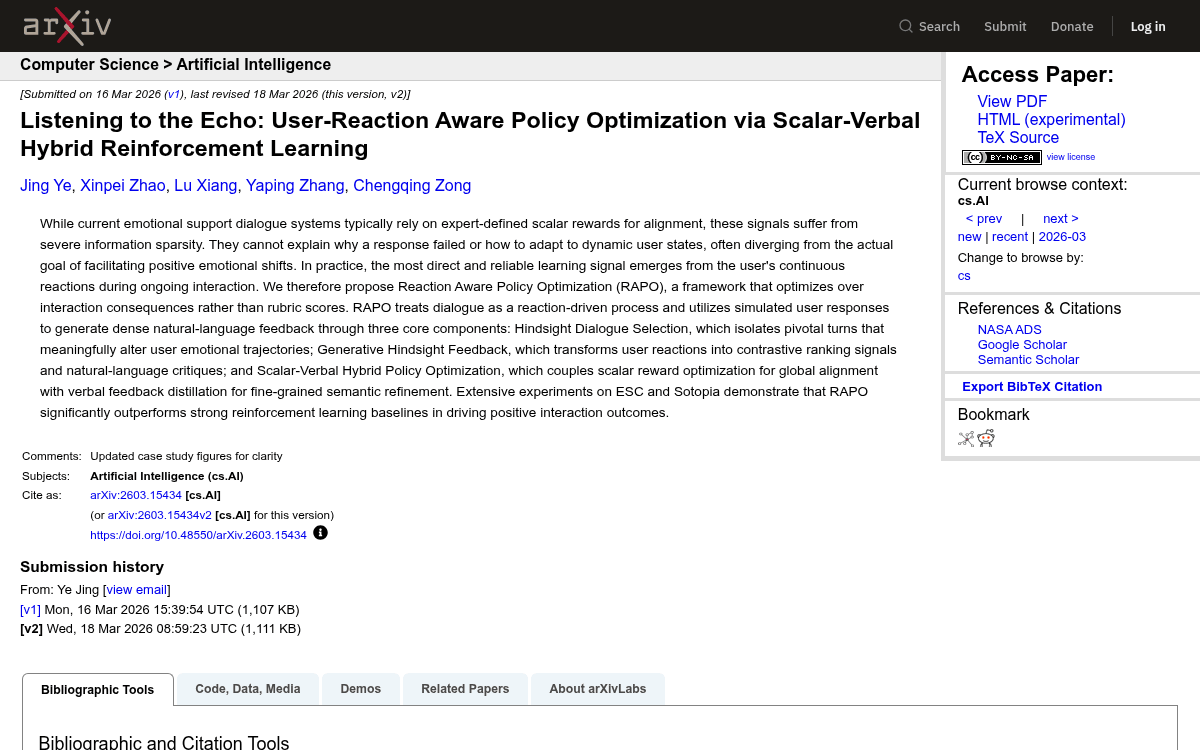
The framework, Reaction Aware Policy Optimization (RAPO), argues that the most honest signal in a supportive conversation is not a critic's score but the next thing the user says. If they respond with relief, the last turn worked. If they get defensive or shut down, it did not. RAPO shifts the optimization target from static, expert-defined rubrics to dynamic, dense natural-language feedback derived from simulated user reactions, achieving significant improvements in interaction outcomes across ESC and SOTOPIA benchmarks.

Why scalar rubric rewards fall apart
Emotional support conversation (ESC) systems have historically been trained through supervised fine-tuning on curated dialogues or reinforcement learning from a scalar reward model calibrated to expert guidelines. The authors point to two structural failures with that setup:
- Optimization mismatch. A response like "I'm sorry you feel that way" can score well on empathy rubrics while a real user finds it hollow or dismissive.
- Signal sparsity. A reward of 0.2 tells the policy it did badly but nothing about why. Was it too preachy, too vague, or was the timing of the advice wrong?
This is not a new complaint in the field. Prior work has already tried to inject user emotion into the reward function directly, for example by predicting the user's future emotions from an empathy perspective and designing a novel reward function under the RL framework, called the sentiment look-ahead method, to improve user satisfaction. RAPO pushes that idea further by making the raw user reaction, not a derived scalar, the object of optimization.
How the echo becomes a training signal
RAPO treats each dialogue turn as a mini-trajectory: the agent responds, a user simulator produces a plausible reaction, and that reaction is the ground truth for whether the response landed. Three components turn this loop into a training procedure.
- Hindsight Dialogue Selection. Instead of learning from every turn equally, the system isolates pivotal turns where the user's emotional trajectory actually shifts. This concentrates the training signal on moments that matter.
- Generative Hindsight Feedback. A generative reward model looks at a group of candidate responses and their simulated user reactions, then emits two things: a contrastive ranking (which response worked best) and a natural-language critique explaining why. The critique might read something like "the user felt invalidated because you jumped to advice too quickly."
- Scalar-Verbal Hybrid Policy Optimization. The policy is updated on both signals. The scalar ranking drives global alignment through a GRPO-style objective, while the verbal critique is distilled into the model through a self-improvement step where the policy generates a corrected response conditioned on the critique and learns from its own revision.

The verbal-feedback-as-distillation trick is the interesting part. Rather than trying to backprop through a language critique, the model uses the critique to author a better answer to its own past mistake, then treats that improved answer as a supervised target. It is a lightweight way to route dense semantic feedback into a policy update.
Benchmarks and numbers
The team evaluated on the ESConv dataset with 8 support strategies, an internal personalized-support setup called EmoHarbor, and SOTOPIA, a social simulation benchmark covering negotiation and other multi-agent scenarios. Across all three, RAPO beat both supervised fine-tuning and vanilla GRPO baselines. On SOTOPIA specifically, RAPO reached a Goal Completion score of 8.41 in harder scenarios, edging out GPT-4o according to the paper's reported results.
Qualitatively, the authors note that SFT models tended to collapse into repetitive empathy templates ("I understand how you feel..."), while RAPO-trained policies preserved semantic variety and stayed goal-directed across turns. That behavior lines up with the broader trend of recent efforts leveraging multi-turn simulations with user simulators to capture nuanced reactions. For instance, Deng et al. (2024) used seeker simulators to predict future responses and train policy planners guiding supporter models.
Where it fits and where it breaks
The obvious use cases are anywhere a dialogue agent has to steer a user's internal state over multiple turns: mental health triage, coaching, customer de-escalation, tutoring, and social simulation for game NPCs. The SOTOPIA result suggests the same recipe transfers to negotiation and other goal-driven social tasks, not just emotional support.
Two limitations are worth naming before adopting the approach:
- Compute cost. Every training step now involves rolling out a user simulator to generate reactions for each candidate response, which multiplies inference calls compared to a plain reward-model pipeline.
- Simulator bias. The policy inherits whatever blind spots the user simulator has. If the simulator lacks diversity in demographics, communication styles, or cultural norms, the trained agent will be tuned to a caricature of real users rather than real ones.
The paper does not appear to release code or model weights at the moment; only the preprint and HTML are on arXiv. For teams already running GRPO-based post-training on dialogue models, the ideas here are straightforward to reimplement: swap the frozen scalar reward model for a generative one that emits both a rank and a critique, add a hindsight-selection filter over turns, and fold a self-distillation loss on critique-conditioned rewrites into the objective.
The real shift
Underneath the acronyms, RAPO is arguing something specific about alignment for open-ended tasks. When success is subjective and context-dependent, a scalar reward is not just noisy, it is the wrong shape. What the model needs is a signal that tells it what the other party actually did with the response. Simulated reactions plus generated critiques are a pragmatic way to manufacture that signal at training time without waiting for real human feedback on every rollout. Whether the trick generalizes cleanly to domains with less predictable users, like clinical or crisis settings, is the next thing worth testing.