
Radboud's Brain Model Predicts fMRI Activity Second by Second With Uncertainty
A generative model borrows tricks from diffusion and time series forecasting to predict brain activity, beating the official Algonauts 2025 baseline.
 Pro
Takeaways
- New framework autoregressive flow matching (AFM) forecasts fMRI BOLD activity probabilistically from movie stimuli.
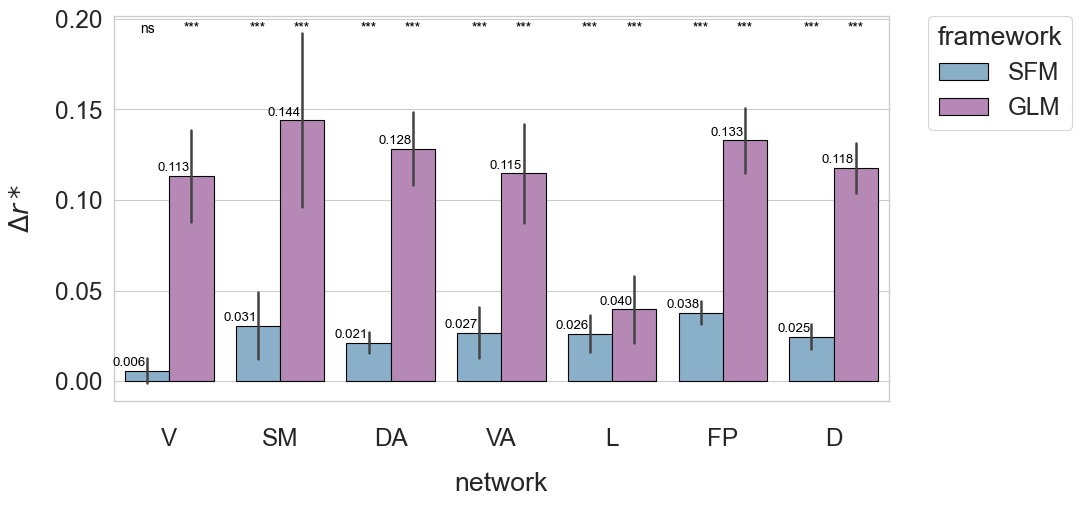
- Beats non-autoregressive flow-matching and GLM baselines on the Algonauts 2025 challenge across cortical parcels.
- Learns conditional distribution of future neural activity given past BOLD dynamics and multimodal sensory context.
- Ablation: past BOLD signal is the dominant performance driver; autoregressive factorization gives modest gains.
- Evaluated on CNeuroMod subject-specific data, 1,000 Schaefer parcels, TR of 1.49 seconds.
- Positioned for closed-loop neurotechnology applications needing short-horizon probabilistic forecasts of neural activity.
Predicting how the brain will respond to a movie scene, second by second, is one of the harder open problems in computational neuroscience. A team from Radboud University's Donders Institute and Maastricht University has a new attempt at it, using a generative approach they call autoregressive flow matching (AFM). The model forecasts fMRI BOLD signals from movie stimuli and, importantly, doesn't just spit out a point estimate. It produces a full probability distribution over what the brain might do next.
Why forecasting brains is hard
The standard way to model brain responses to naturalistic stimuli is deterministic regression: feed features from a video into a regressor, get predicted activity per voxel or parcel. That works, but it ignores two facts. Brain activity is noisy and stochastic, so a single predicted value hides real uncertainty. And the brain's next state depends heavily on its recent state, not just on what's on the screen right now.
The Algonauts 2025 challenge is where these ideas get benchmarked. It's built on the CNeuroMod dataset, with whole-brain fMRI BOLD responses to naturalistic video stimuli aligned with audio and text, including roughly 65 hours of training data from Friends seasons 1-6 and four feature films. The fMRI is parcellated into 1,000 cortical regions using the Schaefer atlas, sampled every 1.5 seconds and aligned to MNI space. A central twist is out-of-distribution generalization: models train on Friends but get evaluated on entirely different movies with distinct aesthetics and acoustics, so successful models have to learn something about brain organization rather than overfit to specific stimulus features.