
RADA Trains 3D Medical AI From Just Three Labeled Slices per Scan
A new framework uses Alpha-CLIP with sparse mask prompts to segment 3D medical scans from just three labeled slices per volume.
 Pro
Takeaways
- RADA trains 3D medical segmenters from only three labeled slices per volume using Alpha-CLIP.
- Sparse annotation masks are fed as a visual prompt via Alpha-CLIP's alpha channel, focusing features on target anatomy.
- A dual encoder fuses region-aware visual features with text prompts through a lightweight trainable Adapter.
- Three parallel V-Net sub-networks segment sagittal, coronal, and axial views with cross-view consistency loss.
- Sets SOTA on LA2018, KiTS19, and LiTS under 10% labeled settings, with large boundary metric gains.
- No public code released yet; the paper provides full pseudocode, hyperparameters, and architectural details.
Annotating 3D medical scans is one of the least glamorous bottlenecks in clinical AI. A single CT or MRI volume can contain hundreds of slices, and radiologists have to trace organ boundaries on each one to build a training set. A new framework called RADA (Region-Aware Dual-encoder Auxiliary learning) tries to break that bottleneck by training accurate 3D segmentation models from just three labeled slices per volume, using a vision-language backbone borrowed from Alpha-CLIP to compensate for the missing supervision.
Three slices, one volume
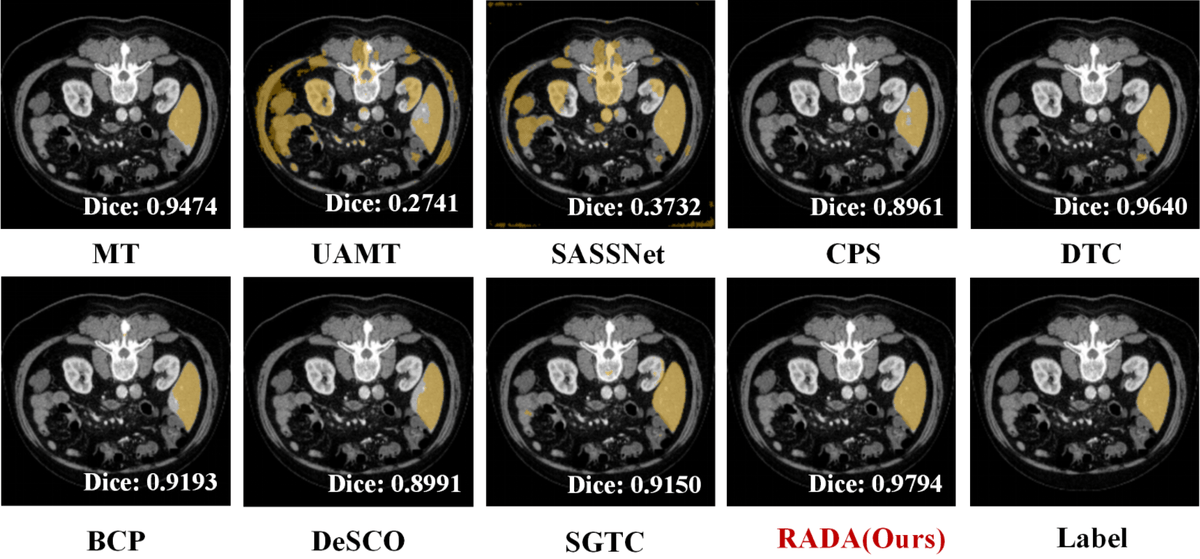
The setup here is called barely-supervised learning. Semi-supervised methods still assume some volumes are fully labeled, while barely-supervised approaches label only a handful of 2D slices inside each 3D scan and treat the rest as unlabeled. Existing methods such as DeSCO generate pseudo-labels through inter-slice registration, propagating limited annotations to neighboring slices. Because these methods rely solely on intensity and spatial correspondence, they lack semantic understanding, and pseudo-labels degrade in regions with weak boundaries or subtle intensity variations.
A more recent approach, SGTC, added text prompts through CLIP to inject class-level semantics. Its use of standard CLIP provides only a global, coarse-grained semantic prior, confined to the text encoder and lacking the fine-grained, region-aware visual features needed for pixel-level segmentation. RADA's argument is that with only three annotated slices, you need to squeeze more out of them than a caption ever could.