
R4-CGQA Boosts VLM Game Render Quality Scores by 12 Points Without Training
A new dataset and retrieval framework teaches vision language models to critique computer graphics renders across six perceptual dimensions instead of spitting out opaque scores.
 Pro
Takeaways
- R4-CGQA introduces a 3,500-image CG dataset with descriptions across six perceptual dimensions instead of only MOS scores.
- A two-stream retrieval framework combines CLIP content and RE-IQA quality embeddings to pick example descriptions.
- The approach is training free and drops directly into off-the-shelf vision language models via prompts.
- Bakllava gains 12.25 points on multiple choice; Gemma 3 gains 11.67 on yes-or-no questions.
- Feeding multiple raw images to a VLM performs worse than retrieving one similar image's text description.
- Dataset, code, and Q&A benchmarks are open source at github.com/lizhuangzi/R4-CGQA.
Rating the quality of a rendered game screenshot or a 3D movie frame is not the same problem as rating a compressed JPEG. The distortions come from lighting, materials, and simulated cameras rather than sensor noise or blocking artifacts. A new paper called R4-CGQA tackles this gap with a dedicated dataset for computer graphics quality assessment and a retrieval-augmented pipeline that plugs into off-the-shelf vision language models without any fine-tuning.
Why scalar scores are not enough
Most existing computer graphics quality datasets hand you a mean opinion score and stop there. Existing databases provide CG images with score labels, but they do not offer reasons or explanations for the assigned scores. That is a problem if you want an assessment model to tell an artist why a render looks off, not just that it does.
Directly borrowing natural image quality assessment tools does not fix this either. CG images are entirely constructed by simulation including objects, textures, light sources, and camera perspectives and thus differ substantially from natural images in both distortions and perceptual characteristics. VLMs, meanwhile, tend to hallucinate on niche visual domains, and full fine-tuning is expensive and quickly out of date.
A dataset built around how humans actually judge renders
The authors interviewed CG industry practitioners and distilled the vocabulary they use into six perceptual dimensions: lighting quality, material quality, color quality, atmosphere, realism, and space.

They then built a dataset of 3.5K CG images with diverse styles, including medieval realism, modern realism, dark realism, fantasy, and cartoons. 15 participants with gaming experience or professional backgrounds in CG annotated each image along at least three salient dimensions plus an overall verdict. Source material was pulled from Wallpaper Engine, high-definition screenshots of titles like Elden Ring, World of Warships, and World of Tanks, plus the existing CGIQA-6K database.
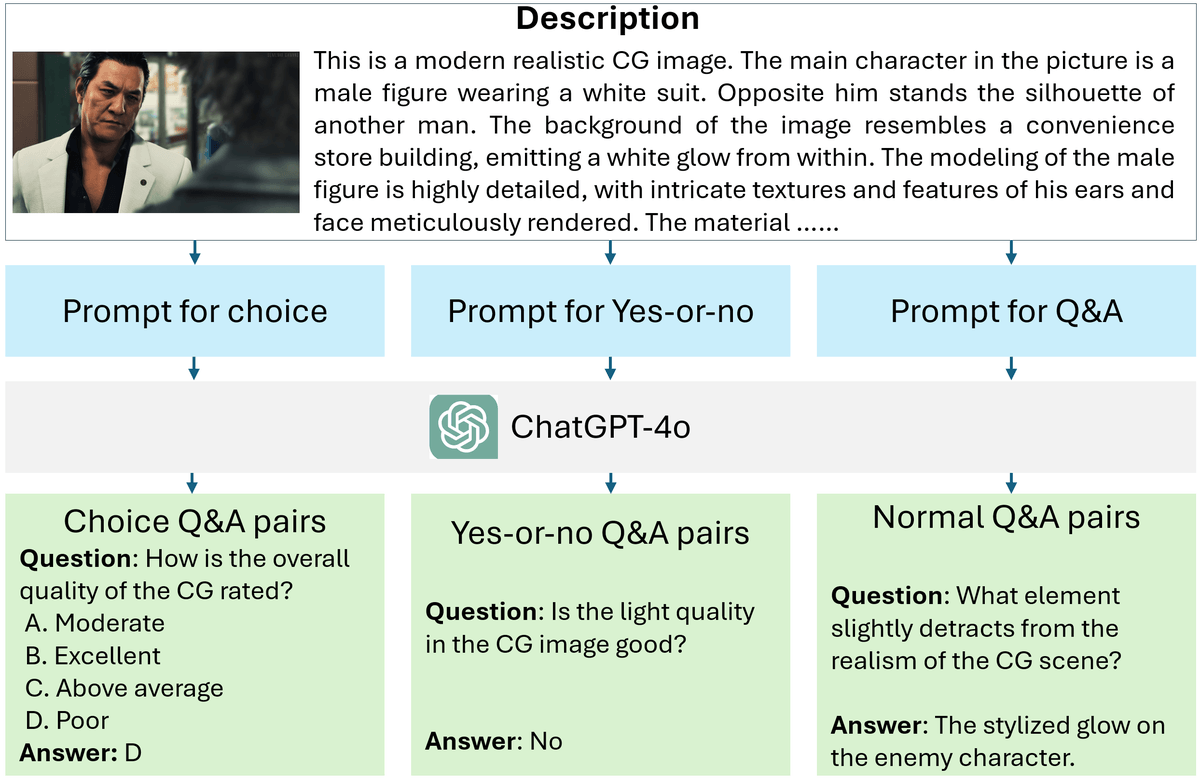
The split is 3,190 images for the base retrieval library, 90 for validation, and 220 for testing. For the eval sets, GPT-4o is used to generate three types of questions: multiple-choice, yes-or-no, and normal Q&A, producing more than 5,000 question answer pairs.
The retrieval trick that makes it work
The core insight came from a simple probe: give a VLM descriptions of visually similar CG images alongside the target, and its accuracy on quality questions jumps noticeably. Feed it irrelevant descriptions and accuracy drops. That points straight at retrieval augmented generation, but with a catch. CLIP embeddings alone are not sensitive to rendering degradations, so two images that look like the same castle scene might have very different quality.
R4-CGQA solves this with a two-stream retrieval scheme derived from a Bayesian MAP formulation. Concretely:
- Content stage. CLIP embeddings for every library image are indexed with FAISS. For a query, the top K nearest neighbors are pulled back.
- Quality stage. Within that neighborhood, a RE-IQA quality-aware ResNet computes a second embedding, and cosine similarity is measured again.
- Fusion. The two similarities are averaged with equal weights, and the highest-scoring library image supplies its human-written description as an in-context example for the VLM.
A similarity threshold guards against noisy matches. If the maximum fused score falls below the threshold, no example description is used for this query and the VLM is prompted only with the query image and question.

How much it actually helps
The authors evaluated 11 VLMs including LLaVA-1.6, Llama 3.2-Vision, Gemma 3, MiniCPM-V, Bakllava, Pixtral, LLaVA-Next, and Qwen 2.5-VL. Every model improves on every metric. Some highlights:
- Bakllava-7B jumps from 43.72% to 55.97% on multiple choice, a 12.25 point gain.
- Gemma3-4B gains 11.67 points on yes-or-no and more than doubles its Q&A score from 1.05 to 2.32.
- Llama 3.2-Vision-11B picks up 10.39 points on yes-or-no.
- Even the strongest baseline, Qwen 2.5-VL-32B, still improves from 77.71% to 79.21% on choice.
Ablations confirm both streams matter. Dropping the quality embedding or the CLIP content embedding each hurts, and the full pipeline wins on Q&A across the board. The authors also tried the obvious alternative of just feeding multiple images to a VLM that supports it. On Pixtral-12B, performance on the Choice metric decreases by 2.3%. Even when multiple images are combined with our method, performance on Choice is still 2.5% lower than R4-CGQA alone. Text descriptions of neighbors work better than the neighbor images themselves.
What it is and is not good for
R4-CGQA is training free, which is the main practical selling point. If you already have a VLM deployed for content review of game assets, VFX shots, or 3D animation dailies, you can bolt on the retrieval library and get sharper, more explainable quality feedback without touching model weights. The dataset also gives researchers a first proper benchmark for VLM-based CG assessment, with question formats that measure both accuracy and description quality.
The ceiling is bounded by the library. Coverage is currently gaming-heavy, and truly novel styles outside the base set may fall below the similarity threshold and get no retrieval boost at all. Gains also compress on the strongest models, with Qwen 2.5-VL-32B and LLaVA-Next-32B seeing improvements under two points on choice questions. And this is quality description, not pixel-level defect localization, so it will not replace tools that flag a specific broken shader.
Code, dataset, and evaluation benchmarks are available in the R4-CGQA GitHub repository.