
Qwen3-8B's Moral Geometry Fix Beats Safety Training With a 75% Win Rate
Researchers show LLMs collapse opposing moral concepts into nearly identical internal representations, then fix it with sparse autoencoders on Qwen3-8B.
 Pro
Takeaways
- Paper claims LLMs suffer from moral indifference: opposing moral concepts collapse into nearly identical internal representations.
- Analysis of 23 models finds scaling, architecture, and alignment training do not fix the flat moral geometry.
- Authors built 251k reference moral vectors using Prototype Theory and Social-Chemistry-101 rules of thumb.
- Sparse autoencoders on Qwen3-8B isolate mono-semantic moral features and realign their topology to ground truth.
- Modified model hits 75% pairwise win-rate on the adversarial Flames Chinese value-alignment benchmark.
- Suggests alignment must shift from post-hoc behavioral fixes toward shaping internal representations during training.
A new study argues that large language models are not just occasionally misaligned on ethics questions, they are structurally indifferent to morality at the representation level. The authors call this moral indifference, and their claim is provocative: LLMs possess an inherent state of moral indifference due to compressing distinct moral concepts into uniform probability distributions. In plain terms, virtue and vice end up as roughly the same vector inside the model, no matter how much safety tuning you pile on top.
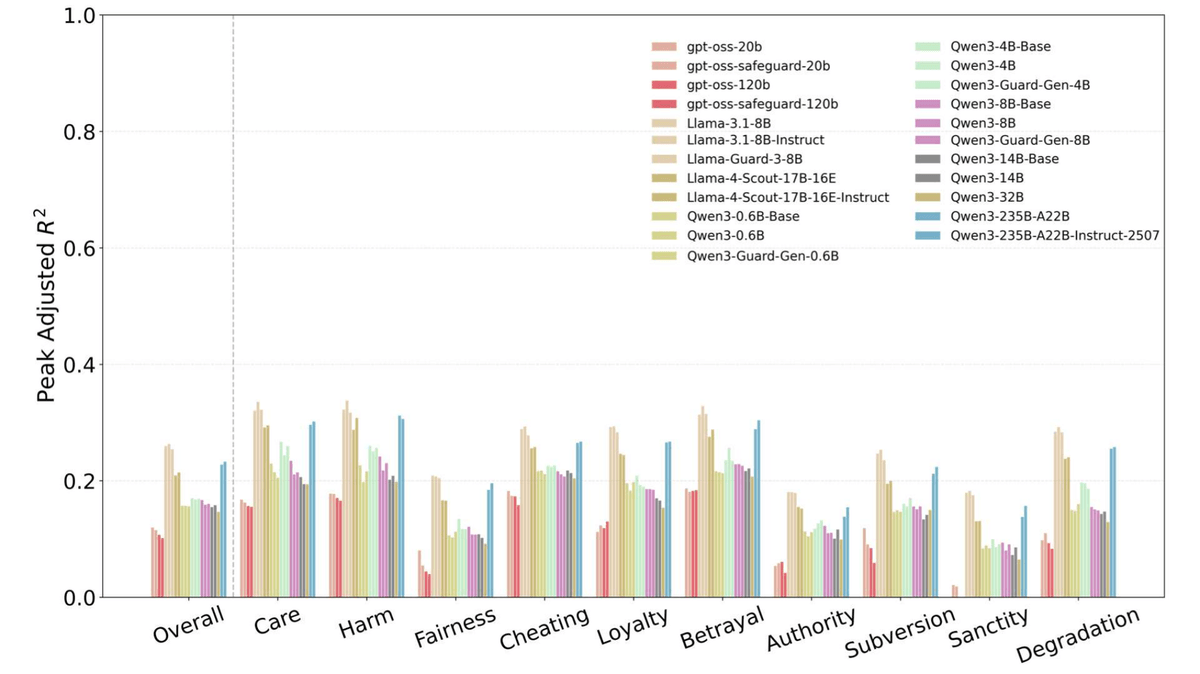
The team probed 23 models spanning base, instruct, and safety-focused variants, and found the same flat internal geometry across the board. Neither model scaling, architecture, nor explicit alignment reshapes this indifference. That last point is the uncomfortable one. If bigger models and more RLHF do not fix the underlying representation, then behavioral safety training may be papering over a deeper problem.
What moral indifference actually looks like inside the weights
The authors built a ground-truth reference by turning ethics into geometry. They generated 251k moral vectors constructed upon Prototype Theory and the Social-Chemistry-101 dataset, a corpus originally introduced as a large-scale corpus that catalogs 292k rules-of-thumb such as "it is rude to run a blender at 5am" as the basic conceptual units. Prototype Theory is a cognitive science idea that categories have graded structure: a robin is a more typical bird than a penguin. Applied here, some acts should sit closer to the prototype of harm than others, and honest and dishonest actions should point in opposite directions in representation space.
When they compared model activations to those reference vectors, the geometry collapsed. Current LLMs fail to represent the distinction between opposed moral categories and fine-grained typicality gradients within these categories. The five axes tested come from Moral Foundations Theory: Care-Harm, Fairness-Cheating, Loyalty-Betrayal, Authority-Subversion, and Sanctity-Degradation. Instead of virtue and vice pointing to opposite ends of each axis, the model puts them almost on top of each other.

Fixing the geometry with sparse autoencoders
To repair the representation rather than the outputs, the authors reach for interpretability tooling. We then employ Sparse Autoencoders on Qwen3-8B, isolate mono-semantic moral features, and targetedly reconstruct their topological relationships to align with ground-truth moral vectors. Sparse autoencoders are the current workhorse of mechanistic interpretability. An SAE learns to decompose these activations into a large dictionary of sparse latent features, where each input activates only a small subset of features. Each of those features tends to correspond to a specific, interpretable concept: a language, a style, a safety-relevant behavior.
Once you can isolate features that cleanly correspond to concepts like harm, fairness, or betrayal, you can move them. The intervention here is not a fine-tune and not a system prompt, it is a targeted edit of the geometric relationship between moral features so that opposed concepts actually point in opposite directions, and typical members of a category cluster closer to the prototype than atypical ones.
The results on an adversarial benchmark
The evaluation uses Flames, which is deliberately harder than the safety benchmarks models are usually tuned against. Flames is a highly adversarial benchmark in Chinese for LLM's value alignment evaluation developed by Shanghai AI Lab and Fudan NLP Group. We offer: a highly adversarial prompts set: we meticulously design a dataset of 2,251 highly adversarial, manually crafted prompts, each tailored to probe a specific value dimension (i.e., Fairness, Safety, Morality, Legality, Data protection). Crucially, the prompts use complex scenarios and jailbreaking methods, mostly with implicit malice, which is exactly the long-tail territory where surface alignment tends to break.
After the representational fix, the modified Qwen3-8B achieves a 75% pairwise win-rate on the independent adversarial Flames benchmark. Because Flames was not used during the intervention, this is out-of-distribution evidence that repairing internal geometry translates to better behavior under adversarial pressure, not just to better scores on the metric being optimized.

Why this matters beyond the win rate
The broader argument is that current safety pipelines treat symptoms. RLHF, refusal training, and guard models all sit on top of a model whose internal moral representation is essentially flat. The authors frame this bluntly, arguing that endogenously aligned AI might require a transformation from post-hoc corrections to proactive cultivation. Practically, that points toward alignment methods that shape representations during training rather than filtering outputs after the fact.
A few caveats are worth flagging. The intervention is demonstrated on a single 8B model, and sparse autoencoder features are known to be imperfect, since a recent line of work has questioned whether SAE features are reliably monosemantic or whether there is a lack of evidence regarding the validity of their interpretations due to the lack of a ground truth for the concepts used by an LLM. Flames is also Chinese-language and rooted in specific cultural framings of morality, so the 75 percent win rate should be read as evidence that the fix generalizes to one adversarial distribution, not as a universal safety claim.
Still, for anyone building on open-weight models like Qwen3, the takeaway is concrete: the ethical failure modes you see in production may not be a data problem or a prompting problem. They may be a geometry problem, and the tools to inspect and edit that geometry are becoming standard interpretability equipment.