
Qwen3-30B-A3B Beats 405B Models When AI Gets the Same Question Rephrased
A new metamorphic testing framework rephrases the same problem eight ways and finds that bigger reasoning models often crack under trivial rewordings.
 Pro
Takeaways
- New metamorphic testing framework probes whether reasoning models give consistent answers to semantically equivalent rephrasings.
- Eight transformations tested: identity, paraphrase, reorder, expand, contract, academic, business, and contrastive framing.
- Qwen3-30B-A3B leads robustness with 79.6% stability, beating models over 100x its active parameter count.
- Every model tested degrades under contrastive framing, with gpt-oss-120b dropping by 0.449 points.
- DeepSeek-R1 is unusually sensitive to fact reordering; gpt-oss family shows the widest variance across transformations.
- Read the full paper on arXiv for the transformation taxonomy and per-model heatmaps.
A team from the Luxembourg Institute of Science and Technology, Barcelona Supercomputing Center and Universitat Politècnica de València ran a systematic experiment that most benchmark leaderboards quietly skip: they asked whether a reasoning model gives the same answer when you rephrase the same problem. The paper introduces a metamorphic testing framework for what the authors call semantic invariance, and the ranking it produces looks almost nothing like the standard benchmark tables.
The headline result is uncomfortable for scaling maximalists. Qwen3-30B-A3B, with only 3B active parameters, achieves the best robustness profile: lowest MAD (0.049), highest stability rate (79.6%), and highest semantic similarity (0.914), while several models with 10 to 100 times more parameters were markedly more fragile.
Why accuracy scores hide the real problem
Standard evaluations like MMLU or GSM8K feed models a canonical version of each question and score the answer. The authors argue that in agentic deployments the input is never canonical: users paraphrase, reorder facts, add business framing, or paste in extra context. Mounting evidence reveals that LLMs are surprisingly sensitive to superficial input perturbations that preserve semantic content, and this fragility undermines the reliability of LLM agents in real-world deployments.
To probe this, they borrow an idea from software testing called metamorphic testing. Rather than requiring ground-truth labels for transformed inputs, metamorphic testing specifies metamorphic relations, expected relationships between outputs given known relationships between inputs. If two semantically equivalent phrasings of a physics problem produce different answers, that gap itself is the signal, no oracle required.
Eight ways to ask the same question
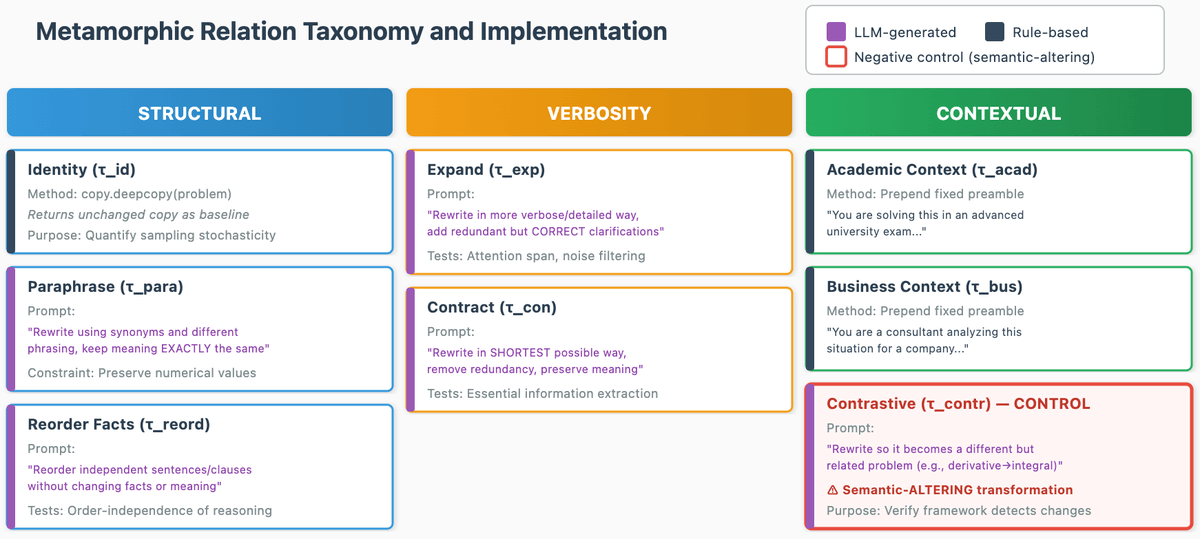
The framework defines eight transformations grouped into three families. Seven are meant to preserve meaning entirely; the eighth is a deliberate stress test.
- Structural: identity (baseline), paraphrase, and reorder facts.
- Verbosity: expand with clarifying context, or contract to the essentials.
- Contextual: reframe as an academic exam question, a business scenario, or add a contrastive alternative.
They ran these across seven foundation models spanning four distinct architectural families: Hermes (70B, 405B), Qwen3 (30B-A3B, 235B-A22B), DeepSeek-R1-0528, and gpt-oss (20B, 120B), on 19 multi-step reasoning problems distributed across eight scientific categories (Physics, Mathematics, Chemistry, Economics, Statistics, Biology, Calculus, and Optimization) at three difficulty levels. Answers were embedded with all-MiniLM-L6-v2 and compared via cosine similarity to a reference solution, giving both a solution-level score and a step-by-step trace similarity.
Two aggregate metrics do most of the work. Mean Absolute Delta averages the magnitude of score change caused by a transformation, and Stability Rate is the fraction of runs where that change stays below 0.05, meaning the model effectively didn't flinch.
The leaderboard flips
On raw accuracy, Hermes-4-70B tops the table at 0.667 and gpt-oss trails below 0.45. On robustness, the order rearranges. The full picture:
| Model | Score | MAD (lower better) | Stability | Sem. Sim. |
|---|---|---|---|---|
| Hermes-4-70B | 0.667 | 0.086 | 50.7% | 0.832 |
| Hermes-4-405B | 0.618 | 0.109 | 67.1% | 0.878 |
| Qwen3-235B-A22B | 0.529 | 0.072 | 69.7% | 0.891 |
| Qwen3-30B-A3B | 0.514 | 0.049 | 79.6% | 0.914 |
| DeepSeek-R1-0528 | 0.470 | 0.107 | 67.1% | 0.783 |
| gpt-oss-20b | 0.445 | 0.211 | 27.0% | 0.527 |
| gpt-oss-120b | 0.441 | 0.143 | 64.5% | 0.772 |
Each family shows a distinct failure signature. The Hermes family demonstrates strong baseline performance but particular vulnerability to contrastive transformations. The Qwen3 family shows the most balanced robustness profile, with minimal degradation across all MRs. The DeepSeek-R1 model exhibits pronounced sensitivity to structural transformations, particularly reorder_facts, suggesting reliance on input ordering for reasoning. The gpt-oss family shows catastrophic instability, especially under contrastive and reorder_facts transformations.
Everyone breaks under contrast
The one transformation that hurts every model is the contrastive framing, which appends an explicit comparison with an alternative scenario or common misconception. The contrastive transformation, which introduces irrelevant but superficially plausible alternative framings, induces performance degradation across all models, with mean delta ranging from -0.088 (Qwen3-30B) to -0.449 (gpt-oss-120b). That is a nearly half-point drop on a scale where the best models sit around 0.5 to 0.7, and it points at something structural. The authors suggest a fundamental limitation in attention-based reasoning when distractors are present.
There's also an asymmetric finding about verbosity that matters for prompt engineering. While Qwen3 models show slight improvement under verbosity expansion, gpt-oss and DeepSeek models degrade substantially. This suggests that additional contextual elaboration aids reasoning in some architectures, while overwhelming attention mechanisms in others. In other words, padding your prompt with helpful context can help or hurt depending on which model is behind the API.
What to do with this
The practical takeaway for anyone building agent pipelines is that robustness is a separate axis from raw capability, and you probably want to measure it on your own inputs. A few concrete implications from the paper:
- Model selection for orchestration frameworks should weight stability, not just top-line scores, especially where users generate free-form inputs.
- Ensembles that pair models with complementary failure modes (say, Hermes for baseline accuracy and Qwen3 for contrastive resilience) could hedge against single-model fragility.
- Prompt templates should be tested under paraphrase, reordering, and irrelevant-context injection before shipping, since a template that works on the canonical phrasing may collapse on the user's version.
Caveats are worth naming. The evaluation encompasses 19 problems across eight categories, which, while diverse, represents a subset of possible reasoning domains. The single-shot inference protocol also doesn't average over sampling noise, and the paraphrase and expansion transformations were themselves generated by an LLM, which could introduce stylistic bias. No code repository is linked in the paper itself, though the framework builds on the authors' earlier IEEE Access work on metamorphic testing for semantic invariance.
The uncomfortable subtext, echoing recent findings that larger models become less reliable, is that the current scaling narrative optimizes for the wrong thing when the deployment target is an autonomous agent. A 3B-active-parameter mixture-of-experts model that answers consistently may be a better substrate for a multi-step pipeline than a 405B dense model that answers brilliantly on Monday and differently on Tuesday.