
Qwen3-14B Beats GPT-4o Safety Judging at Half the Cost Using Debate
A structured debate between small language models matches GPT-4o on jailbreak judging at 46% of the cost, backed by an 11,100-example human-labeled benchmark.
 Pro
Takeaways
- Multi-Agent Judge with critic, defender, and judge roles hits kappa 0.7331 vs GPT-4o's 0.7589 at 46% cost.
- New HAJailBench ships 11,100 human-labeled jailbreak responses across 12 attacks and 11 target models.
- Three debate rounds is optimal; four or more rounds actively hurt accuracy through error accumulation.
- Fine-tuned safety judges like Llama-Guard-3-8B score near zero kappa on the harder semantic and multi-turn attacks.
- Multi-turn attacks Actor and X-Teaming exceed 50% attack success, vastly outperforming token-level GCG and COLD.
- Value-aligned five-aspect scaffolding prevents debate drift; stripping it collapses agreement to kappa 0.5200.
Using GPT-4o as a safety judge works well, but it burns money fast when you are running thousands of jailbreak attempts against dozens of target models. A new paper argues you can recover most of the accuracy by wiring together three smaller models into a structured debate, and it ships a large human-labeled benchmark to prove it.
The work introduces HAJailBench, an 11,100-example human-annotated jailbreak dataset, together with a Multi-Agent Judge that runs a critic, a defender, and a final judge over several rounds of debate. The strongest configuration, Qwen3-14B with the debate framework, reaches Cohen's kappa of 0.7331 against human labels, only 0.0258 below GPT-4o, while using 46% of GPT-4o's estimated cost per query.
Why single-shot judges keep disagreeing
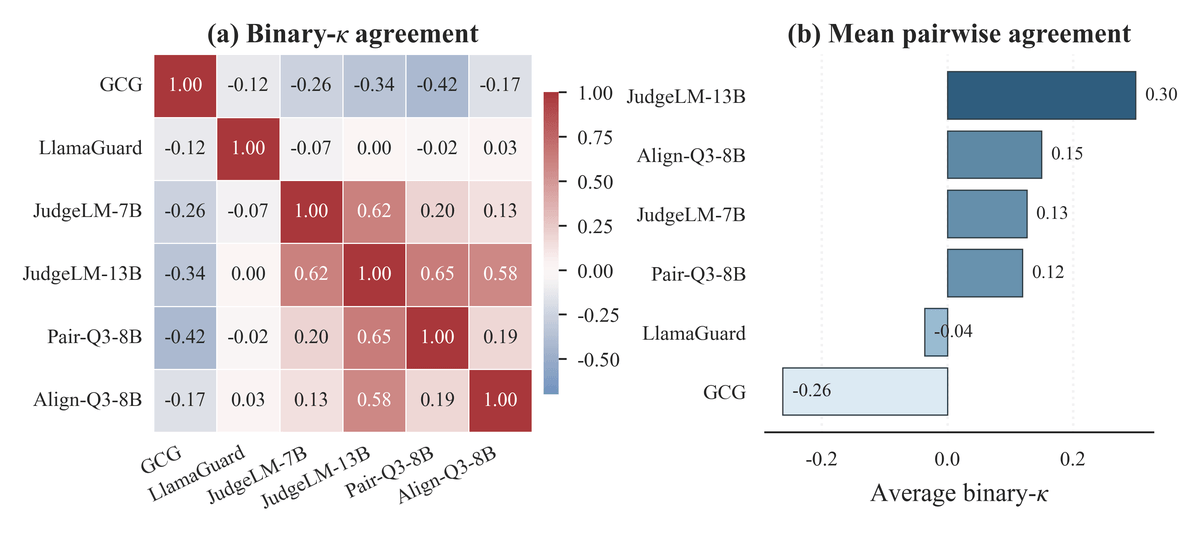
Safety evaluation today mostly relies on LLM-as-a-Judge pipelines: hand a prompt-response pair to a strong model and ask it to score harm. The problem is that judges disagree with each other more than you would expect. Pairwise agreement among safety judges is low across rule-based, fine-tuned, and prompt-based methods, which means an evaluation looking good against one judge may just be conforming to that judge's biases rather than actually being safer.
Fine-tuned safety classifiers are cheap but brittle. On HAJailBench, the best fine-tuned safety judge reaches only kappa of 0.3510, and Llama-Guard 3-8B is essentially at chance. Frontier judges like GPT-4o work, but cost dominates at scale. That is the gap the authors want to close.
How the debate actually runs
The framework is a four-stage pipeline rather than a single prompt. Cohen's kappa, for context, measures agreement between raters while correcting for chance; a value near 0.75 is generally considered substantial agreement with human labels.