
Queensland University Study Shows GPT-4 Chatbot Fights Drowsy Self-Driving Passengers
A test-track study with 40 drivers finds a GPT-4 powered voice agent measurably reduces passive fatigue in Level 3 automated cars.
 Pro
Takeaways
- QUT and Seeing Machines tested a GPT-4 voice agent in a real Level 3 autonomous vehicle on a closed track.
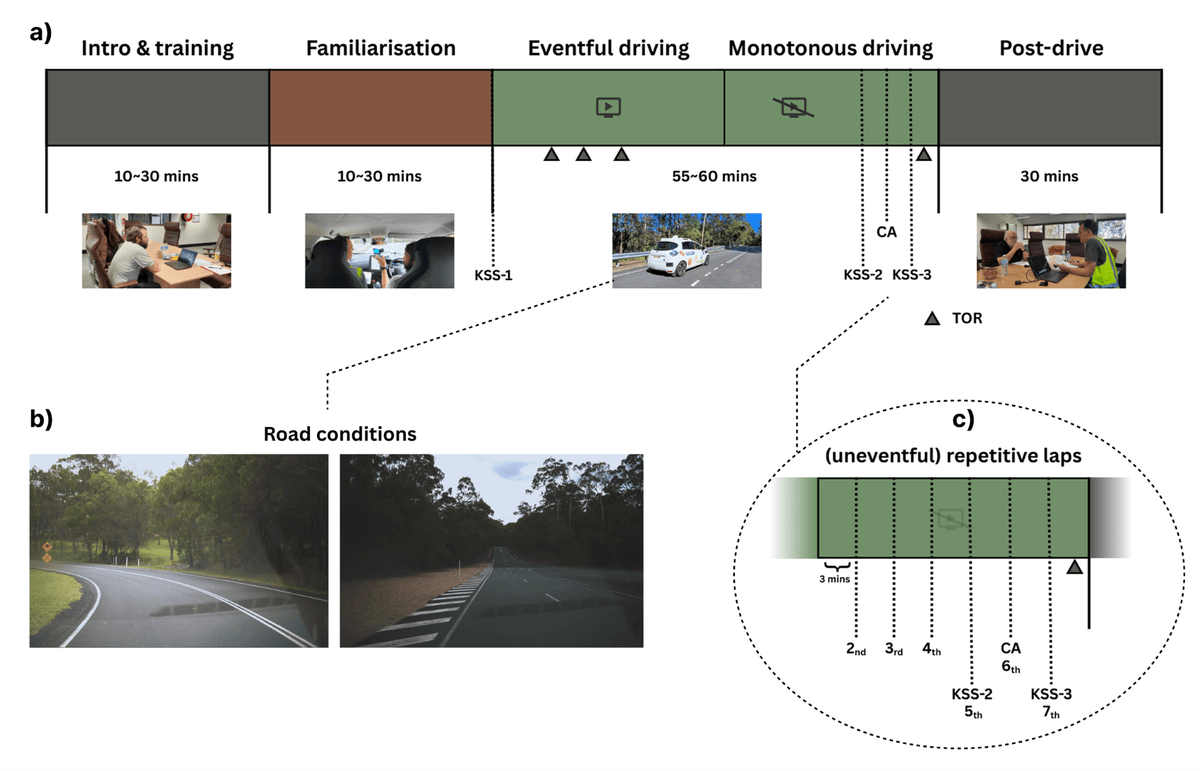
- 40 drivers, 55-minute drives; sleepiness rose without the agent and fell after a 120-second conversation.
- Agent ran on OpenAI's real-time API via an iOS app with bone-conduction headphones for hands-free audio.
- Karolinska Sleepiness Scale showed a significant Time by Group interaction (p = .006) favouring the agent.
- Three user archetypes emerged: Safety-First, Entertainment-Seeking, and Social-Connection Oriented drivers.
- Authors argue future in-car LLM agents should switch personas dynamically rather than enforce one style.
Sitting behind the wheel of a car that drives itself sounds relaxing until the boredom sets in. A new study from Queensland University of Technology and Seeing Machines argues that a chatty voice assistant, powered by a live large language model, can pull drivers back to alertness before that boredom becomes dangerous. The team ran one of the first on-road trials of an LLM-based conversational agent inside a real Level 3 prototype vehicle, and the results suggest small talk may be a viable safety intervention.
The paper, accepted to CHI 2026, tackles a paradox baked into partial automation. SAE Level 3 conditional driving automation creates conditions for passive fatigue, a mix of cognitive underload, monotony, and vigilance decline that undermines a driver's readiness to take control back. Prior work reports that fatigue sets in after as little as 15 minutes of automated driving, and traditional countermeasures like beeps, seat vibrations, or gamified dashboards can feel intrusive or fail to adapt to individual drivers.
Why the test track mattered
Most previous research on in-car conversational agents has been conducted in driving simulators or with Wizard-of-Oz setups, where a human researcher secretly plays the role of the AI. Simulators may suppress behavioural responses due to the absence of real motion and perceived risk, while WoZ setups constrain experimental control, making it difficult to replicate the precise timing and behavioural nuances of automated systems. This work puts a genuinely autonomous LLM in an actual moving vehicle on a closed circuit, exposing participants to real motion, road curvature, and the psychological weight of being in a car that is driving itself.