
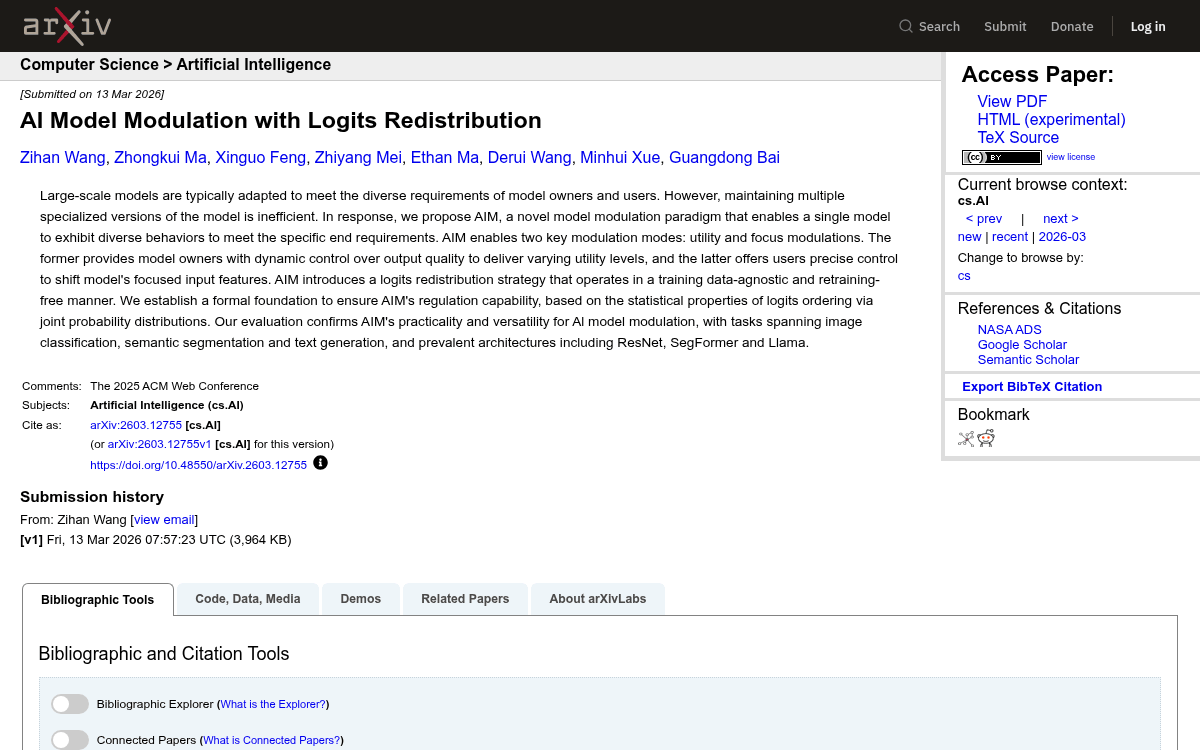
Queensland Researchers' AIM Turns One AI Model Into Many Without Retraining
A new logits-redistribution technique turns one trained model into a knob-controllable family, no fine-tuning, retraining, or training data required.
 Pro
Takeaways
- AIM modulates a single trained model's behavior by redistributing logits at inference, with no retraining or training data required.
- Utility mode adds symmetric Gaussian noise to trade accuracy for controlled degradation across service tiers.
- Focus mode adds folded normal noise to a target class, boosting its recall without hurting overall mIoU.
- Validated on ResNet-56, SegFormer-B2, and Llama-3.1-8B across CIFAR, ADE20K, KITTI, GSM8K, and MMLU.
- Pedestrian pixel accuracy rose from 91.24% to 96.20% under focus modulation with essentially unchanged mIoU.
- Code is available at github.com/UQ-Trust-Lab/AIM, published at The Web Conference 2025.
Serving a big model to different users usually means shipping different models. A free tier gets a stripped-down version, a paying tier gets the full one, and a safety-critical customer wants a variant tuned to spot pedestrians instead of cars. Each variant means another fine-tune, another checkpoint, another thing to maintain. A team from the University of Queensland and CSIRO's Data61 has proposed a way to skip that whole pipeline, using a trick that lives entirely at inference time.
Their method, called AIM (AI Modulator), treats a trained network like an instrument with a dial. Turn the dial one way and accuracy drops in a smooth, predictable curve. Turn it another way and the model starts paying more attention to a specific class you care about. The dial is not a new set of weights. It is a small statistical intervention on the model's logits, the raw scores produced right before the softmax.
One model, many personalities
AIM supports two modulation modes: utility and focus modulation. Utility modulation makes the model output deviate from the original output, which is useful in scenarios where restricted responses are desired. Focus modulation aims to make the model more responsive to specific areas of interest, which is helpful for subsystems of safety-critical systems to anticipate specific potential hazards.
The mental model is simple. Logits are the raw scores generated just before the final output probabilities, and they encapsulate the learned features and internal confidence levels across different outcomes. Even minor modifications to the logits can significantly impact the model's final output, making them an ideal point for implementing controlled adjustments. Rather than retraining, AIM inserts a control function between the feature extractor and the softmax that perturbs those scores.
How the dial actually works
For utility modulation, AIM adds independent Gaussian noise with standard deviation sigma to every logit. As sigma grows, the ordering of the logits gets scrambled more often, and accuracy degrades. The paper backs this with a clean piece of probability theory: for logits with gaps delta between adjacent ranks, the probability the top-1 prediction survives factorises into a product of standard normal CDFs of delta over sqrt(2)*sigma. In plain terms, if two classes are close in confidence, small noise is enough to flip them. If one class dominates, you need a lot of noise to knock it out of first place.
Focus modulation flips the sign structure. Instead of symmetric Gaussian noise, AIM samples from a folded normal (the absolute value of a Gaussian) and adds it only to the target class's logit. That pushes the target upward without ever pushing it down, biasing the model toward that class without touching the others' relative ordering.
A minimal implementation looks like this:
import torch
def utility_modulate(logits, sigma):
    return logits + torch.randn_like(logits) * sigma
def focus_modulate(logits, target_idx, sigma):
    bump = torch.randn_like(logits[..., target_idx]).abs() * sigma
    logits[..., target_idx] = logits[..., target_idx] + bump
    return logits
What the numbers show
The team validated AIM on three modalities. On image classification with ResNet-56, CIFAR-10 accuracy dropped from 94.37% to 20.00% as sigma increased from 0 to 20, and at sigma = 5.0 the accuracy was 72.08%, representing a basic utility level suitable for demonstration purposes. On CIFAR-100, accuracy falls from 72.62% to 4.59% over the same range. For semantic segmentation with SegFormer-B2, the Mean Intersection over Union decreases smoothly from 46.20% to 1.24% as sigma increases.
The language model results are where it gets interesting. On GSM8K, accuracy decreased from 80.74% to 2.12%, and on MMLU accuracy decreased from 66.40% to 28.03% over the range of sigma. Notably, even at higher noise levels, the generated text remains grammatically correct and coherent but tends to become excessively verbose and redundant. Llama-3.1-8B does not devolve into gibberish under noise. It just gets wordier and less reliable, which is a much more usable failure mode for a free-tier product than incoherent output.

Focus modulation delivered the kind of targeted boost autonomous driving teams look for. Increasing the noise level from 0.0 to 2.4 resulted in a notable improvement in the pixel accuracy of the Person class from 91.24% to 96.20%, with a negligible decrease in the overall segmentation quality. Bicycle and streetlight accuracy also climbed several points at sigma = 1.0 while average mIoU moved by 0.02%.

Why this is more than a temperature knob
The obvious comparison is temperature scaling, but that only rescales the softmax and preserves logit ordering. AIM is designed to change the ordering in a controlled, statistically bounded way. The other alternatives, early exit introduces intermediate exit points at different layers within a neural network, allowing early termination of inference for faster but potentially less accurate predictions, and fine-tuning both require either architectural surgery or access to training data. AIM needs neither.
The practical takeaways for anyone shipping models:
- Free vs premium tiers can come from one checkpoint with a sigma parameter.
- Focus modulation gives a per-user personalization surface without LoRA adapters or per-user fine-tunes.
- Because it only touches logits, it works across ResNet-style CNNs, transformer segmentation heads, and autoregressive LLMs.
- There is a theoretical guarantee that performance changes smoothly with sigma, so tier boundaries can be calibrated rather than guessed.
Limitations are real. Utility modulation is a controlled degradation, not a controlled improvement. Focus modulation was only shown to help segmentation; the paper does not stress-test it on classification or generation. And LLM behavior under noise trades correctness for verbosity, which is fine for a demo tier but not something you would want silently deployed in an assistant that must be concise.
The code is on GitHub under the UQ-Trust-Lab organization, and the work was published at The Web Conference. If you already ship a served model and are staring at a roadmap that includes distilled variants for cheaper tiers or fine-tunes for niche customers, this is worth a weekend of experimentation before you commit to another training run.