
Quantum Theorist Cirac Says LLMs Are Structurally Unfit for Real Physics
A team from Max Planck and ETH argues general LLMs fail at physics research and lays out what domain-specialized agents would need.
 Pro
Takeaways
- Position paper from Max Planck and ETH argues general LLMs are unfit for real theoretical physics research.
- Authors include quantum theorist J. Ignacio Cirac and ML researcher Bernhard Schölkopf.
- Identifies concrete failure modes: approximation judgment, constraint satisfaction, notation tracking, symmetry use, units.
- Argues prompting, RAG and tool use alone cannot close the gap without physics-specific training.
- Proposes deriver-critic loops, certificate-backed discovery, and physics-tuned reward signals.
- Calls for SWE-Bench-style benchmarks covering full research workflows, not exam-style problems.
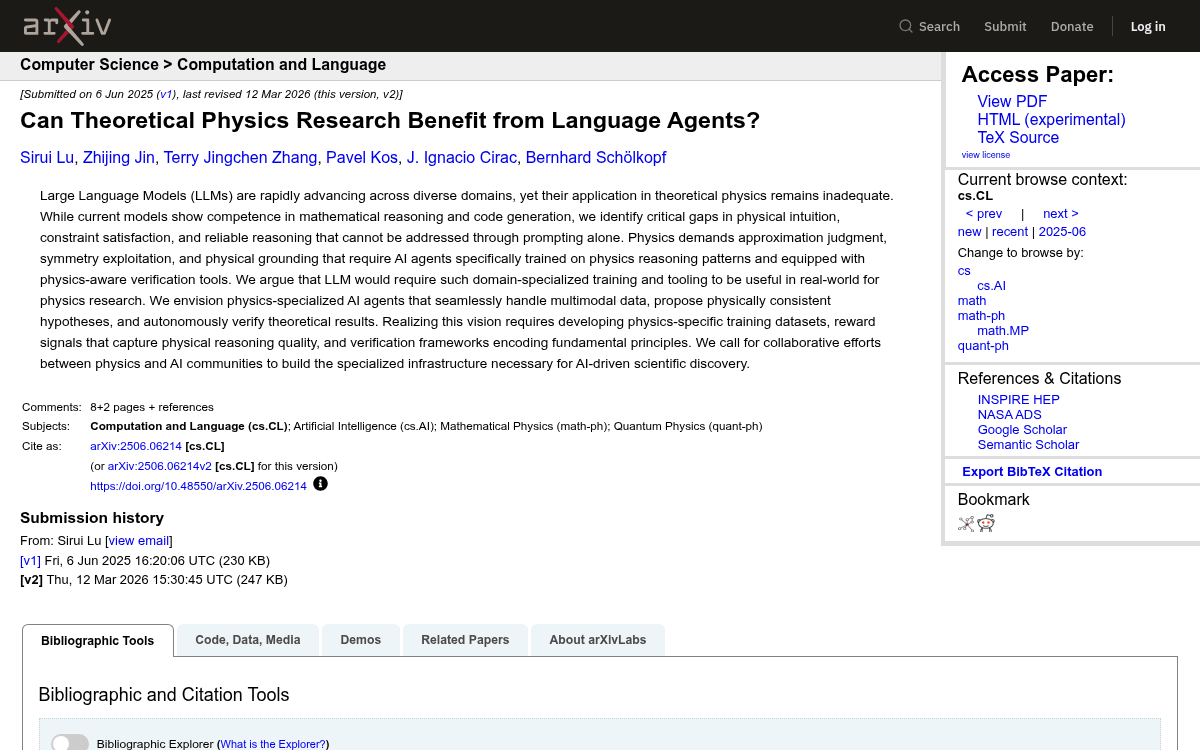
A group of physicists and machine learning researchers, including quantum theorist J. Ignacio Cirac and Bernhard Schölkopf, have published a position paper arguing that current large language models are structurally unfit for real theoretical physics work, and that prompting tricks alone will not close the gap. Their thesis: physics needs its own training data, its own reward signals, and its own verification tools, built jointly by the physics and AI communities.
The paper is not a benchmark and not a model release. It is a detailed audit of where frontier reasoning models break when asked to do the actual work of a physicist, and a roadmap for what a physics-specialized agent stack would look like.
Where general LLMs fall over
The authors accept that modern LLMs handle textbook mathematics and code generation reasonably well, but argue theoretical physics needs something different. Unlike formal mathematics with its focus on axiom-based proof, theoretical physics centrally involves constructing models, making justified approximations, seeking validation in experiments, and designing new models from scratch with physical intuition. That gap shows up in specific, repeatable failure patterns:
- Approximation judgment. Models retrieve the right perturbation formulas but skip the validity conditions, applying them where the small-parameter assumption does not hold.
- Constraint satisfaction. In modeling system-bath interactions for quantum spin systems, an LLM might erroneously place system spins and bath spins on the same lattice sites if not explicitly prohibited, producing derivations that are algebraically clean but physically nonsensical.
- Notation tracking. After a Jordan-Wigner transformation maps a spin Hamiltonian to a fermionic one, models tend to confuse operators living in different Hilbert spaces and cascade errors from there.
- Missing symmetry shortcuts. Asked for the expectation value of position in a symmetric potential, a brute-force LLM will grind through Hermite polynomials instead of noticing that the integrand is odd and the answer is zero.
- Unit and dimensional slips. Models struggle with unit consistency, for example mixing SI and natural units, raising questions about their reliability for research-level derivations.
The authors also flag a subtler failure mode from early attempts at reproducing published results: models correctly execute standard procedures like routine operator expansions but fail at the key non-standard step requiring genuine insight, such as discovering a novel proof technique or recognizing a technically delicate prerequisite.
Why prompting is not enough
A big part of the paper pushes back on the idea that retrieval, chain-of-thought and tool use can paper over these gaps. Retrieval-augmented workflows help with literature review, but performance often degrades as context length increases, a phenomenon known as "lost in the middle," and models can be easily distracted by irrelevant information. Tool use with Mathematica or SymPy helps, but only if the model can formulate the right query and interpret the output in physical context, which is exactly the skill it lacks.
There is also an alignment-tax angle worth flagging for anyone building on top of chat models: default system prompts optimized for verbose, Markdown-formatted answers can suppress the terse, formal style that mathematical physics actually uses, hiding what the underlying model can do on complex derivations.
What a physics-specialized agent stack would look like
The constructive half of the paper sketches the infrastructure the authors think is missing. The recurring theme is verification: agents that generate must be paired with agents, tools, or humans that check against physical law, not just logical consistency.
- Physics-tuned base models. Fine-tuned on domain corpora, with reward signals that go beyond pass/fail on benchmark problems and instead capture reasoning quality, dimensional analysis, and symmetry use.
- Deriver-critic loops. One agent generates a derivation, another critiques it without seeing intermediate artifacts, so the check is genuinely independent.
- Certificate-backed discovery. Focus agents on problems where candidates are hard to find but easy to verify, such as quantum error-correcting codes satisfying Knill-Laflamme conditions or Hamiltonians with exact symmetries.
- Multimodal physics parsing. Reliable handling of Feynman diagrams, tensor network notation, quantum circuit diagrams and phase diagrams, including translating them into executable code.
- Better benchmarks. The authors call for evaluations closer to SWE-Bench than to exam questions, covering full research workflows including replicating technical appendices of papers.
Why this matters for practitioners
For anyone shipping LLM tooling into scientific domains, the useful takeaway is a diagnostic checklist. If your product asks a model to do physics, the paper suggests instrumenting for specific failure modes rather than trusting aggregate benchmark scores: check whether the model states validity conditions for approximations, whether it tracks changes in variables across transformations, whether it enforces conservation laws in outputs, and whether it can exploit symmetry instead of brute-forcing integrals.
The authors are cautious about the near term. They see LLMs as promising collaborators for automating literature review, prototyping simulations, and exploring parameter spaces, but they explicitly reject the framing of LLMs as autonomous physicists today. The distant target they describe is an "AI physicist" that can propose novel research ideas and verify them end to end, which they treat as an ambitious open problem rather than a near-term product. There is no code or model release accompanying the paper; the deliverable is the argument and the research agenda.