
QuantFL Slashes IoT Training Bandwidth 80% Without Sacrificing Accuracy
A new federated learning recipe uses pre-trained weights to shrink client uplink traffic by roughly 80 percent while keeping accuracy on par with uncompressed baselines.
 Pro
Takeaways
- QuantFL compresses federated learning updates using per-layer bucket quantization on top of pre-trained initialization.
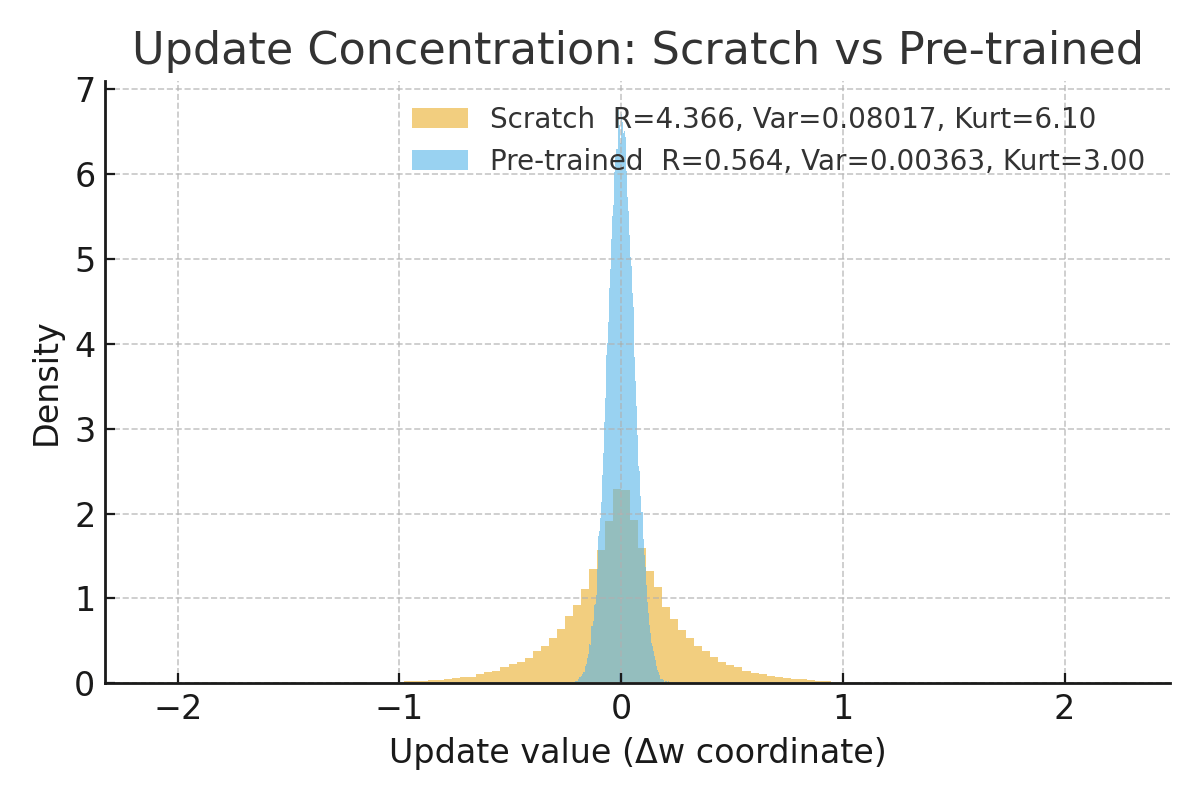
- Pre-training concentrates update statistics, letting simple scalar quantizers work without error-feedback memory overhead.
- On CIFAR-100 with ResNet-18, Bucket-Uniform hits 66.89% accuracy versus 47% for uncompressed FedAvg.
- Total communication drops about 40%, with uplink savings above 80% and roughly 6 bits per parameter.
- Bucket-Uniform stays robust under Dirichlet non-IID skew where QSGD and Bucket-Quantile collapse.
- Full paper on arXiv; no public code release accompanies the work.
Federated learning has a dirty secret: every training round, thousands of edge devices push large model updates over cellular or Wi-Fi links, and that uplink traffic is where most of the battery drain and carbon cost lives. A new paper called QuantFL argues that if you start from a pre-trained model instead of random weights, you can compress those updates with a simple scheme and still match the accuracy of full-precision training.
The trick is an observation, not a new optimizer. The authors show that pre-training pulls client updates into a narrow, low-variance distribution, so a cheap scalar quantizer can encode them with only a handful of bits per parameter and almost no distortion.
Where the energy actually goes
In cross-device federated learning, a server sends a global model to a subset of clients, each client trains locally on its private data, and then every selected client uploads its update to be averaged. FedAvg, the standard algorithm, transmits full 32-bit floats for every parameter each round. On battery-powered IoT nodes, uplink radio is the dominant energy sink.
Existing compressors like QSGD, TernGrad, or top-k sparsification cut bits but usually rely on error feedback, where each client stores the quantization residual and adds it back next round. That works, but it costs memory and compute that constrained devices do not have to spare. QuantFL sidesteps error feedback entirely by making the underlying signal easier to compress in the first place.