
Qualcomm Rewrites AI Reasoning Efficiency Using Lossy Compression Math
Qualcomm AI Research reframes Chain-of-Thought compression as an information theory problem, cutting reasoning tokens by up to 48% while improving accuracy
 Pro
Takeaways
- Core idea: Qualcomm AI Research reframes Chain-of-Thought compression as lossy information compression, not token minimization.
- Key finding: Standard length penalties treat all tokens equally -- a theoretical flaw the paper calls the "flat-tax" problem.
- New framework: The Conditional Information Bottleneck (CIB) penalizes tokens by their surprisal under a frozen base LM, not by count.
- Results: Up to 48% token reduction with under 1.5% accuracy drop; mild compression often improves accuracy by 1-2% simultaneously.
- Generalization: Trained only on math, CIB improves GPQA Diamond (+1.9%) and MMLU-Pro (+2.2%) with up to 38.6% fewer tokens.
- Overhead: The frozen prior model adds less than 6% training throughput cost and zero inference cost.
Every time a reasoning model thinks out loud, it burns tokens. Lots of them. A model solving a math problem might spend hundreds of tokens rechecking work it already did correctly, restating the question, or computing cube roots for numbers it will immediately discard. The field has known this for a while, and the standard fix has been blunt: penalize the model for being long. Researchers from Qualcomm AI Research now argue that this approach is fundamentally broken, and they have a principled replacement rooted in information theory.
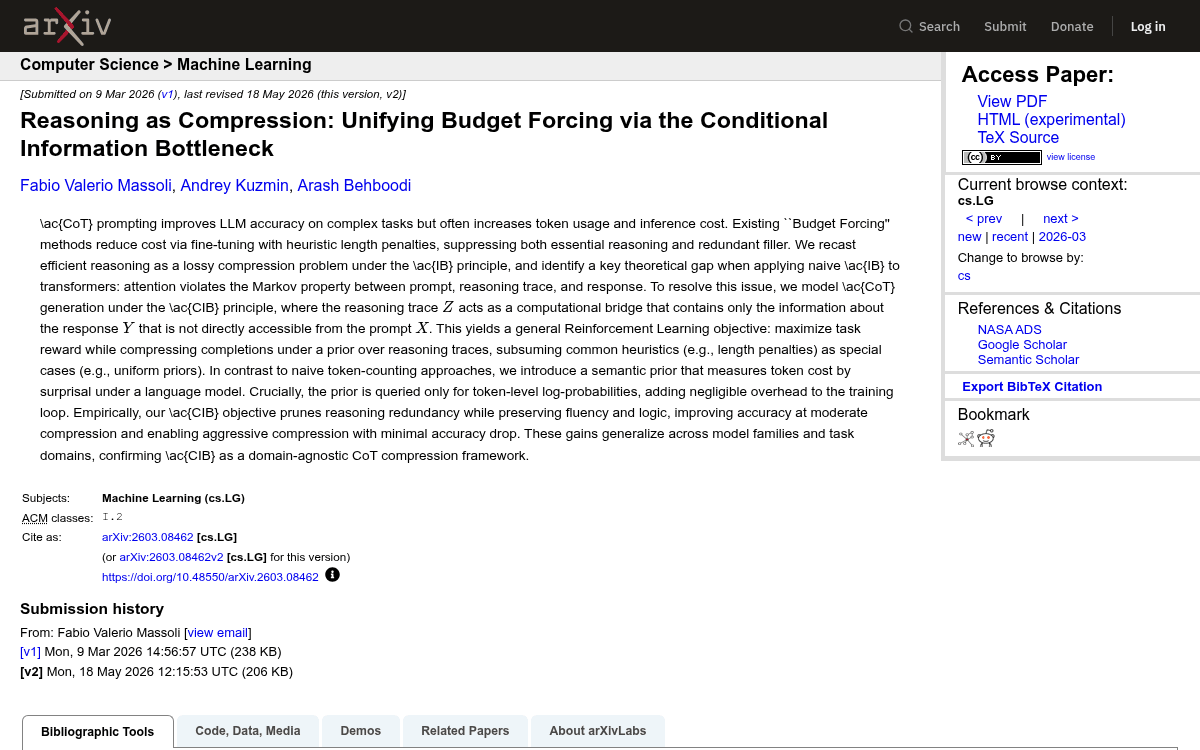
Their paper, "Reasoning as Compression," recasts the problem of efficient Chain-of-Thought (CoT) reasoning as lossy compression -- the same mathematical framework used in image and audio codecs. The goal is not to make reasoning shorter. It is to make reasoning denser, keeping only the tokens that carry real information toward the answer.
The flat-tax problem
Reasoning chains are often excessively verbose, increasing latency and compute usage. The field's response has been "Budget Forcing" -- constraining models to yield correct answers within a restricted token budget. The dominant technique is simple: add a length penalty to the training reward. The shorter the output, the better the score, all else equal.
The authors call this a "flat tax" on computation. Whether penalizing output length or enforcing a hard token limit, these methods impose a uniform cost on every token, implicitly assuming all tokens contribute equally to the solution. That assumption is obviously wrong. A token that introduces a novel algebraic substitution is not the same as a token that says "Let me double-check my answer." Treating them identically means the model is incentivized to delete tokens regardless of their semantic value, which can gut essential reasoning steps just as readily as it removes filler.
Why standard information theory breaks on transformers
The natural fix is to use the Information Bottleneck (IB) principle -- a framework from information theory that says a good compressed representation should keep only the information about the output that is not already in the input. Applied to reasoning, this would mean: keep only the parts of the chain-of-thought that tell you something about the answer that the prompt alone does not.
There is a catch. The standard IB assumes a Markov chain where the latent representation Z mediates all information flow from X to Y. This assumption is fundamentally violated in transformer-based LLMs. Due to the causal attention mechanism, the decoder predicting Y attends to both the prompt X and the generated chain Z. This forms what the authors call a "collider structure" -- the answer depends on both the prompt and the reasoning trace simultaneously, not just on the trace alone. They name this the Attention-Markov Incompatibility.
The consequence is that naively applying IB to a transformer would penalize the reasoning chain for containing information that is already in the prompt -- but the model can always see the prompt anyway, so that information is never truly redundant from the model's perspective. Standard IB gets the accounting wrong.
The fix: Conditional Information Bottleneck
The paper's core contribution is the Conditional Information Bottleneck (CIB). Under CIB, the reasoning trace Z acts as a computational bridge that contains only the information about the response Y that is not directly accessible from the prompt X. Formally, instead of minimizing mutual information between the prompt and the trace, CIB minimizes the mutual information between them while maximizing the conditional mutual information between the trace and the answer, given the prompt.
This yields a clean RL training objective with two terms:
- Sufficiency: reward the model for generating a trace that leads to the correct answer (a standard binary accuracy reward)
- Minimality: penalize the model for each token, but weight that penalty by how surprising that token is to a frozen base language model
The second term is the key innovation. Instead of a uniform length penalty, the authors assign a semantic cost to each token based on its information content relative to a frozen base model. This formulation aligns cost with information flow: the model is encouraged to "pay" for informative tokens that increase answer probability while suppressing redundancy.
In practice, the minimality reward for a full reasoning trace Z is:
# r_min: sum of log-probabilities under a frozen base model prior
# High log-prob = predictable = cheap = good (low penalty)
# Low log-prob = surprising = expensive = penalized unless it helps accuracy
r_min(X, Z) = sum(log Q_phi(z_t | z_<t) for t in range(len(Z)))
# Full reward:
R(X, Y, Z) = r_acc(X, Y, Z) + beta * r_min(X, Z)
# r_acc = 1 if answer is correct, 0 otherwise
# beta controls the accuracy-compression tradeoff
The frozen prior model Q_phi is a base (not instruction-tuned) language model. Tokens that are predictable filler -- "Let me verify," "Wait, let me reconsider" -- get high log-probability under the prior and thus low penalty. Tokens that introduce genuinely new reasoning steps get low log-probability and high penalty, but they survive if they contribute to a correct answer via the accuracy reward.
Length penalties are a special case
One of the paper's cleaner theoretical results is showing that existing methods are degenerate versions of CIB. A standard length-based penalty is equivalent to the CIB objective under the assumption of a maximum entropy (uniform) prior over the vocabulary. If every token is equally likely under the prior, surprisal is constant, and the minimality term collapses to a flat count of tokens -- exactly what length penalties do. Similarly, target-length penalties like LCPO-Exact correspond to CIB with a Laplace prior centered on a "golden" length. CIB subsumes both as special cases.
Training setup and benchmarks
The authors evaluate CIB on three small reasoning model families: DLER-{1.5B, 7B}, OpenReasoning-Nemotron-1.5B, and DeepScaleR-1.5B. Training uses GRPO with a group size of 16 and a Qwen2.5-Base-{1.5B, 7B} prior; the prior is used at training time only, adding no cost at inference. The main evaluation spans five mathematical reasoning benchmarks:
- MATH500
- AIME24 and AIME25 (competition-level math)
- Minerva Math
- OlympiadBench
They also test generalization on GPQA Diamond (graduate-level science), MMLU-Pro, and LiveCodeBench -- none of which were used in training.
The numbers
The headline result is that CIB can simultaneously improve accuracy and reduce token count. On DeepScaleR-1.5B, CIB at mild compression increases average accuracy by 1.5% while reducing average CoT length by ~24%. The competing length-penalty method L3L1-EXACT achieves stronger compression but at a steep cost: L3L1-EXACT drops AIME24 accuracy by 13.8% despite achieving strong compression.
The beta parameter gives practitioners a continuous dial between accuracy and compression:
- Low beta: mild compression, often with accuracy gains (the model is forced to be more precise)
- High beta: aggressive compression, up to ~48% token reduction with less than 1.5 accuracy points lost
- 7B prior vs. 1.5B prior: a larger prior model gives a sharper semantic signal, enabling deeper compression
On DLER-7B, CIB at mild compression matches the baseline's strong accuracy while reducing average CoT length by ~16%, and aggressive compression achieves roughly a one-third reduction with a 1.5-point accuracy trade-off.
The generalization results are notable. Although CIB is trained exclusively on math data, on DeepScaleR-1.5B it improves accuracy on GPQA Diamond (+1.9%) and MMLU-Pro (+2.2%) while matching LiveCodeBench, with token reductions of up to 38.6%. The compression learned is not math-specific; it is a general preference for dense reasoning over verbose exploration.
What actually gets cut
The qualitative analysis is where the paper gets interesting. CIB does not just shorten outputs -- it changes the structure of reasoning. The authors identify three recurring patterns in what gets eliminated:
- Algorithmic shortcuts: In geometry problems, the baseline defaults to brute-force coordinate calculations. CIB models converge on concise trigonometric identities instead. Minimizing surprisal under a language prior naturally selects for elegant, abstract proofs -- they are the most compressed path from prompt to answer.
- Stochastic exploration: Baseline models compute wrong candidates before finding the right one (e.g., calculating 98³ before trying 97³). CIB eliminates these dead-end branches.
- Verification bloat: Baseline models re-verify conclusions they already derived correctly, check tautologies like "positive lengths satisfy x > 0," and engage in self-doubt loops. CIB suppresses these entirely.
Training overhead is negligible
A practical concern with any approach that uses a second model is training cost. Because the prior model is frozen, it requires no gradient accumulation, backward passes, or optimizer states; it only adds a static VRAM footprint and a single forward pass over the generated trajectory, scoring all tokens in parallel. Scaling the prior up to 7B reduces rollout token throughput by less than 6% and the effective data collection rate by less than 6.2%, confirming that training is largely insensitive to prior size in wall-clock terms.
Where it falls short
The authors are candid about limitations. The quality of compression depends heavily on the prior model's capacity.
If the prior is too weak, its predictive distribution flattens toward uniform and the semantic cost degenerates into a naive length penalty, unable to distinguish redundant tokens from critical reasoning steps.
There is also a cross-family problem: using a Llama prior for a Qwen policy introduces tokenization mismatches that can penalize formatting rather than actual verbosity. The beta hyperparameter also needs tuning per prior size -- the authors used values optimized for the 1.5B prior without re-tuning for 7B, which may explain some accuracy gaps at aggressive compression.
The bigger picture
The real contribution here is not just better compression numbers. It is a principled framework that finally gives the field a theoretically grounded way to think about what a reasoning trace is for. By varying the implementations of the verifier and the prior, practitioners can explore a broad design space tailored to specific downstream tasks and deployment constraints. The verifier does not have to be a binary correct/incorrect check -- it could be a reward model for code quality, factual accuracy, or safety. The prior does not have to be a base LM -- it could be domain-specific.
No code or fine-tuned model checkpoints are publicly released with this paper. The work comes from Qualcomm AI Research, and the models used (DLER variants) are available under research-only licenses on HuggingFace. The training implementation uses the TRL library with GRPO, which is publicly available, making the approach reproducible for those with access to the base models.