
QSC Wants to Build Quantum-Proof Security Into Agentic AI From the Start
A new design paradigm bakes post-quantum cryptography, quantum entropy, and QKD directly into the architecture of distributed AI agents from day one.
 Pro
Takeaways
- New QSC paradigm embeds quantum-secure communication into agentic AI architecture from inception, not as a retrofit.
- Combines NIST PQC (Kyber, Dilithium), QRNG entropy, and QKD in a layered, pluggable stack.
- Runtime policy agent picks per-link cryptographic posture using security, latency, cost, and jurisdictional compliance.
- Unified HKDF session-key derivation composes QKD, PQC KEM, and QRNG entropy for graceful degradation.
- Azure benchmarks show ~297ms cloud baseline masks PQC overhead; linear scaling to 50 workers preserved.
- Monte Carlo test with 100,000 attack vectors achieved 100% detection of tampering and replay attempts.
Agentic AI systems are increasingly built to run for years across clouds, edges, and even satellites, exchanging state and coordinating actions continuously. That longevity is what makes them dangerous under quantum threats: encrypted traffic captured today can be decrypted later once cryptographically capable quantum computers arrive. A new paper on Quantum-Secure-By-Construction (QSC) argues that bolting on quantum-resistant crypto after deployment is not viable, and proposes treating quantum-secure communication as a first-class architectural property of agentic systems.
Why retrofitting quantum security breaks agentic AI
The core problem is that agentic systems are stateful and long-lived in ways stateless services are not. They often operate continuously over extended lifetimes, making post-deployment cryptographic migration far more complex and costly. Encrypted memory, signed task graphs, and long historical audit trails accumulate under classical cryptographic assumptions that may not hold for the operational lifetime of the deployment.
The threat model has two teeth. Foundational primitives including RSA, elliptic-curve cryptography, and Diffie-Hellman key exchange become vulnerable to quantum algorithms such as Shor's and Grover's. On top of that, encrypted communications transmitted today are susceptible to harvest-now-decrypt-later attacks, where adversaries archive data for future quantum decryption. For a fleet of coordinating agents whose messages, memory, and identities need to remain trustworthy for a decade or more, that risk is not hypothetical.
Three cryptographic layers, chosen at runtime
QSC composes three primitives instead of picking one:
- Post-quantum cryptography (PQC): Lattice- and hash-based algorithms standardized by NIST to replace classical public-key schemes vulnerable to quantum attacks.
- Quantum random number generation (QRNG): Physically sourced entropy to eliminate predictability in key material and strengthen authentication and session establishment.
- Quantum key distribution (QKD): Information-theoretically secure key exchange for high-assurance communication links where quantum infrastructure is available.
The interesting move is that the choice per link is dynamic. Each communication edge in the agent graph gets one of three postures: PQC alone, PQC plus QRNG entropy, or the full QKD plus PQC plus QRNG stack. A policy agent picks the posture per link by weighing security against latency, cost, and regional compliance rules, so agents in a jurisdiction with satellite QKD can escalate while agents on a plain cloud VPC fall back to PQC-only without any code change.

Session keys that survive missing infrastructure
To keep semantics consistent whether or not QKD is available, QSC derives every session key with an HKDF construction that concatenates three inputs: a QKD-derived key when a quantum channel exists (otherwise omitted via an indicator function), a post-quantum KEM shared secret from Kyber, and fresh QRNG entropy. The resulting key inherits information-theoretic security when the quantum channel is present and gracefully degrades to post-quantum security when it is not. The message layer wraps payloads in authenticated encryption bound to a QRNG-derived nonce and signs them with Dilithium, with receivers maintaining a nonce set to reject replays.
What the benchmarks actually show
The team ran a two-phase evaluation: a local testbed for isolated primitive timing, and an Azure deployment for realistic cloud latencies. On raw primitives, the PQC overhead looks alarming in percentage terms, with signing taking 0.34 ms versus 0.01 ms classically. In absolute terms, that is a fraction of a millisecond. The seven-channel latency chart makes the sticker shock clearer.

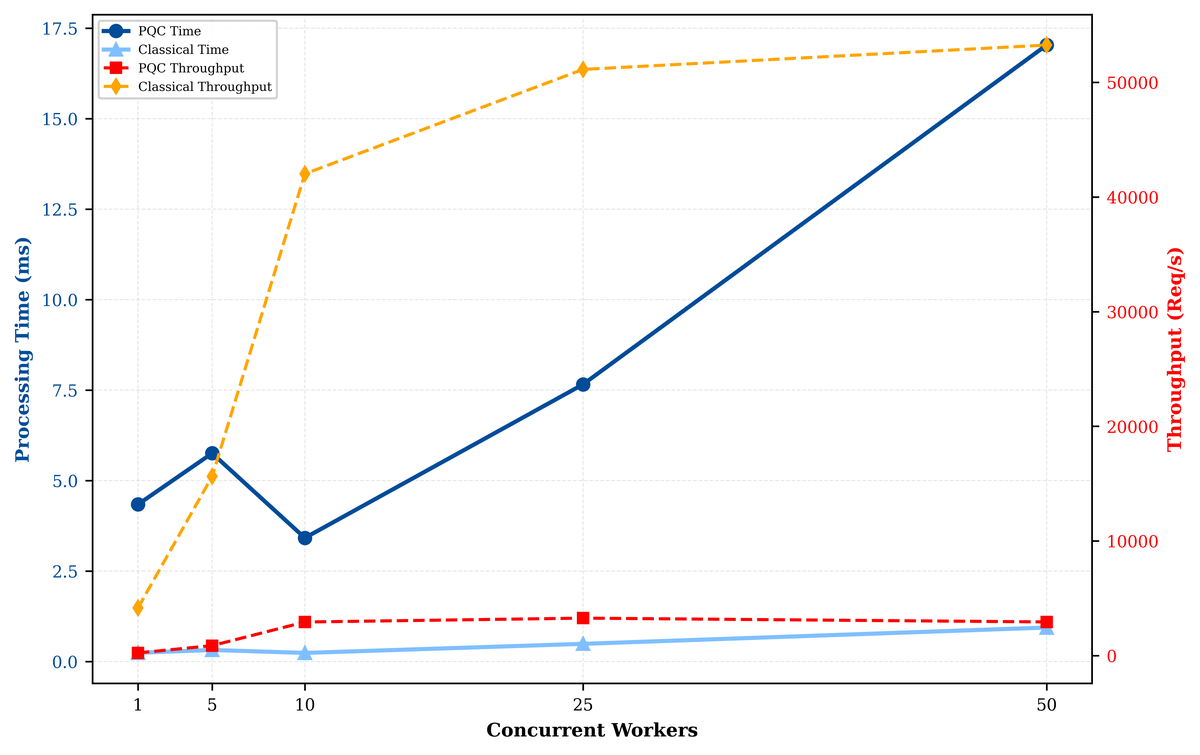
Once the framework runs in Azure, the story changes. Cloud results show a consistent internal latency baseline of roughly 297 ms, indicating that cloud networking dominates total transaction time and largely masks the cryptographic overhead. Scaling from 1 to 50 workers, the PQC-enabled system tracks the same linear profile as the classical baseline, so the sidecar-based security layer does not become a serialization bottleneck.
The one exception is Channel 7, orchestrator aggregation, where the paper explicitly notes the orchestrator verifies incoming agent signatures sequentially. That was left in place to isolate per-signature verification cost, and can be parallelized or batched in production. On resilience, a Monte Carlo adversarial simulation with 100,000 injected malicious vectors (tampering and replay) reported a 100% detection and blocking rate via PQC signature verification and QRNG nonce-enforced freshness.
Where it fits and where it does not
The framework is deliberately domain-agnostic, with the paper mapping it to decentralized finance, global healthcare, critical infrastructure, and space-based autonomy. The strongest fit is any deployment where you cannot easily re-key or re-sign years of accumulated state, particularly geo-distributed systems that cross regulatory boundaries.
The honest limitations sit mostly on the QKD side. Existing deployments are largely point-to-point optical links, and scaling requires quantum repeaters, entanglement swapping, and key relay protocols that do not yet exist at internet scale. QKD hardware also carries much higher setup latency and lower throughput than PQC, so it only pays off on truly high-assurance channels. PQC artifacts are also chunky: signature public keys are roughly 60x larger than classical equivalents and signatures themselves are around 50x larger, which matters for bandwidth-constrained edge or satellite links.
Cryptography as a runtime knob
The headline is quantum security, but the deeper contribution is treating cryptographic posture as a runtime, policy-driven property of the agent graph rather than a static transport choice. Every edge in the DAG can have a different cryptographic profile chosen by the same optimizer that handles task placement, and session keys are composed from whatever entropy sources happen to be available in that jurisdiction. That framing, more than any single primitive, is what lets a globally distributed agentic system stay coherent as quantum infrastructure rolls out unevenly across regions and vendors. Related work from the same authors on quantum-resistant roadmaps and post-quantum AES frameworks suggests this is part of a broader push to make cryptographic agility a systems-level primitive.