
QPINN Hits 99.46% Accuracy Predicting Battery Life Across Four Chemistries
A hybrid model blends quantum-inspired kernel features with physics constraints to estimate lithium-ion battery health at 99.46% accuracy across four chemistries.
 Pro
Takeaways
- QPINN combines quantum-inspired kernel features with a physics-informed neural network for battery SOH estimation.
- Achieves 99.46% average accuracy across 387 cells and four lithium-ion chemistries.
- MAPE drops up to 65% and RMSE up to 62% versus PINN, MLP, CNN, and SPIKAN baselines.
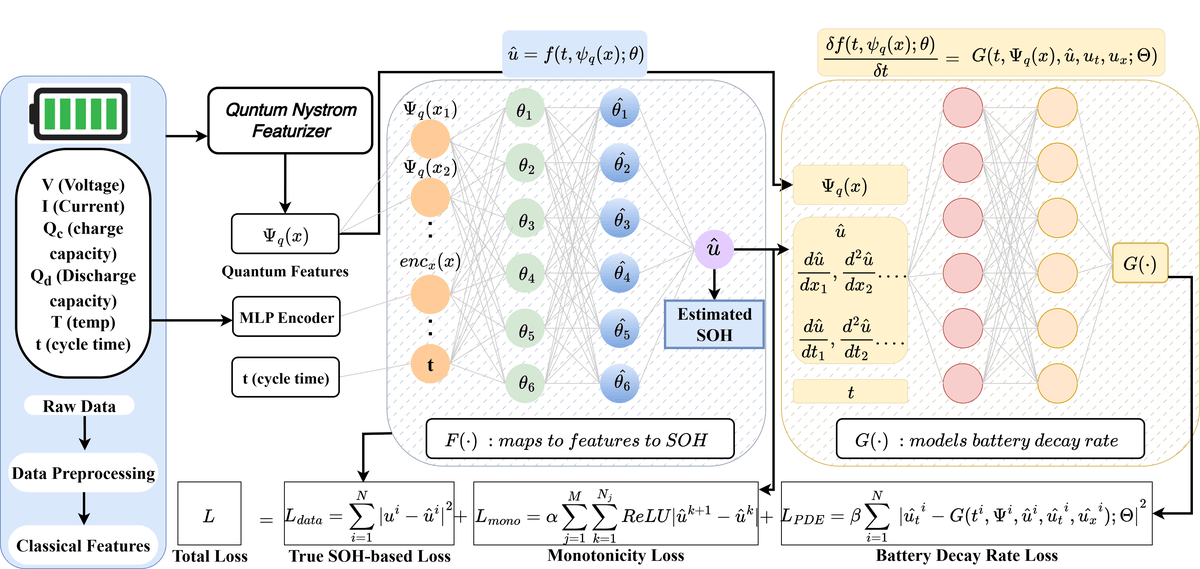
- Uses an 8-qubit simulated feature map compressed by the Nystrom method into 256 dimensions.
- Cross-chemistry transfer works after fine-tuning encoder and solution network with dynamics frozen.
- Zero-shot transfer, edge deployment, and unlabeled domain adaptation remain open problems.
Predicting how much life is left in a lithium-ion battery sounds like a solved problem until you try to move a model from one chemistry to another. A new architecture called QPINN borrows a trick from quantum machine learning to reshape the input features, then hands those richer features to a physics-informed neural network that enforces the rules of battery degradation.
The result is a state-of-health (SOH) estimator that reports an average accuracy of 99.46% across four public datasets and four cell chemistries, with error metric reductions of up to 65% versus recent baselines.
Why battery SOH is stubbornly hard
SOH is the ratio of a cell's current usable capacity to its nominal capacity, and it drives everything from EV range warranties to grid-scale storage economics. Physics-based models are stable and accurate, but cells with different chemistries need different parameters and heavy compute. Data-driven models are accurate too, yet they depend on hand-crafted features and often become dataset-specific.
Physics-informed neural networks (PINNs) were supposed to bridge that gap by baking degradation equations into the loss function. Current SOH implementations still lean on hand-crafted statistics like means, slopes, and incremental capacities that miss high-order correlations in voltage and temperature traces. Train one on NCA cells and it tends to stumble on LFP.

Borrowing a page from quantum kernels
Quantum feature mapping (QFM) is a technique from quantum machine learning where classical inputs are encoded as quantum states, so distances between them are measured by the overlap of those states rather than by ordinary vector similarity. That overlap acts as a kernel, and kernels can compactly represent very high-order interactions between input variables.